

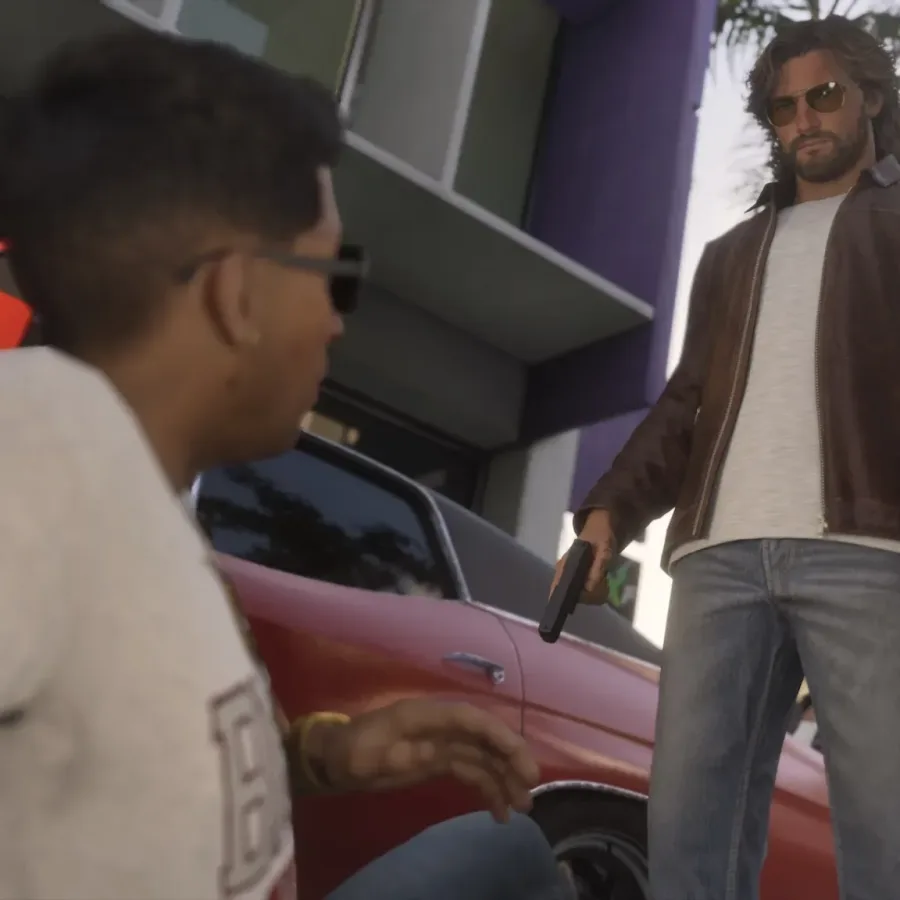
Grand Theft Auto 6 has always been expected to let players cause chaos, steal vehicles, commit crimes, and push an open world to its limits. Rockstar Games has not abandoned that foundation. Instead, it has added more friction, context, and consequences around how players choose to act. A central part of that change is the game's divisive criminal profile system, which evaluates the severity of a player's actions rather than simply treating every crime as equal.
Rockstar Games boss Rob Nelson discussed the thinking behind the system in an interview, tying it to lessons learned during the development of Red Dead Redemption 2. The studio wanted to build upon that game's reactive world and offer more ways to engage with people outside of immediate, lethal force. In practical terms, GTA 6 gives players options to intimidate, threaten, rob, or de-escalate situations that earlier games often reduced to shooting, punching, or fleeing.
The result is not a morality system that forbids criminal behavior. This is still Grand Theft Auto, and Rockstar plainly expects players to break the law. The distinction is in the level of force used. A robbery handled with threats and minimal harm may leave a player's criminal profile unchanged. Walking into the same location and killing everyone inside, however, can lower that profile. GTA 6 is interested in whether a player is merely a criminal within its world or someone who leaves excessive devastation behind them.
A reactive world built from Red Dead Redemption 2's foundations
Nelson framed GTA 6's approach as an evolution of the work Rockstar had already done with Red Dead Redemption 2. That earlier game placed considerable emphasis on the way townspeople, law enforcement, companions, and the wider world responded to Arthur Morgan's decisions. GTA 6 applies a related philosophy to a modern setting where weapons, vehicles, crowds, and fast-moving crimes can turn a minor encounter into a major catastrophe in seconds.
For useful background on this topic, read BioWare Reportedly Passed on KOTOR 2 After LucasArts Set an 18-Month Deadline.
Rather than limiting player agency, Rockstar's goal appears to be expanding it. Violence remains available, but it is no longer the only meaningful input. Pointing a gun at somebody can be a threat with its own outcome. A person may surrender valuables without being physically attacked. They might run. They could resist. They may have a gun of their own. Each possibility introduces tension that does not exist when every confrontation begins and ends with a trigger pull.
That emphasis matters because it changes the emotional rhythm of criminal activity. In many past open-world games, drawing a firearm was an immediate gateway to action with few intermediate steps. GTA 6 aims to make the threat of violence as important as violence itself. The player can create fear, read a response, and then decide how far to take an encounter.
It also means the world can acknowledge behavior before an actual crime is completed. Nelson described a more alert civilian population than players may be used to. In GTA 5, carrying a weapon did not necessarily attract attention unless it was directly aimed at someone. GTA 6's NPCs are more likely to react when they see a player retrieving a rifle from a car trunk. People may quietly move away, creating a sense that the situation is becoming dangerous before the first shot is fired.
Weapons are meant to feel visible and consequential
One of the biggest changes supporting this system is the apparent move away from the familiar idea of an endless, invisible arsenal carried by the player at all times. Nelson explained that starting a full-scale rampage now requires more consideration. A player may need to call for their car, access its trunk, take out a weapon, and then move through the world while nearby people take notice.
That sequence has gameplay implications beyond realism. It gives NPCs time to react and gives the player a moment to reconsider. Pulling out a long gun becomes a public escalation rather than a near-instant switch from casual exploration to mass destruction. Civilians can flee, armed individuals can prepare to fight back, and the player's intended crime may spin off in an unexpected direction.
Rockstar is not presenting this as an attempt to remove explosive action from Grand Theft Auto. The series' spectacular mayhem remains part of its identity. But the studio wants those moments to have more build-up and more texture. A chaotic firefight can be more memorable when it emerges from a robbery gone wrong, a civilian refusing to cooperate, or an attempted vehicle theft that turns into an armed confrontation.
Nelson's example of trying to force someone off a motorcycle captures that design goal. The target may draw a gun, requiring the player to react. If the encounter turns deadly, it feels less like a random animation and more like a chain of decisions and consequences. Rockstar's view is that such scenarios can be funnier, sharper, and more meaningful precisely because the violence is specific to what happened, rather than being a default solution applied to every problem.
What the criminal profile actually judges
The criminal profile is not positioned as an explicit punishment for being bad. Rockstar is not asking players to role-play as saints in a game built around crime. Instead, it appears to monitor harshness and excess. A player who robs a store, threatens the clerk, and avoids unnecessary casualties can remain in a relatively stable position. A player who executes everyone present during the same robbery is making a different statement to the game's systems.
This creates a morality-adjacent structure without turning GTA 6 into a traditional good-versus-evil role-playing game. The question is not whether the player committed a crime. They did. The question is whether they showed restraint once the crime was underway. That distinction could make repeated activities feel less routine, as the player has a reason to think about the tools they bring and the methods they use.
There is also an option for players who reject the premise entirely. Nelson said that players can still unleash the kind of destructive rampages associated with the series and effectively destroy their criminal profile. At that point, they can enter what he called an irredeemable state: an open declaration that they do not want to participate in the system's expectations.
That is an important detail for longtime fans concerned that Rockstar is imposing a single preferred style of play. GTA 6 may encourage deliberation and restraint, but it does not eliminate the freedom to be catastrophically reckless. The difference is that the game now recognizes and records that choice. Chaos remains possible; it simply has a defined place in the world's broader simulation.
A controversial shift for the power fantasy
Not every player is convinced that added consequence is an improvement. For some fans, Grand Theft Auto is at its best when it is immediate, empowering, and unrestricted. They want to steal an exotic vehicle, equip powerful weapons, and cause enormous damage without waiting for systems to catch up or asking whether an NPC will react realistically. From that perspective, more deliberate weapon handling and a criminal profile can feel cumbersome.
Nelson acknowledged the underlying tension. Previous games could offer entertaining rampages, but Rockstar felt that the appeal could fade quickly without additional substance. GTA 6's new design intends to give violence more weight, making it part of a scenario instead of an activity detached from the rest Of the World.
The same divide extends to progression. The game's approach means a player may not be able to immediately grab a supercar and race through the city at the very beginning. Acquiring that kind of vehicle can take dozens of hours. For players who enjoy a gradual climb from smaller crimes to greater wealth and influence, that structure can make major rewards feel earned. For players looking for instant fantasy fulfillment, it may feel like an unnecessary barrier.
- Players seeking immersion may welcome NPCs that notice weapons, respond to threats, and fight back in unpredictable ways.
- Players seeking freedom may appreciate that rampages are still possible, even if they carry a lasting profile consequence.
- Players seeking progression may find more value in earning high-end cars and access to powerful tools over time.
- Players seeking instant chaos may find the extra steps around weapons and rewards less appealing.
Early success does not end the debate
Whatever the disagreement surrounding its systems, GTA 6 has achieved extraordinary commercial and critical results. It became the highest-rated game in Metacritic history and generated nearly $4 billion in revenue during its first 24 hours, making it the biggest entertainment launch in history. Those figures indicate immense enthusiasm, though they do not mean every design decision will be embraced by every corner of the series' audience.
The more interesting question is what Rockstar learns from the response over time. GTA 6 represents a notable move toward a world that observes player behavior more closely, places more emphasis on escalation, and gives non-lethal actions a greater role in crime. Future games could push even further in that direction, or Rockstar could seek a broader compromise between simulation, progression, and immediate sandbox freedom.
For now, the criminal profile system defines GTA 6's ambition. Rockstar is not trying to make players stop being criminals. It is trying to make criminality feel more reactive, more personal, and more connected to the world around it. Players can intimidate rather than kill, walk away rather than escalate, or choose total destruction and accept the consequences. The freedom remains, but GTA 6 wants every path to say something about the player who chose it.
Community
Discussion
Start the conversation.
No comments have been posted yet.