

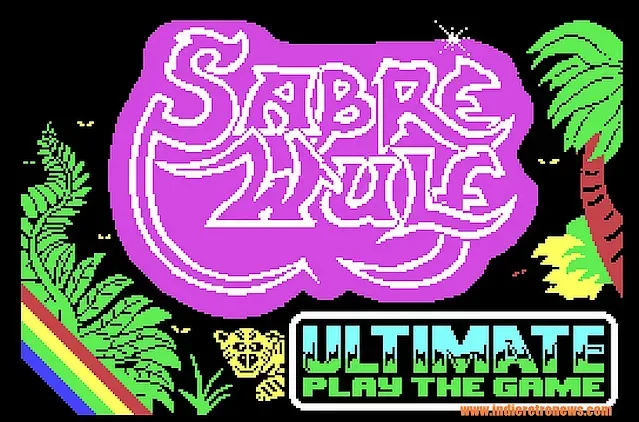
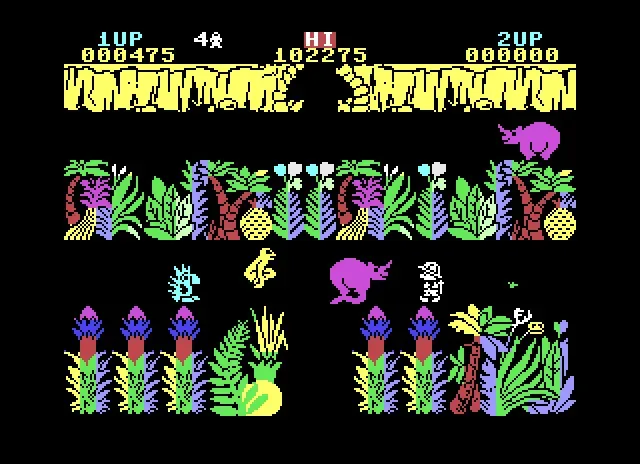
Sabre Wulf Remastered, a new Commodore 64 adaptation of Ultimate Play the Game's influential 1984 adventure, has been released by developer Sveinacious-G. The project approaches the classic with a clear goal: retain the design and behavior players remember from the ZX Spectrum original while replacing the technical foundation beneath it with a modernized C64 engine.
The result is positioned as a faithful but enhanced version of Sabre Wulf, rather than a redesign that merely borrows its name or setting. Its interconnected jungle, hostile creatures, collectible items and game rules have all been retained, including the original item spawn rates. At the same time, the release is built to use the Commodore 64's sprite hardware and sound capabilities more extensively than earlier interpretations.
It is also important to distinguish this version from another Sabre Wulf remaster in development by Genesis Project. Sveinacious-G's release is a separate, standalone fan-made production, with no connection to that upcoming project. For C64 players, it offers a newly rebuilt route into one of the formative games from Ultimate's early catalogue.
A classic jungle rebuilt rather than reinvented
Before Ultimate Play the Game became synonymous with later landmark series and the work of Tim and Chris Stamper, Sabre Wulf established a striking template for an action-adventure on home computers. Players are dropped into a dangerous jungle maze and must gather four pieces of an amulet, all while surviving a huge range of creatures roaming from screen to screen. The simplicity of that objective concealed a game that felt much larger and less predictable than many of its contemporaries.
For useful background on this topic, read Battle Squadron CD32 Remix Revives a 1989 Amiga Shooter for CD32 Hardware.
Part of that reputation comes from the way the world behaves. The jungle is an interconnected map rather than a disconnected sequence of arcade stages, giving exploration real importance. Enemies are not simply reset into place every time the player enters a screen, either. Their movement and location beyond the current view contribute to the impression that the jungle is a continuous place, not a collection of isolated rooms.
That foundational structure remains central in Sabre Wulf Remastered. Sveinacious-G has preserved every creature and gameplay mechanic from the Spectrum game, alongside the exact rate at which items appear. That level of preservation matters because the original's tension was shaped as much by timing and chance as it was by map knowledge. A slightly more generous item system, altered enemy population, or substantially different movement rules could quickly change how players approach the jungle.
Instead, this remaster is designed for those who want the same broad challenge and route-finding demands, with presentation and responsiveness tailored to Commodore 64 hardware. It is a philosophy that suits the game particularly well. Sabre Wulf has long been remembered not only for its visual identity, but for the dense, almost overwhelming feeling created when the player is suddenly surrounded by unpredictable wildlife.
New engine, smoother jungle
Although the game's design is deliberately intact, its underlying code has been completely modernized. The new engine takes advantage of custom sprites on the Commodore 64, allowing the remake to pursue a notably fluid presentation. It targets stable performance at 50 frames per second on PAL machines and 60 frames per second on NTSC systems.
For a fast-moving maze game, that performance target is more than a technical footnote. Encounters in Sabre Wulf can become chaotic in moments, with animals entering from multiple directions while the player tries to locate an exit, recover a dropped objective, or use an item at the right time. Smooth animation and steady response can make those split-second decisions more legible without making the original challenge any less demanding.
The C64's visual hardware also gives the remaster a different set of strengths than the ZX Spectrum version it follows. Rather than attempting to force Spectrum art unchanged onto a machine with a very different palette and display character, the graphics have been adapted thoughtfully for the Commodore 64. The standard appearance emphasizes rich, saturated colors intended to make the jungle feel vivid and dense.
Players who prefer a less intense presentation have an alternative dusky visual setting. This option provides a more subdued atmosphere, offering a meaningful choice without requiring the game to compromise on its primary C64-focused look. The inclusion acknowledges that retro game presentation is rarely just about technical accuracy; personal memory, display hardware and individual taste all influence how a classic feels when revisited.
A Spectrum color mode for purists
Perhaps the most intriguing visual option is a dedicated ZX Spectrum color setting. It is intended for players who want to recreate the look and mood of the 1984 game as closely as possible, even while playing an adaptation built for the Commodore 64.
On ordinary hardware, that Spectrum-oriented mode may appear somewhat muted. That is an understandable consequence of translating an aesthetic associated with one machine onto another with different color behavior. However, the option has particular appeal for users of advanced hardware such as the Commodore 64 Ultimate, where it can more accurately reproduce the visual character associated with the original release.
Its presence says a great deal about the project's priorities. Sabre Wulf Remastered does not present a single idea of what a remaster should be. The default setting leans into the strengths of the C64, the dusky option offers a different mood, and the Spectrum palette caters to preservation-minded players. All three choices are built around the same unchanged game design.
That balance is especially appropriate for a title with such a strong history across British home computers. A conversion does not need to erase its own platform's identity to respect the original. Here, the game can look like a colorful Commodore 64 production while still giving dedicated fans a route toward the familiar Spectrum appearance.
Music with a connection to the C64's past
Music for the remaster has been created by Greg Duddle. The audio pays respect to the Commodore 64's own history with Sabre Wulf, drawing on music and character optimizations associated with Firebird's official 1985 C64 port. That connection gives the project a place between two versions of the same classic: it protects the design blueprint of Ultimate's Spectrum release while recognizing that the Commodore 64 already has its own longstanding relationship with the game.
This is not simply a matter of adding a new soundtrack to an old program. The C64's sound chip is a defining part of the platform's identity, and an adaptation of a famous Spectrum title has an opportunity to make use of that legacy. By pairing newly implemented technology with nods to the 1985 conversion, the remaster aims to feel grounded in Commodore history rather than detached from it.
The production credits underline that blend of old and new. Sveinacious-G handled code, while Greg Duddle provided the music. The original game design remains credited to Tim and Chris Stamper. Development used TRSE, short for Turbo Rascal Syntax Error, a toolset associated with modern creation for classic Commodore machines. The release also acknowledges the 1984 copyright of A. C. G / Ultimate Play The Game.
Why Sabre Wulf still matters
Nearly every element described around this remaster points back to why Sabre Wulf continues to attract attention decades after its debut. It is not merely a recognizable name from the 8-bit era. Its open-feeling structure, persistent enemy behavior and compact but complex jungle anticipated ideas that would become increasingly important in later action-adventure games.
The game's appeal also lies in its immediacy. There is no lengthy setup before the jungle starts pressing in. Players learn its rules by moving, escaping, experimenting with objects and gradually creating a mental map. The four amulet pieces provide a direct objective, but reaching them is never just a matter of marching toward a marker. Dangerous animals, uncertain item appearances and the maze itself keep the player alert.
Modern recreations can sometimes smooth away the rough edges that made early games memorable. Sabre Wulf Remastered instead appears built around the conviction that those systems are worth retaining. Its enhancements are focused on performance, machine-specific audiovisual presentation and player choice over display style, while the game's essential balance is left in place.
For longtime Commodore 64 owners, that approach offers a chance to experience a cornerstone of Ultimate's early work through a freshly engineered version designed around the platform's capabilities. For retro players discovering the game for the first time, it provides a useful reminder that ambitious world design did not begin with modern hardware. Sometimes it was already present in a jungle maze, a handful of amulet fragments and the uneasy knowledge that the creatures just off-screen were still moving.
Community
Discussion
Start the conversation.
No comments have been posted yet.