

ScopeCreep, a dark active incremental game from solo developer Foolbox Studio and publisher Pretty Soon, has launched on Steam. Built around a grim world of wandering spirits, an insatiable fire, and steadily expanding player power, the game distinguishes itself with combat tied directly to music: every beat in its original soundtrack triggers an attack.
That rhythm-focused foundation gives ScopeCreep a different identity from a more traditional idle or incremental game. Rather than simply watching numbers rise or periodically choosing an upgrade, players are asked to remain engaged with the flow of battles. The soundtrack is not merely mood-setting background music; it is part of the mechanical structure. As its beat continues, attacks continue, linking the sensation of progression to the game's audio-driven pace.
ScopeCreep is available now on Steam for $5.99 USD. A 20% launch discount is planned for the first two weeks following release. Before launch, the game's Steam demo received 100% positive user reviews, offering an encouraging early response to the project's blend of haunting presentation and active incremental systems.
A flame with an appetite for souls
ScopeCreep begins in an unknown place shrouded in darkness. The player is positioned beside a whispering flame with a clear demand: it wants souls. That simple premise drives the central gameplay loop. Players seek out wandering spirits, defeat or harvest them for essence, then return that essence to the ever-hungry fire.
For useful background on this topic, read Dave the Diver and Core Keeper Set Permanent Free Crossover for November 30.
Each offering helps the player grow stronger. That growth is not only about increasing damage or speeding up a familiar resource loop. Feeding the flame opens the path to new abilities and allows the player to push deeper into the void. The game frames its advancement around an uneasy relationship with the entity at the center of the experience: the fire provides power, but its need is never truly satisfied.
It is an effective setup for an incremental game because it gives constant collection a thematic purpose. In many games in the genre, resources are abstract currencies accumulated for their own sake. Here, the resource is spiritual essence, and the destination is a creature-like flame that communicates in whispers. The result is a progression structure that leans into mystery rather than pure efficiency.
Combat timed to the soundtrack
The most notable mechanical element in ScopeCreep is its rhythm-driven combat. Every beat of the game's original music corresponds to an attack, making the soundtrack a direct part of the action rather than a separate layer. Foolbox Studio composed the music specifically for ScopeCreep so the audio and gameplay could be closely interwoven.
For another perspective on this story, read ScopeCreep Launches on Steam With Rhythm-Driven Soul Hunting.
This design means players are not simply fighting alongside a musical score. They are playing within its pulse. The cadence of a track becomes the cadence of combat, while the atmosphere of the music helps define how exploration and harvesting feel. In a setting built around darkness and uncertainty, that approach can make even routine encounters feel more deliberate, as attacks arrive with the recurring certainty of the beat.
Rhythm mechanics have appeared in many forms across games, from strict button-timing challenges to action games that reward players for moving in time with music. ScopeCreep applies the concept to an active incremental format. The emphasis is on creating a continuous connection between fighting, gathering souls, and expanding the player's capabilities instead of presenting music as a detached minigame.
That distinction matters for players who enjoy the persistent growth of incremental games but want more involvement than a passive loop usually provides. ScopeCreep's systems are designed around ongoing action, with the beat acting as a constant framework for attacks as players work through its shadowy spaces.
An upgrade web rather than a straight path
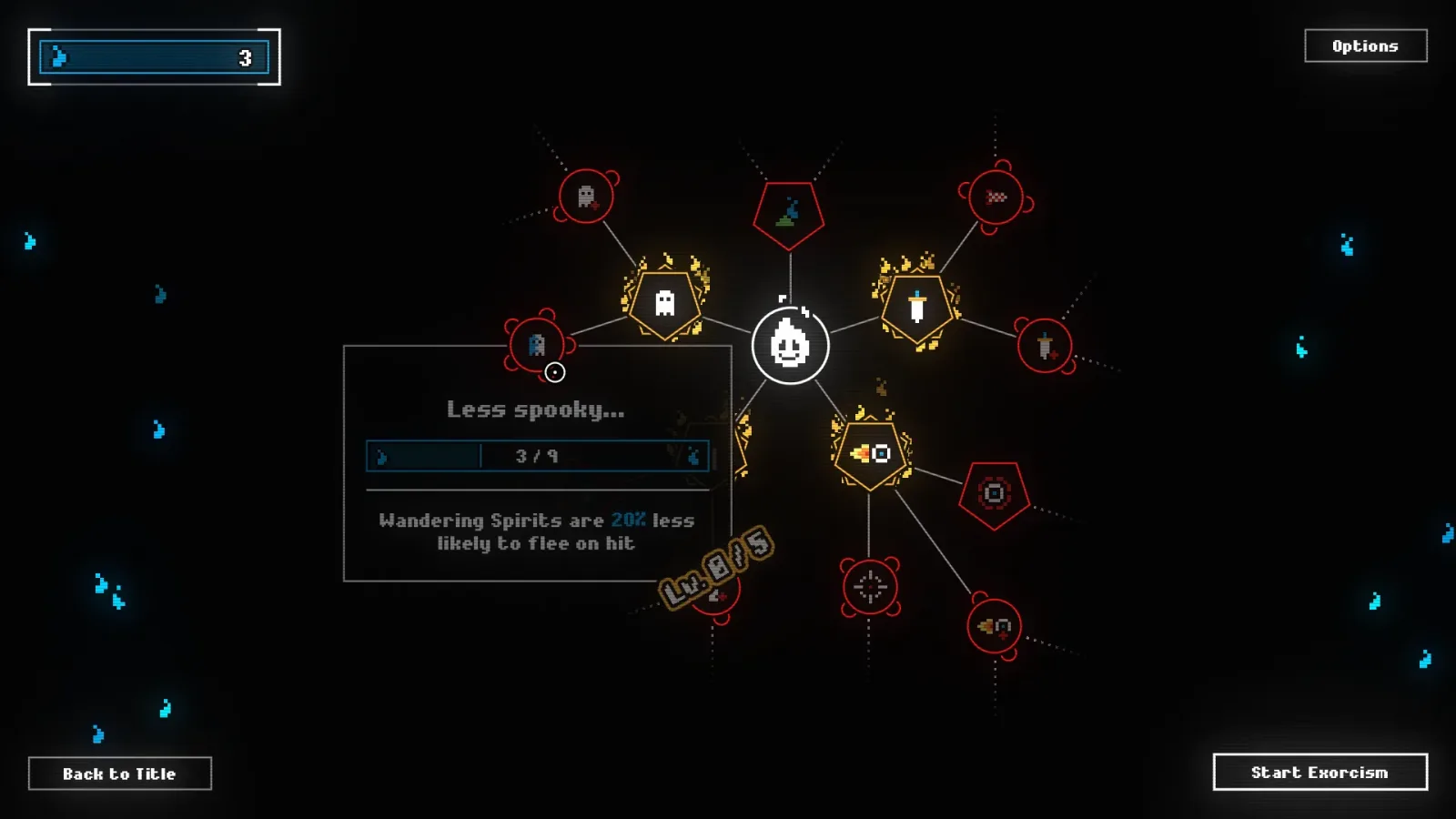
Progression in ScopeCreep is built around an interconnected upgrade web. As souls are harvested and offered to the flame, players gain access to new abilities and improvements that can alter their route through the game's systems. The web structure suggests a broader set of choices than a single linear upgrade chain, encouraging players to consider which benefits best support their current approach.
For an incremental game, the shape of an upgrade system can have a major impact on long-term appeal. A straight list of increasingly expensive boosts can make growth clear, but it may offer limited room for experimentation. An interconnected web can instead turn progression into a process of discovery, where reaching one node may open access to another ability or a previously unavailable direction.
ScopeCreep combines that structure with its soul-harvesting premise. The player's advances are tied to the repeated act of feeding the flame, so the cycle of combat, collection, offering, and upgrading remains at the center. New power is not presented as a separate menu-driven activity; it is part of the ongoing descent into the unknown.
The game also promises hidden story elements throughout its world. Details about the flame, the darkness surrounding it, and the deeper purpose behind the player's actions are intended to be uncovered gradually. That narrative layer gives the upgrade chase an additional hook, especially for players who enjoy piecing together lore through continued exploration rather than receiving every answer at the outset.
From game jam concept to full Steam release
ScopeCreep started as a small game jam project before expanding into a complete release. That origin is visible in the clarity of its core idea: hunt spirits, collect essence, feed the flame, get stronger, and move farther into the void. The finished game develops that compact concept through music-driven attacks, a larger progression system, and a mysterious setting intended to reveal more over time.
Game jam projects often begin with a single focused mechanic or theme, and the transition to a full game can be most successful when that original spark remains recognizable. ScopeCreep's defining spark is the relationship between rhythm and incremental growth. Its combat is built around the soundtrack, while its progression uses the familiar appeal of accumulating resources and unlocking new possibilities.
Foolbox Studio is developing the game as a solo project, an approach that can lend a particularly cohesive tone to a title with such a concentrated premise. ScopeCreep's imagery and systems are all directed toward the same mood: a lonely location, a whispering fire, spirits moving through the dark, and a player gradually becoming capable of venturing beyond the safety of the starting flame.
What players can expect from ScopeCreep
At its core, ScopeCreep is aimed at players looking for a compact progression game with a more active, atmospheric spin. Its key elements include:
- Rhythm-driven attacks: Combat is synchronized with the beats of the original soundtrack.
- Soul harvesting: Wandering spirits provide the essence needed to satisfy the mysterious flame.
- Active incremental progression: Players repeatedly gather resources, grow stronger, and expand their reach through the void.
- An interconnected upgrade web: New abilities and improvements are unlocked through a networked progression system.
- Hidden narrative details: The world contains story elements for players to uncover as they press deeper into its darkness.
The game's Steam launch arrives with a low entry price and an introductory discount, making it an accessible option for those curious about its particular mix of genres. Its demo's perfect positive-review percentage before release is also a promising sign, though players will ultimately decide how the full version's rhythm, upgrades, and mysteries hold together across a longer progression arc.
For now, ScopeCreep offers a stark proposition: enter the darkness, listen to the beat, hunt what moves in the void, and give the flame what it asks for. Every soul fed into that fire is another step toward greater power--and potentially toward answers the player may or may not be ready to find.
Community
Discussion
Start the conversation.
No comments have been posted yet.