

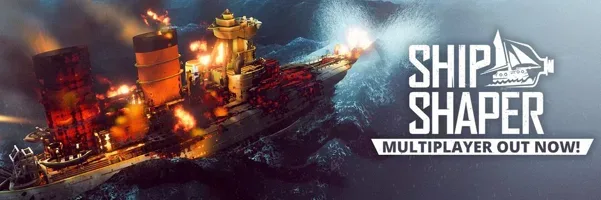
ShipShaper has received a major free multiplayer update on Steam Early Access, opening the shipbuilding sandbox's detailed creations up to online combat, racing and the unpredictable consequences of putting handcrafted vessels under pressure. The update arrived on November 19, 2026, and represents the third major stage of the game's Early Access development.
Developed by Tomas Sala and published by Wired Productions, ShipShaper is a standalone creative sandbox centred on designing ships one component at a time. Its new online features are intended to turn that construction process into more than a solitary engineering project: players can now test their designs against friends and other players in naval warfare and racing arenas, where an ambitious build may either prove seaworthy or come apart in dramatic fashion.
The key idea remains simple, even if the execution is likely to be anything but. Players build a ship, account for its physical properties, and then discover whether it can actually do what it was designed to do. Multiplayer raises the stakes because vessels are no longer being judged only by a builder's own experiments. They can be challenged by rival ships, pushed through race routes, and subjected to the chaos that occurs when real physics meets player ingenuity.
Creativity, physics and multiplayer come together
ShipShaper's Early Access journey has been built around three core pillars: creativity, physics and multiplayer. With the latest update, those elements are now intended to operate as one complete loop. The design tools allow players to make ships piece by piece, while the simulation asks them to consider practical concerns such as weight distribution, sails and engineering. Online modes then provide a public proving ground for the results.
For useful background on this topic, read Bushcraft Survival Plans Steam Early Access Launch in 2027.
That structure differentiates the game from a conventional naval combat title. Success is not simply a question of selecting a preferred vehicle from a predetermined roster and learning its weapons or handling. In ShipShaper, the vehicle itself is part of the challenge. A ship's silhouette, balance and construction choices can all become factors once it enters a race or battle.
It also means that failure is likely to be one of the multiplayer update's most entertaining outcomes. A ship can look impressive while sitting still in a workshop, yet reveal serious problems once it begins moving, turns sharply, encounters opposing fire or carries too much weight in the wrong place. The game explicitly embraces those engineering disasters, making the possibility of a spectacular sinking part of the experience rather than merely a punishment for a flawed design.
For players who enjoy experimentation, that can create a useful cycle. An online match may expose a weakness that was not obvious during construction. The builder can then return to the tools, revise the layout, rebalance the vessel or rethink its sails, and bring an improved version back into the arena. A disastrous first outing may therefore become the starting point for the next, more successful prototype.
For another perspective on this story, read ShipShaper's Free Multiplayer Update Brings Custom Ships Into Online Battles and Races.
Online battles put player designs to the test
The multiplayer update introduces naval warfare as one of ShipShaper's central online activities. Combat offers an immediate test of whether a custom vessel can remain functional when confronted by hostile designs. A ship built for speed may have a very different set of strengths and liabilities from one made to withstand punishment, while a complicated engineering concept may be impressive only as long as it stays intact.
The announcement does not detail every rule set, weapon option or match format included in the update. What it does establish is that players can take their own handcrafted ships into online combat arenas. That makes the battles an extension of the creation system rather than a separate mode detached from it. The same construction choices made in the sandbox carry into the conflict.
There is a compelling social element to that premise as well. Building games often encourage players to show off their most elaborate or unusual creations, but multiplayer provides a stronger answer to the question of whether those creations work. A vessel can be admired for its design and then immediately asked to survive a confrontation. Rival players are not only opponents; they are also an audience for every triumph, collision and catastrophic miscalculation.
Because ShipShaper uses a physics-driven simulation, the appeal of combat is not limited to a clean win-loss result. The route to that result can matter just as much. A confrontation between two custom vessels can produce situations that no prebuilt ship roster would easily replicate, particularly when builders have approached weight, sails and overall engineering from different directions.
Races create a different kind of shipbuilding challenge
Racing is the other major pillar of the new multiplayer offering. While combat challenges a ship's ability to deal with rivals directly, a race can place emphasis on performance, control and reliability. A design meant to cross the course quickly still needs to stay balanced and responsive enough to complete the journey.
That creates room for different priorities in the workshop. One player might pursue a streamlined racing vessel intended to gain every possible advantage in movement. Another may favour a more forgiving design that can handle mistakes or rough conditions more consistently. A ship that dominates in a battle arena may not necessarily be the best choice for a race, and a swift racer may be ill-suited to a prolonged fight.
These distinctions give the multiplayer update an important degree of variety. The same creative toolset can lead to different experiments depending on the activity a player has in mind. Instead of designing toward one universal optimum, builders can explore specialised vessels, compromise designs, or simply make something eccentric and see how far it gets.
Racing also fits naturally with the game's appetite for engineering mishaps. Not every failed build needs to be defeated by an enemy. Sometimes the most memorable outcome can come from discovering that a ship which looked fast in theory handles poorly in practice, or that an apparently minor balance decision becomes a major problem when a course demands speed and control at the same time.
A new chapter for Tomas Sala's sandbox
ShipShaper comes from Tomas Sala, the developer behind The Falconeer and Bulwark: Falconeer Chronicles. This project shifts the focus toward a standalone shipbuilding sandbox, but it continues Sala's interest in vehicles, movement and worlds shaped by striking machinery and player experimentation.
Early Access is especially suited to a game with this kind of design focus. Construction systems and physics simulations invite repeated testing, feedback and iteration, while multiplayer can reveal new uses for tools that may not emerge in single-player experimentation. The latest update is described as the third major stage of the game's Early Access path, suggesting that the online layer is a significant milestone rather than a small add-on.
For existing players, the update offers a reason to revisit earlier designs with new goals in mind. A ship built before multiplayer may need revision before it is ready to meet human opposition or take part in a competitive race. For newcomers, the online component makes the pitch easier to understand: construct a vessel with care, then bring it into a setting where its strengths and weaknesses become visible.
Steam Early Access players can join now
The multiplayer update is available now at no additional cost for ShipShaper players on Steam Early Access. The announcement also makes the eye-catching claim that the game is currently outselling GTA VI on Steam. No further sales figures or ranking context were provided alongside that statement, so it should be treated as a snapshot of the store's changing performance rather than a permanent comparison.
Regardless of where it sits on Steam's charts, ShipShaper's new update gives its central concept a clearer competitive purpose. Building a ship is no longer only about making an interesting machine or observing how it behaves in isolation. Players can now bring their work online, compete in combat and racing, challenge friends, and find out whether their latest engineering masterpiece is genuinely seaworthy.
For a game built around freedom of design, that is a meaningful expansion. Multiplayer does not replace the creative sandbox; it gives that sandbox consequences. Every decision about a hull, sail, balance point or engineering layout can now be carried into a match where someone else's creation is waiting to test it. Sometimes the reward will be victory. At other times, it may be the far more memorable sight of a beautiful custom ship sinking in front of everyone.
Community
Discussion
Start the conversation.
No comments have been posted yet.