

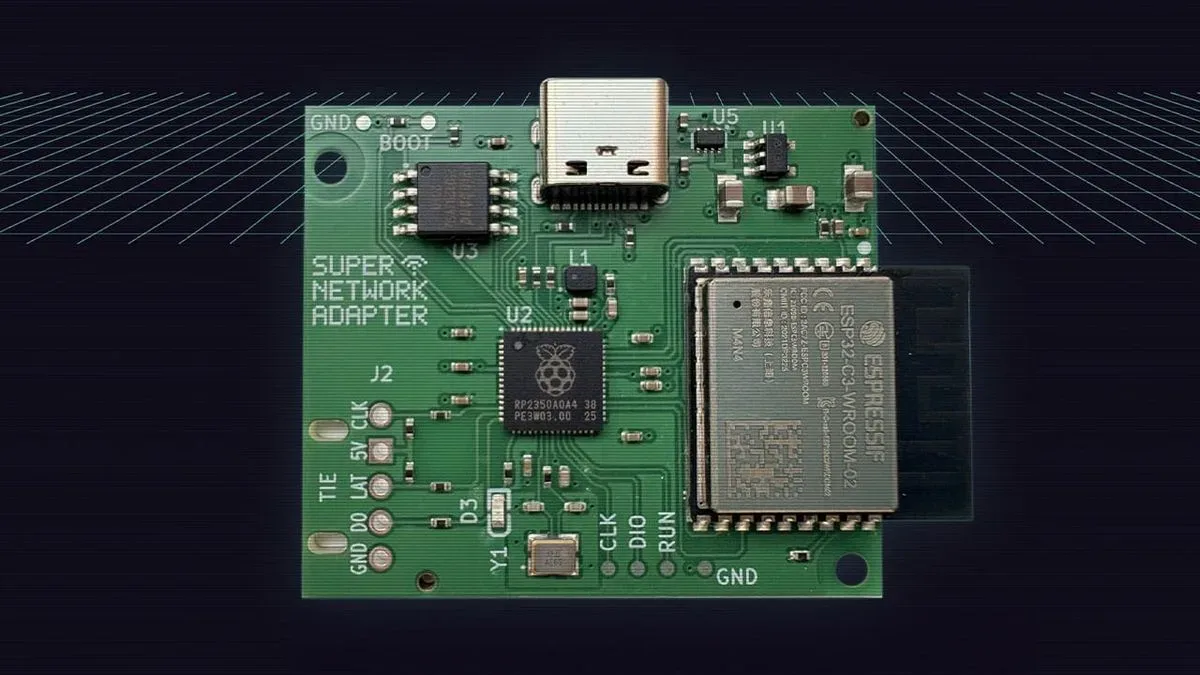
The Super Nintendo Entertainment System was built for a very different era of gaming. Its world was one of cartridges, couch multiplayer, passwords written on scraps of paper and memory saved directly to a game's battery-backed chip. Networked console play was not part of the standard SNES experience, particularly outside Japan. That makes SNET, a homemade wireless network adapter created by Danny Boland, an especially intriguing piece of modern retro-hardware experimentation.
SNET, short for Super Network Adapter, is designed to bring a Wi-Fi connection to original SNES hardware without changing the console's internal components. Rather than using the expansion connector on the underside of the system, the device plugs into one of the SNES controller ports. From there, it creates a data link between the console and a local wireless network, or can operate as a hotspot for direct connections.
The project is not presenting itself as a lost official Nintendo peripheral or a straightforward attempt to turn every old cartridge into an online game. Instead, it is an exploration of what a network-aware Super Nintendo accessory might have looked like through a "16-bit futurism" lens. Its possibilities range from relatively practical save-file management to more unusual experiments involving AI-generated dialogue in classic games.
A modern network link through a familiar SNES port
The core concept behind SNET is deceptively simple: use a port already present on every compatible console to give the machine a path to the network. The adapter communicates through the controller interface, a choice that makes the project visibly distinct from hardware that relies on internal modifications or rarely used console expansion features.
For useful background on this topic, read retro gaming Black Friday deals Cut Prices on Handhelds, Consoles and Classic-Inspired Gear.
Its hardware combines an RP2350 microcontroller with an ESP32-C3, the latter providing Wi-Fi capability. The controller-port connection is reported to offer a data link of approximately 30 kB/s. That figure is modest by current standards, but it is meaningful in the context of a 16-bit console designed decades before home broadband, wireless networking and cloud save systems became ordinary parts of gaming.
The limited bandwidth also explains why SNET's most compelling uses are not about downloading enormous games or forcing the SNES into tasks beyond its design. Small save files, game patches, text data and network commands are much more natural fits. In that sense, the adapter works best when it respects the constraints of the machine it is connecting.
For retro enthusiasts, the controller-port approach has another appeal: it leaves the original hardware intact. Modifications to vintage systems can be rewarding, but they can also be intimidating for owners who do not want to solder, alter their consoles or risk damage to aging hardware. An external peripheral is easier to understand, remove and experiment with.
For another perspective on this story, read SNET Gives the SNES a Homemade Wi-Fi Link Through Its Controller Port.
Looking back at Nintendo's earlier network ambitions
The SNES was not entirely without network-related ambitions during its original lifespan. In Japan, Nintendo launched the Satellaview in 1995, a satellite modem accessory for the Super Famicom. It delivered broadcasts, games and special content through a satellite service, creating an early form of scheduled digital distribution years before online storefronts became a standard console feature.
Satellaview remains a fascinating part of Nintendo history because it demonstrated ideas that would eventually become familiar: downloadable content, time-limited events, digital game delivery and even broadcasts connected to game experiences. But it was tied to its Japanese service and never became a broadly adopted global platform. For many SNES owners elsewhere, the console's legacy remained firmly rooted in physical cartridges and local play.
SNET does not recreate Satellaview, nor does it attempt to imitate every part of that service. It instead imagines a different technological path: an SNES with a wireless local network connection. The idea is deliberately anachronistic, pairing a machine from the early 1990s with components and services from today. Yet that contrast is also exactly what makes the device appealing. It gives enthusiasts a way to ask what the platform could do when connected to contemporary tools while still keeping the original console at the center of the experience.
Save syncing and flash-cart possibilities
One of SNET's more practical functions involves save data. Many SNES games store progress in cartridge memory, making preservation an increasingly important issue as original batteries age and physical media grows older. A network adapter that can move saves between a cartridge setup and a server could offer a useful additional backup route for hobbyists.
The project is described as supporting the linking of game saves between cartridges and servers, including use cases involving emulators. That could allow a player to continue a save on different setups, provided the games, save formats and software involved are compatible. For example, someone could potentially preserve progress from a real-hardware session before using the same save in an emulator, or move a compatible emulator save back to a flash-cart environment.
That sort of interoperability is one of the most attractive ideas in the wider retro scene. Original hardware offers the feel, timing and presentation of playing on the real machine, while emulators can offer convenience, display options, debugging tools and easier file management. Bridging those two worlds has often required cables, cartridge dumpers or manual copying. SNET points toward a more network-oriented approach.
The adapter can also work alongside a flash cart for patching and loading ROMs. Flash carts have already become important tools for preservation-minded collectors, homebrew developers and ROM-hack players, allowing compatible software to run on original consoles from removable storage. Network functionality could make updating patches or moving files into a play setup more convenient, although the exact workflow will naturally depend on the flash cart and software configuration being used.
As with any device that handles ROM files, users should be mindful of ownership and copyright. The most straightforward applications are homebrew projects, personal backups where permitted and community patches intended for games users legally possess. The technical possibilities are broad, but responsible use remains important.
An experimental AI link for SNES dialogue
The most eye-catching and potentially divisive SNET feature is its ability to connect games to an AI language model. In a demonstration using The Legend of Zelda: A Link to the Past, the setup shows non-player-character dialogue being generated on the fly.
This is less a traditional enhancement than a technical experiment. SNES games were written around tightly controlled text, carefully authored scenes and strict memory limits. Replacing or supplementing dialogue with material generated outside the game changes a fundamental part of the original experience. For a beloved game, especially one whose writing and atmosphere are closely tied to its identity, many players may prefer to leave the original text untouched.
Still, the experiment reveals an interesting avenue for ROM hackers and homebrew creators. Dynamic dialogue could be useful in custom-built projects, prototype adventures, fan-created scenarios or games designed from the outset around player-specific responses. It could also provide a way to test how old hardware interacts with modern online services, even if the final result is more novelty than a definitive way to play a classic.
There are obvious creative questions as well. AI-generated dialogue can be inconsistent, tonally inappropriate or less polished than hand-written text. It may also introduce unpredictability that does not suit a game with established characters and narrative beats. SNET does not solve those challenges on its own; it simply provides a route for developers and tinkerers to explore them on hardware that predates the modern internet.
A project for tinkerers rather than a plug-and-play accessory
SNET is best viewed as a maker project and proof of concept, not a mass-market SNES add-on waiting on store shelves. Its appeal is likely to be strongest among people who enjoy electronics, homebrew development, flash carts, ROM hacking and the technical side of retro gaming. The project's documentation details the steps involved for those interested in making their own adapter.
That do-it-yourself nature is part of its charm. Retro hardware communities have kept old machines relevant not only through collecting, but through new controllers, video mods, replacement parts, homebrew games and inventive peripherals. SNET belongs in that tradition. It takes an interface designed for a wired gamepad and repurposes it as a gateway to wireless networking.
Even if its AI experiments are not for everyone, the broader concept has clear potential. Save preservation, flexible file transfer and communication between original hardware and emulation setups are all useful ideas for a console whose library remains deeply loved. More than anything, SNET is a reminder that the SNES is not a static museum piece. More than three decades after its debut, enthusiasts are still finding new ways to make Nintendo's 16-bit machine do surprising things.
Community
Discussion
Start the conversation.
No comments have been posted yet.