

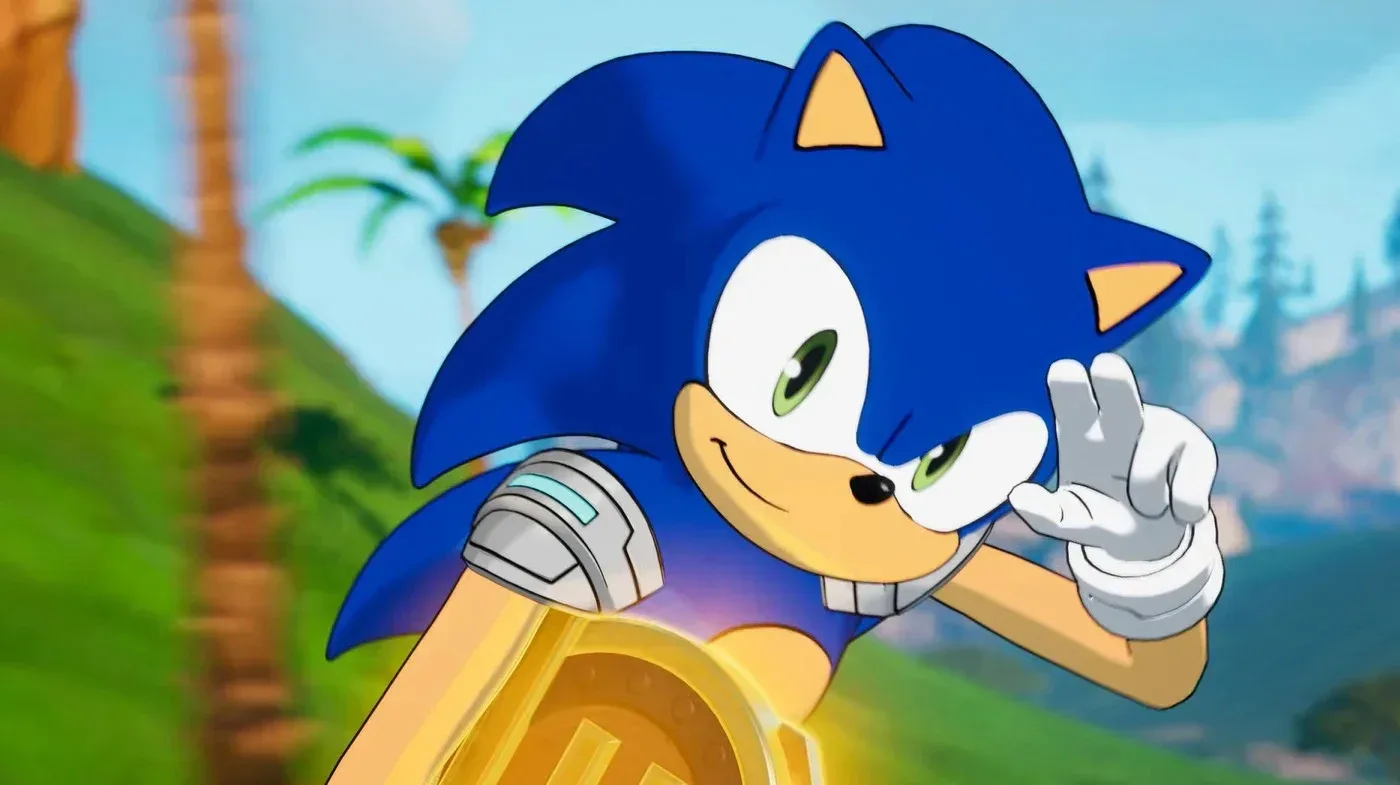
Sonic the Hedgehog has spent decades as one of gaming's most recognisable heroes, usually defined by speed, colourful worlds, and a broadly family-friendly image. Fortnite's current gaming-focused season has presented a very different version of that character: one able to wield the battle royale's assortment of firearms alongside icons from across games and entertainment.
That unusual sight has evidently connected with players. Sega president and COO Shuji Utsumi and Epic Games Japan managing director Takayuki Kawasaki have shared early engagement figures for the Sonic collaboration, revealing that Fortnite players collected more than 1.5 billion rings and defeated Dr. Eggman more than 14 million times during the first weekend after the crossover launched.
The numbers underline the immense reach of a Fortnite appearance, but the partnership was not simply a matter of dropping the Blue Blur into an existing character slot. Utsumi and Kawasaki described a process involving creative discussions, technical revisions, and a broader effort to explain why this particular version of Sonic belongs in Fortnite's world.
For Sega, that distinction was especially important. The Sonic appearing in Fortnite has been framed as an android version rather than the standard Sonic associated with the series' usual adventures. That premise helps address the deliberate contrast between Sonic's traditional persona and the run-and-gun action expected in Epic's hugely popular game.
For useful background on this topic, read Bungie Says Extraction Will Remain Central to Marathon as New Modes Arrive.
A huge opening weekend for Sonic in Fortnite
Kawasaki said player reaction has been strongly positive, with Fortnite's overall player numbers also higher during the current season than they were in the equivalent period one year earlier. The ring-collection total and the number of Eggman defeats offer a clearer glimpse at how actively people have engaged with Sonic-specific content, rather than merely purchasing or equipping crossover cosmetics.
Eggman has always been Sonic's central adversary, so it is no surprise that players have enthusiastically taken him on. Still, 14 million defeats in a launch weekend is an enormous number, particularly when paired with 1.5 billion rings gathered around the world. The scale illustrates how Fortnite can turn familiar series symbols into communal objectives for a player base spread across several platforms.
Utsumi expressed surprise at the results, while Kawasaki jokingly suggested that players were not inclined to go easy on a villain as famous as Eggman. The reaction makes the crossover an immediate success in engagement terms, and it provides both companies with a compelling example of what can happen when a major character is introduced with gameplay hooks and not only a cosmetic presence.
Fortnite has long featured guests from across games, film, comics, television, music, and sports. Yet Sonic poses a particular creative challenge because his silhouette, movement, and identity are so closely tied to his original games. His oversized head and compact body are unmistakable in a platformer, but those same proportions must work within Fortnite's established character templates, animations, and combat presentation.
Why Sonic needed redesign work and a new backstory
Utsumi explained that the companies went through several iterations while adapting Sonic for Fortnite. One of the practical hurdles was the relationship between the character's head and body proportions. Making a character fit a game's systems is not always as simple as importing a familiar model; animation, camera framing, hit presentation, equipment, and visual readability all need to work together.
There was also a larger brand question. Sega did not want the appearance to feel like Sonic had been inserted into Fortnite solely because a crossover had been requested. The team wanted to find an appropriate connection between the two worlds while respecting both communities: people who play Fortnite and longtime Sonic fans with clear expectations for how the character should be represented.
The result extended beyond the game itself. Sega developed a backstory for why Sonic exists in this Fortnite form and created a comic intended to make that explanation feel convincing. That extra narrative layer is notable because it treats the collaboration as more than a short-lived promotional moment. It is an attempt to give a potentially jarring visual idea--Sonic holding Fortnite weaponry--a context within the character's wider fiction.
The android framing is central to that approach. Shadow has a history with firearms and a darker edge within the Sonic franchise, but Sonic is generally positioned very differently. By making Fortnite's version an android counterpart, Sega can preserve a line between the series' core hero and the crossover interpretation designed for Epic's multiplayer sandbox.
This kind of careful positioning reflects a reality facing every major entertainment company considering a Fortnite partnership. The potential audience is vast, but licensed characters carry history, rules, and fan expectations. A crossover may introduce a character to millions of people, yet it can also create debate if the character seems detached from what made them popular in the first place.
A relationship built around shared confidence in the crossover
Utsumi and Kawasaki pointed to mutual respect between Sega and Epic Games as an important part of making the project happen. Epic Games chief executive Tim Sweeney's fondness for Sonic also helped support the collaboration. Those foundations mattered because Sonic's appearance required agreement not only on business terms, but on creative details ranging from character design to narrative justification.
The discussion also touched on Sweeney's long-running view of the metaverse. Kawasaki recalled an example used by Sweeney well before Fortnite launched: children playing with action figures in a sandbox would not normally reject a shared game simply because one figure came from one fictional universe and another belonged to a different company's property. In digital spaces, however, intellectual-property divisions have historically made that kind of mixing far more difficult.
Fortnite is increasingly an attempt to reduce those barriers, at least within a controlled and licensed environment. Its roster can place characters and objects from distinct fictional settings next to one another in ways that would have seemed implausible years ago. In Kawasaki's example, the idea has reached a point where Sonic can use Mega Man's Mega Buster while Dragon Ball's Goku can unleash a Kamehameha.
That does not mean the legal, creative, or technical complications have vanished. If anything, Sonic's crossover demonstrates why they remain significant. Bringing together famous properties requires active decisions about how each one will look, act, and be explained. The more normal these crossovers become, the more important it may be for rights holders to define the boundaries that keep their characters distinct.
Sega sees both opportunity and responsibility
Utsumi said Fortnite's current state makes Sweeney's long-discussed vision feel increasingly real. At the same time, he emphasised that Sega must continue establishing Sonic's own worldview as these connected, metaverse-like spaces grow. The company had substantial concerns over how to remain a distinct, independent intellectual property while adapting to a larger shared environment.
That perspective is likely to resonate with other publishers and entertainment owners. Fortnite offers visibility few games can match, including exposure to younger audiences who may know a character primarily through a crossover before playing their original games. For Sega, the benefit is not limited to a successful Fortnite event; it is also the chance that Fortnite players become interested in Sonic's broader catalogue.
Epic benefits as well. A new major character can create fresh excitement among existing users, bring in Sonic fans who might not otherwise return for a season, and reinforce Fortnite's reputation as a place where gaming's biggest names can coexist. The reported early activity suggests that Sonic has delivered on those goals.
There is a broader lesson in the collaboration's preparation. The biggest crossover moments can look effortless once they reach players, but the work behind them can be extensive. Sonic's Fortnite appearance involved model adjustments, internal debate, an original story explanation, and coordination between companies with their own priorities. The 1.5 billion rings and 14 million Eggman defeats are the visible outcome of that work.
What Sonic's response could mean for future collaborations
The opening figures do not by themselves guarantee what comes next for Sonic in Fortnite, and no further plans were outlined. They do, however, demonstrate that the character can generate substantial participation in a game built around crossovers. That may encourage continued experimentation with how established series appear in shared digital spaces--provided their owners can find a version that feels authentic enough for fans.
For Sonic, Sega's answer was not to pretend the usual character had suddenly become a standard Fortnite combatant. Instead, the company built an alternate explanation around an android Sonic, letting the collaboration embrace Fortnite's chaotic spirit without fully redefining the mainline hero. It is a compromise that preserves room for the game's playful anything-goes fantasy while acknowledging that character identity still matters.
Players have made their verdict clear in the short term: they have chased rings in staggering quantities and sent Eggman back to the drawing board millions of times. Whether Sonic's Fortnite role becomes a model for future Sega collaborations or remains a particularly memorable event, it has already shown how much planning can sit behind a crossover that initially seems as simple as putting a famous hedgehog into a battle royale.
Community
Discussion
Start the conversation.
No comments have been posted yet.