

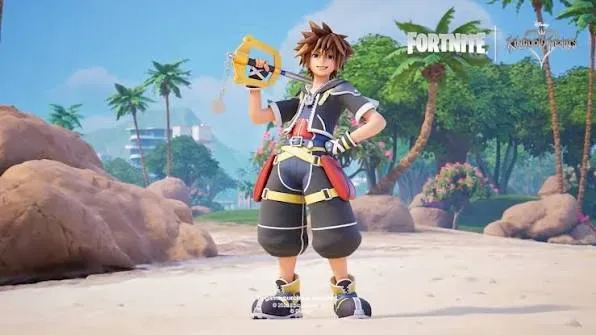
Sora is coming to Fortnite, placing the longtime Kingdom Hearts hero in one of gaming's largest and most crossover-heavy virtual spaces. Fortnite shared the arrival through its social media, and the collaboration is part of the game's current Gaming Legends season. More characters from the Kingdom Hearts series are expected to follow later in the week, though no further names have been confirmed.
It is the kind of announcement that is completely predictable for Fortnite in 2026 while still feeling surreal. Sora has spent more than two decades traveling between worlds, meeting characters from Disney films and crossing paths with Final Fantasy favorites. Yet seeing him translated into Fortnite's highly standardized character style is a different proposition. The first look has prompted a particularly strong reaction because, while the costume and silhouette aim to evoke Sora's familiar design, the character's expression and proportions appear unusually detached from the bright, emotive adventurer Kingdom Hearts players recognize.
Fortnite is built to make wildly different properties coexist. That is both its central attraction and the unavoidable trade-off behind every major guest appearance. A character needs to function inside a competitive third-person shooter, fit animation requirements, and adhere to a common gameplay framework. Those practical constraints can make even a careful recreation feel slightly strange. With Sora, whose personality is so often communicated through exuberant facial animation, an altered expression becomes especially noticeable.
Embedded X/Twitter post
A crossover built for Fortnite's biggest stage
Kingdom Hearts is hardly unfamiliar with crossover storytelling. The series began as an improbable union between Square Enix and Disney, built around an original protagonist who visits worlds inspired by films ranging from Hercules and The Little Mermaid to Toy Story and Big Hero 6. Its identity has always depended on the friction between recognizable icons, original mythology, earnest emotion, and increasingly complicated cosmology.
For useful background on this topic, read Needle In A Haystack Simulator Adds "Original" Label as Steam Lookalikes Multiply Before Launch.
That history makes Fortnite seem like a logical destination on paper. Fortnite has welcomed characters from games, movies, television, comics, music, and sports, turning its item shop and seasonal events into an ever-changing museum of pop-culture collaborations. The Gaming Legends label is specifically suited to guests from gaming history, making a Kingdom Hearts addition an easy fit alongside the broad range of video game personalities Fortnite has hosted over the years.
But Kingdom Hearts occupies an unusual place within crossover culture. Its Disney connections are not merely decorative costumes applied to an unrelated game. Sora's journey, friendships, combat tools, and emotional stakes are bound up with traveling through those worlds. As a result, bringing Sora into another crossover arena can feel less like a novelty cameo and more like a character who has been pulled one layer farther away from the context that defines him.
That tension is visible in the reaction to Fortnite's Sora model. Fortnite skins routinely adapt characters to support readable movement and a consistent competitive presentation. The result can be charmingly odd: familiar heroes may look taller, broader, stiffer, or simply more toy-like than they do in their original games. Sora's version has drawn attention for a comparatively blank, "dead-eyed" look that contrasts sharply with the optimistic, expressive presentation associated with the Kingdom Hearts protagonist.
The missing Keyblade detail stands out
One small detail has become especially conspicuous in the promotional material: Sora's Keyblade does not appear to retain the Mickey Mouse charm commonly attached to it in Kingdom Hearts. The Keyblade is among the series' most recognizable symbols, and that charm is an immediately identifiable part of its design for many fans.
There has been no confirmed explanation for the omission. Licensing arrangements involving Disney characters, symbols, and game collaborations can be complicated, and visual changes are not always publicly explained. Still, the absence is notable precisely because Kingdom Hearts has made the charm feel inseparable from Sora's signature weapon. In a crossover full of highly specific visual references, even a small missing element can create the sense that a design has been filtered through several approvals before reaching the screen.
It also illustrates why Fortnite collaborations frequently invite close scrutiny. Players do not just ask whether a property has arrived; they examine whether its most important details survived the adaptation. Is a character's silhouette correct? Are their accessories present? Does their face look right? Are their iconic tools represented in a way that feels authentic? For fans who have spent years with a series, those questions matter more than the broad fact of a crossover announcement.
Why Sora's Fortnite appearance feels so uncanny
Sora is an especially difficult character to transplant because he has always been stylized, but not in a static way. His appearance shifts between Kingdom Hearts games, from the oversized shoes and youthful look of the original adventure to the more detailed, mature designs in later entries. Across those iterations, however, he remains defined by warmth, movement, and an open expression. He is usually reacting--to a new world, a reunion, a tragedy, or an absurd situation involving talking animals and giant keys.
A Fortnite skin is not designed around that kind of close-up performance. It needs to read during matches, work with the game's existing animation language, and remain compatible with shared mechanics. The technical and visual need for uniformity is understandable, but it can flatten the qualities that made the guest character distinctive. Sora's face in the Fortnite model has become a focal point because it appears to have lost some of that energy.
There is a long history of fans reacting strongly when a cartoonish or stylized game character gets remodeled for a new context. Sometimes the response is affectionate, as players embrace an unexpectedly awkward version of a favorite hero. Other times it crosses into discomfort, particularly when the redesign preserves a recognizable face but changes the proportions, gaze, or expression enough to make the character seem unfamiliar.
Fortnite's adaptation lands in that uncomfortable middle ground. It is unmistakably intended to be Sora, yet it does not fully evoke the animated optimism associated with him. That may be an inevitable result of placing him inside Fortnite's ecosystem rather than a reflection of a lack of care, but the effect is still jarring in the early footage and images.
Fortnite's collaboration machine keeps expanding
The arrival also renews a broader conversation around Fortnite's role as a crossover platform. For some players, the game's endless guest roster is an entertaining celebration of shared fandom. There is genuine appeal in seeing characters from entirely separate genres and eras occupy the same match, use the same dances, and participate in the same evolving seasonal world. Fortnite has made that kind of collision feel normal.
For others, the constant stream of branded appearances can make individual crossovers feel less special. A character who once carried the weight of a particular game, story, or artistic style can become another selectable cosmetic in a huge catalog. The concern is not that crossovers exist--Kingdom Hearts itself proves that unexpected combinations can produce something memorable--but that repetition can reduce every property to a visual reference and a storefront moment.
Sora's appearance makes that concern unusually easy to understand. Kingdom Hearts has always been commercially collaborative, but it has also been intensely sentimental. Its stories center on friendship, memory, separation, and the effort to save people who have been lost. Putting Sora in Fortnite does not erase that history, yet it asks audiences to view him through a very different lens: as a competitor, an avatar, and a cosmetic identity that can stand beside virtually anyone.
That disconnect may be exactly why the reveal has inspired such a mix of excitement, humor, and unease. The concept is a natural fit for Fortnite's business and for Kingdom Hearts' crossover legacy. The final model, though, demonstrates that a logical collaboration is not always the same thing as a seamless visual match.
More Kingdom Hearts arrivals are still to come
Fortnite has indicated that additional Kingdom Hearts characters are due later this week as part of Gaming Legends. Until those characters are officially shown, it remains unclear how extensive the collaboration will be or whether the later additions will receive a warmer response than Sora's initial design.
For now, Sora's Fortnite debut has accomplished what major Fortnite partnerships usually do: it has put a familiar gaming figure in front of an enormous audience and started an immediate debate about the result. Fans who simply want to bring the Keyblade wielder into a match will have a new reason to log in. Players more attached to Kingdom Hearts' original tone may find the adaptation harder to shake.
Either way, Sora has visited many stranger worlds than Fortnite. The question is whether Fortnite's version can retain enough of his spark to feel like the same hero after the crossover novelty wears off.
Community
Discussion
Start the conversation.
No comments have been posted yet.