

Star Wars: Galactic Racer is designed to test more than a player's reflexes. Fuse Games CEO Matt Webster says the newly released roguelite racer puts substantially greater demands on its audience than the studio's earlier racing work, combining extreme velocity with layered controls, ability management and strategic decision-making.
That approach is particularly notable given the heritage behind the project. Fuse Games includes several developers with roots at Criterion Games, the studio associated with the celebrated Burnout series. Galactic Racer also arrives as Star Wars returns to the racing genre after a long absence: Racer Revenge launched on PlayStation 2 24 years before the new game's release.
Rather than simply recreating the accessible arcade rush associated with either Star Wars: Episode I Racer or the Burnout games, Galactic Racer appears to use those touchstones as a foundation for something more punishing. Players race at enormous speeds, where even a light collision with a wall can destroy a speeder. During campaign runs, only three such destructions are permitted before a player is eliminated and must begin again.
For Webster, that intensity reflects a broader change in what contemporary game players are capable of handling. He believes modern audiences can process a larger amount of information and make more simultaneous decisions than players were generally asked to make in past racing games.
For useful background on this topic, read Street Fighter Director Says Movie Cast Brought Deep Franchise Knowledge to Set.
"Modern gamers can manage a greater amount of cognitive load," Webster said.
A racer built around speed and decision-making
Webster described Galactic Racer as a game that expects players to juggle several responsibilities at once. It is not merely a matter of navigating a course at roughly 700 kilometres per hour. Racers must also use multiple boost options, press more than one face button at a time, change abilities as circumstances evolve, and think in both strategic and tactical terms while the action is at its fastest.
That is a markedly different pitch from the traditional idea of an arcade racer, where simple steering, acceleration and a well-timed boost can often carry the experience. The genre has always had room for technical mastery, of course, whether that comes through drifting lines, vehicle tuning, shortcut knowledge or risk-reward systems. Galactic Racer's twist is that it places those forms of mastery inside a roguelite campaign structure while asking players to actively manage a more crowded control and information space.
The result, based on Webster's description, is a game where the player needs to read the track, monitor their current tools, decide when to deploy them, and preserve a limited supply of chances to continue a run. Speed is not simply a visual flourish; it increases the pressure on every other system. A poor ability choice, missed input or minor loss of control can become much more costly when the vehicle is moving at such a high rate.
That design philosophy also explains why the game does not appear to soften its edge simply because it carries the Star Wars name. The franchise has a broad audience and is often approached as a family-friendly property, but Galactic Racer is willing to make failure immediate and conspicuous. Brushing against scenery can end a race in an explosion, and the campaign's three-destruction limit means that repeated mistakes carry consequences beyond a single event.
The long road back to Star Wars racing
Galactic Racer has particular historical weight because Star Wars racing games have been largely absent for more than two decades. The last major point of reference cited by the game's return is Star Wars Racer Revenge, the PlayStation 2 follow-up to the earlier podracing game. That leaves a 24-year gap between that release and Galactic Racer.
The new game is therefore positioned as both a return and an evolution. It pays tribute to the reckless, science-fiction speed of Star Wars: Episode I Racer, whose pod races turned the franchise's Tatooine sequence into a standalone racing concept. At the same time, Fuse Games' Criterion connections invite comparisons with Burnout 3 and Burnout Revenge, titles remembered for aggressive driving, spectacular crashes and a fierce arcade identity.
Those influences are visible less as a promise of direct imitation than as a statement of intent. Star Wars supplies the vehicles, worlds and familiar universe. The Burnout legacy suggests an appetite for aggression and velocity. The roguelite format, meanwhile, gives the game a contemporary structure built around runs, setbacks and repeated attempts. Put together, those components create a racer that looks backward to beloved genre landmarks while leaning into the expectations of a current audience.
Webster's comments suggest that Fuse Games does not see complexity as an obstacle to arcade excitement. Instead, the team appears to view the two as compatible. The goal is not necessarily to slow the player down so they can make clearer decisions; it is to make rapid decisions part of the thrill. The feeling of barely maintaining control while managing boosts and abilities may be central to what makes a successful run satisfying.
Failure is part of the campaign
The roguelite element is important because it changes the meaning of a crash. In many racers, wrecking a vehicle results in lost time, a reset on the track, or an inconvenient interruption before the player continues. In Galactic Racer, destruction appears to be a campaign-level resource problem. Three blown-up speeders mean the end of the run.
That condition should make consistency as important as outright pace. A racer who takes every corner at maximum risk may gain ground quickly but could also burn through their available chances. Conversely, a more controlled player may be better positioned to survive a long campaign. The tension between those approaches is a natural fit for a game that asks players to make tactical and strategic choices while racing.
It also gives the game's high-speed collisions more weight. The prospect of exploding after grazing a wall sounds deliberately harsh, but it establishes clear stakes. Players are expected to learn how much danger they can absorb, when to push a boost advantage, and when a safer line might preserve the larger run. That is a different form of challenge from simply chasing the fastest lap time.
Webster's emphasis on "cognitive load" may sound technical, but it captures the intended sensation well. Galactic Racer is asking the player to distribute attention across driving inputs, course hazards, special abilities, boost systems and long-term survival. The skill ceiling comes not from any one individual mechanic, but from combining all of them while the track rushes past at an extraordinary pace.
An enthusiastic early reception
That demanding formula has been warmly received. Galactic Racer has quickly become one of the highest-rated Star Wars games, an outcome that points to a strong response for Fuse Games' blend of sci-fi racing, roguelite structure and arcade pedigree.
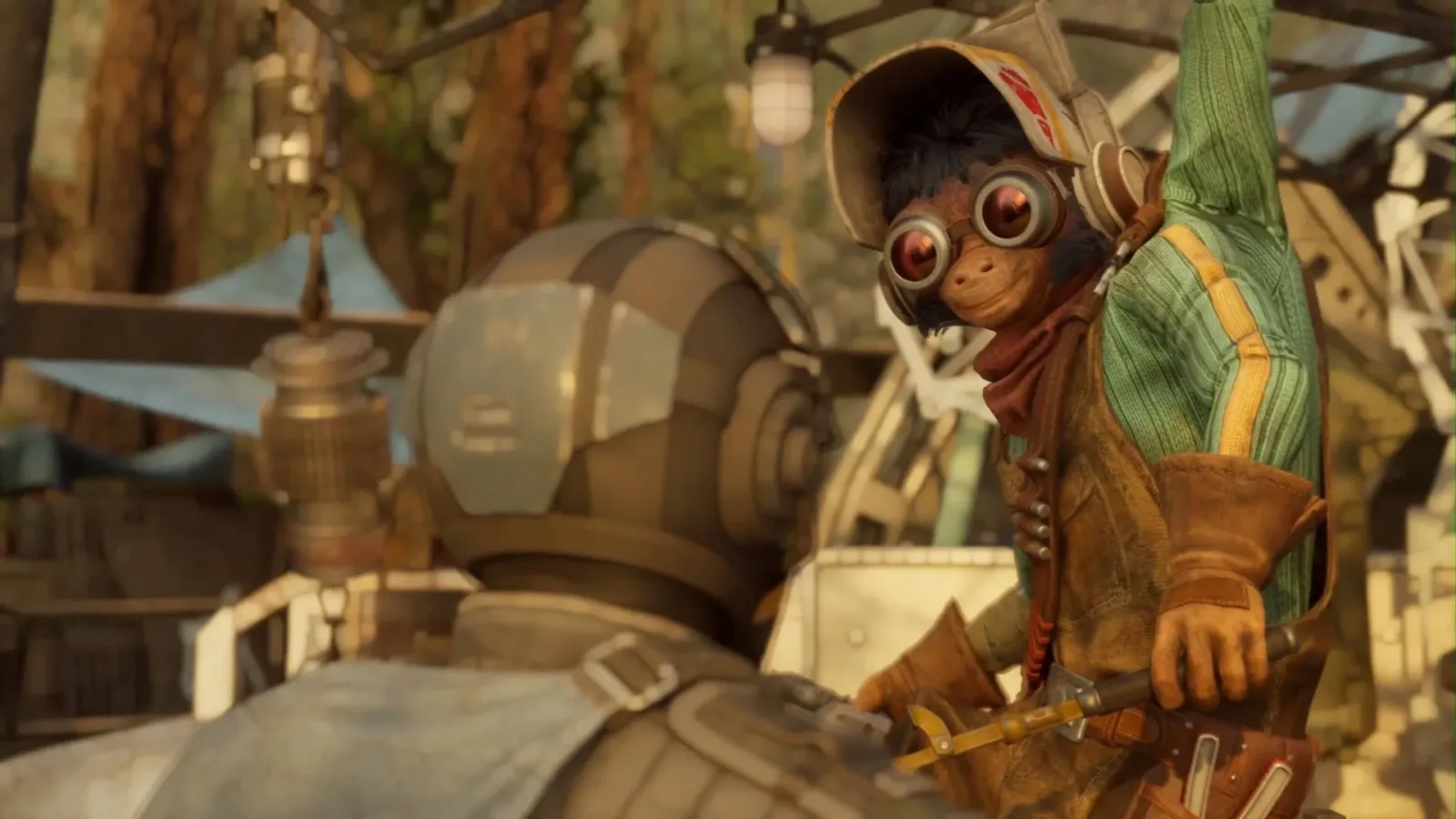
The game's personality has also made an impression. Ben Quadinaros, a minor Star Wars character repurposed here as a troublesome presence, has become a fan favorite. He is portrayed as an irritating little figure who may blow up the player's vehicle simply for his own amusement, adding a mischievous element to a game already built around mechanical pressure and explosive mistakes.
It is an appropriately strange flourish for a Star Wars racing revival. Galactic Racer carries serious ambitions in its design, asking players to do more at once than Fuse Games has previously demanded in a racer. Yet it also has room for the kind of deep-cut character humor that Star Wars fans readily embrace.
For players willing to meet it on its own terms, the challenge is clear: drive at breathtaking speed, master a dense set of inputs and abilities, survive costly crashes, and keep thinking when every instinct says to focus only on the next corner. Fuse Games is betting that today's players are ready for that challenge--and that the pressure of managing it all is exactly what will make the ride memorable.
Community
Discussion
Start the conversation.
No comments have been posted yet.