

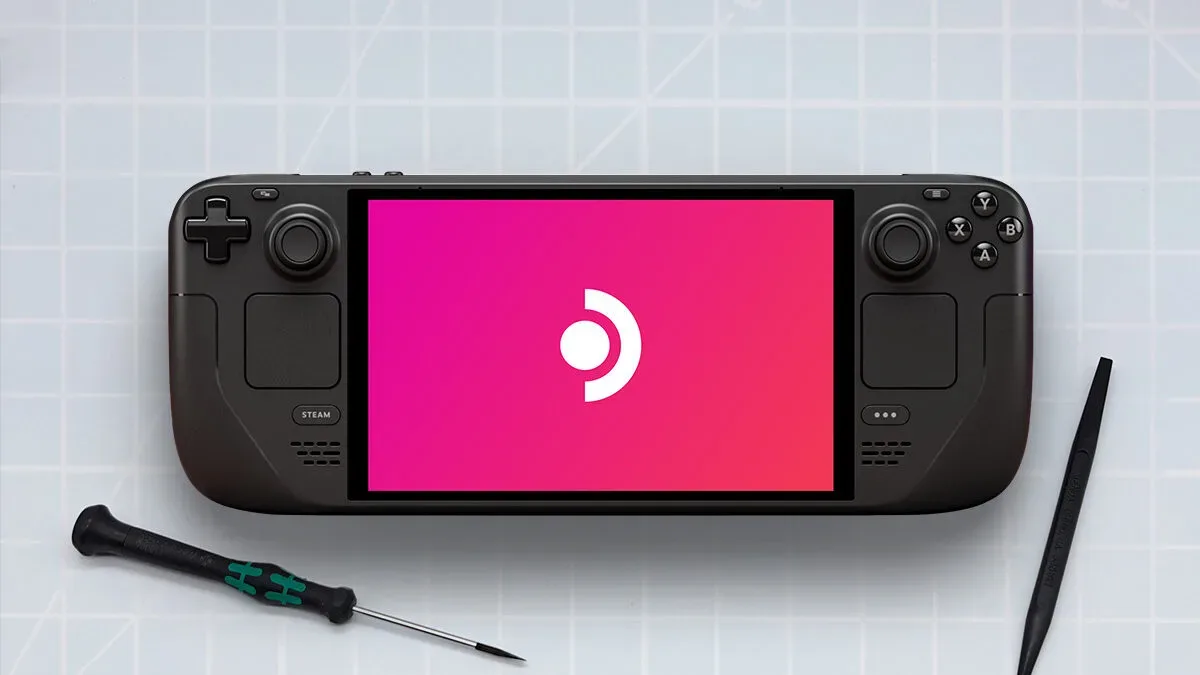
Steam Deck owners are getting a more detailed way to judge whether a game is likely to run well on Valve's handheld PC before making a purchase. Valve has begun adding average frame-rate information to Steam store pages, giving players performance data drawn from people who have opted in to share their gameplay information.
The update is intended to add useful context beside the familiar Steam Deck compatibility labels. A game can be marked as compatible with the device and still deliver a very different experience depending on its graphics demands, optimization, settings, or the version of the Steam Deck being used. The new data does not replace compatibility testing, but it should give prospective buyers a clearer indication of what actual performance may look like.
For games with enough available data, Steam's additional Steam Deck compatibility information now includes an average frame rate. Players can also expand that figure into a histogram, offering a more complete view of how frequently users are reaching particular performance levels and how often they encounter hitches or stutters.
A Steam Deck label is not the whole performance story
Steam's Deck compatibility program has been valuable for reducing uncertainty around PC games on a handheld device. Its labels can indicate whether a title is Verified, Playable, Unsupported, or still Unknown. Those categories address important issues: controller support, text legibility, launcher behavior, compatibility with the Steam Deck's software environment, and other practical concerns.
For useful background on this topic, read Nintendo Switch 23.5.0 Adds Family Group Digital Game Gifting on November 16.
Yet those labels do not necessarily answer the question many players ask first: How smoothly will this run? A game may technically be functional, readable, and controllable on Steam Deck while still requiring substantial visual compromises or struggling to maintain a frame rate that a particular player considers comfortable.
That distinction matters because performance preferences are subjective. Some players are content with a stable 30 frames per second, particularly in slower-paced role-playing games or strategy titles. Others may want 40 FPS, 60 FPS, or higher, especially in action games where responsiveness is a priority. A single compatibility badge cannot fully communicate those expectations.
Valve has acknowledged this limitation in explaining the new feature. The company noted that existing information is based on standardized testing criteria, but that the classifications may not align with every customer's own definition of acceptable gameplay. Average frame-rate data gives buyers another tool rather than attempting to impose one universal standard for performance.
What the new frame-rate display shows
On supported Steam store pages, the new entry appears in the extra information associated with Steam Deck compatibility. It presents an average frame-rate figure based on opted-in player performance data. That baseline number is useful at a glance, but the expanded histogram may be the more important part of the rollout.
Average numbers can conceal a great deal. A game that averages 40 FPS could feel consistently smooth if it mostly stays near that point, or it could fluctuate sharply between much higher and lower results. It could also suffer intermittent pauses caused by asset streaming, shader compilation, loading behavior, or other issues that are not communicated by an average alone.
The histogram is designed to provide that missing context. It breaks the overall result into a graph showing how commonly players see certain frame-rate levels. It also indicates how frequently hitching or stuttering occurs. In practical terms, that means a shopper can look beyond a headline number and better assess whether a game's performance profile suits the kind of experience they want.
That is particularly useful for portable PC gaming. Handheld players often balance visual settings, battery life, heat, resolution, and performance targets. A buyer who hopes to play at 30 FPS with reduced settings may reach a different conclusion than someone expecting a 60 FPS experience. More granular store information can help both make an informed choice without assuming that one preference applies to everyone.
Early examples show a substantial range
The feature is already appearing for titles that have accumulated enough data points. The early examples illustrate why frame-rate reporting can be more meaningful than a simple yes-or-no compatibility result.
On Steam Deck OLED hardware, Final Fantasy VII Rebirth currently shows an average of 37 FPS. By comparison, players running Hades II on the same hardware are seeing an 88 FPS average. The difference is not surprising given the distinct technical demands and visual approaches of those games, but putting the figures directly on a storefront makes that contrast easier to understand before installation or purchase.
Those numbers should not be treated as promises of identical results for every Steam Deck owner. Individual performance can still vary depending on in-game settings, game updates, operating-system changes, background activity, thermal conditions, and how a player chooses to cap their frame rate. The figures are best understood as an evidence-based overview of community results rather than a guaranteed benchmark.
Even so, having that overview built into the store page should be far more convenient than relying solely on scattered community discussions, individual videos, or outdated launch-period tests. It also acknowledges that performance can change long after release as developers patch their games and Valve updates SteamOS, drivers, and Proton compatibility tools.
Opt-in data makes the tool community-informed
The system relies on performance information shared by users who have chosen to opt in. That approach allows Valve to aggregate data from real use rather than presenting only a narrowly controlled test result. It also means the feature will appear only where there is enough information to establish a meaningful average.
This requirement is important. A highly anticipated new release, a niche title, or a game with a small Steam Deck audience may not immediately show frame-rate information. Likewise, the level of detail available can improve as more people play and contribute data. The absence of a number should therefore not be read as evidence that a game performs poorly; it may simply mean Steam does not yet have sufficient data to display a dependable result.
Community-derived figures have their own limitations, but Valve's addition of a distribution graph and stutter-related information should make the data more useful than a bare average. Rather than reducing performance to one definitive verdict, the presentation can show that experiences vary across the player base.
A potentially broader performance feature
Valve plans to extend the frame-rate information beyond Steam Deck. That could be significant as handheld PC gaming continues to grow beyond a single device. Players now have a wider range of portable systems, with different chips, screens, power settings, operating systems, and levels of performance.
Steam Deck remains a major reference point because of its large audience and tightly integrated SteamOS experience, but it is no longer the only handheld PC that players consider. Devices such as the ROG Ally have helped make the category more visible, while newer hardware options continue to emerge. A broader version of this feature could help shoppers compare expectations across devices instead of treating PC performance as one vague, universal category.
Valve has not provided a detailed timetable or complete list of hardware that could be included in that expansion. For now, the active implementation is centered on Steam Deck data. Still, the stated plan suggests the company sees performance transparency as relevant to a wider PC ecosystem, not merely to its own handheld.
Why the update matters for new PC players
One of Steam Deck's strengths is that it has made PC game libraries feel more approachable for people who may not want to build, tune, or maintain a traditional desktop gaming computer. But that accessibility can be undermined when a store page does not clearly explain how demanding a game is in real-world use.
Desktop PC players are accustomed to comparing components and consulting detailed benchmarks. Many handheld owners, however, want a simpler answer: will this game be enjoyable on the device they already own? Steam's compatibility labels addressed part of that concern. The new frame-rate metrics address another major part.
There will still be room for deeper analysis from players who want to explore exact settings, image quality, latency, battery draw, and advanced tweaks. The new store-page data is not trying to replace that level of testing. Instead, it gives everyday buyers a faster and more practical starting point, directly where purchase decisions are made.
As more games gather enough data, the feature could make Steam's storefront more candid about the gap between "runs" and "runs well." For Steam Deck owners, that distinction is often the one that matters most.
Community
Discussion
Start the conversation.
No comments have been posted yet.