

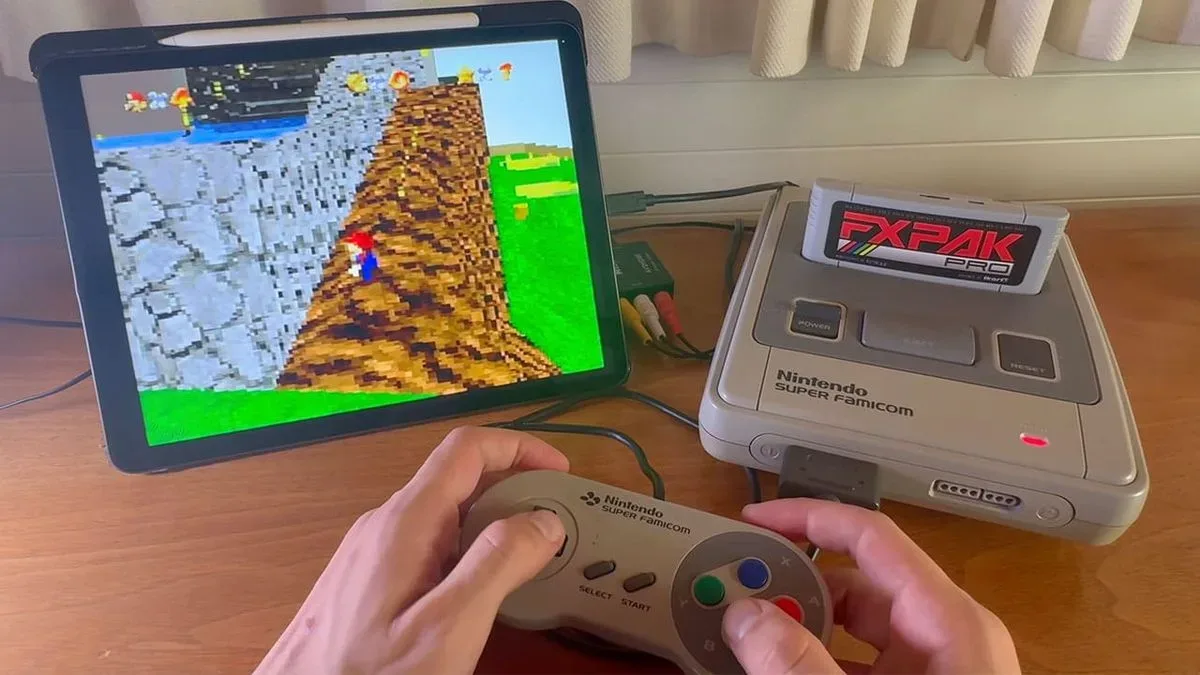
A new fan-development project is attempting something that once would have sounded impossible: getting Super Mario 64 running on Super Nintendo hardware. Developer Game of Tobi has shown a version of Nintendo's landmark 3D platformer operating with the assistance of the SNES Super FX chip, recreating Mario's movement and recognizable level elements within the very different technical limits of the 16-bit console.
The project is not a conventional port in the modern sense. The Super Nintendo was never designed around the sort of fully polygonal 3D worlds that became standard on Nintendo 64, and the work shown so far naturally comes with a reduced visual presentation, a lower level of fluidity, and noticeable jitter in places. Even so, the result is immediately identifiable as Super Mario 64: Mario can move through 3D spaces, his familiar actions are present, and the environments retain enough of their original structure to make the technical achievement clear.
Game of Tobi has said the project uses the original game's source code and assets. That experience is important here, as the developer has previously worked extensively with Super Mario 64 material and has explored bringing the game to hardware far removed from its original Nintendo 64 home. This SNES effort may be the most striking example yet of how far those experiments can go when tailored to an unusual piece of period-appropriate enhancement hardware.
The chip that gave SNES games a 3D future
The key to this project is the Super FX chip, the co-processor most closely associated with Star Fox. Developed through Argonaut's work with Nintendo, the technology was initially known as MARIO, short for Mathematical Argonaut Rotation I.O. It was built into specially made game cartridges rather than the console itself, allowing a game to add processing capabilities beyond what a standard Super Nintendo release could access.
For useful background on this topic, read Fortnite's Five Nights at Freddy's Reveal Becomes Its Most-Liked Post Ever.
For players in the early 1990s, Star Fox was a dramatic demonstration of that idea. Its angular ships and sparse, polygon-heavy battlefields look modest beside later 3D games, but they were an enormous visual leap on a system chiefly known for sprite art, scrolling backdrops, and Mode 7 effects. The Super FX chip helped the SNES draw and manipulate graphics that would otherwise have been outside the machine's normal comfort zone.
That does not mean the chip turns a Super Nintendo into a Nintendo 64. The distinction is central to understanding why this adaptation is so intriguing. Super Mario 64 was created for hardware designed around real-time 3D rendering, analog movement, camera control, and much more spacious technical resources. The SNES and Super FX combination can produce 3D results, but it needs major compromises and carefully engineered solutions to approach a game of Mario's scale.
The footage and demonstrations from Game of Tobi reflect that reality. This is a project working within an extremely constrained environment rather than trying to disguise those limits. The image can be difficult to parse, performance is not perfectly smooth, and the game's geometry has to be handled in a way that makes sense for the older system. Yet the essential appeal lies in seeing a 1996-style 3D platformer interpreted through technology that predates it.
Fitting a 3D Mario game into 2MB
One of the largest hurdles is memory. Game of Tobi has described working with a limited 2MB budget, a restriction that shapes nearly every part of the adaptation. In practical terms, that means assets, level data, animation, and rendering information must all be considered with exceptional care. It is not simply a matter of taking Nintendo 64 data and asking older hardware to display it.
The developer has explained that frames had to be painted back to front, illustrating the kind of rendering work required to make the scene appear correctly on SNES hardware. Modern players may take depth handling and 3D drawing order for granted, but older systems often demand more direct management of what is placed on screen and when. A project like this becomes as much about solving display problems as it is about adapting gameplay.
Those constraints help explain both the visual look and the uneven moments shown so far. The Super FX-powered version does not seek a pixel-perfect recreation of the Nintendo 64 original. Instead, it translates the original into a form that can operate on a machine with radically less memory and a completely different graphics architecture. The achievement is in making the game legible and playable while retaining the identity of its locations and controls.
Mario's moves are especially important to that identity. Super Mario 64 remains celebrated not only because it put Nintendo's mascot into 3D, but because it gave players a remarkably flexible movement set. Running, jumping, turning, and other signature actions created a sense of freedom that defined the game's platforming. Retaining that feel, even under substantial technical compromises, is a far more complicated task than presenting a static 3D scene.
A different outcome from the Game Boy Advance experiment
Game of Tobi has also explored an effort to bring Super Mario 64 to the Game Boy Advance. That project was ambitious in its own right, but the SNES Super FX approach is currently said to be running better. The comparison makes sense when the unusual role of the cartridge chip is considered: the Super FX hardware provides a specialized route to 3D operations that the standard SNES could not offer by itself.
Neither experiment should be mistaken for an official Nintendo product or an announced commercial re-release. They are fan-made technical projects, and their value is largely in the challenge they pose. Ports and demakes often invite easy comparisons to the original game, but that framing can miss the point. Here, the fascination comes from the question of whether an iconic Nintendo 64 game can be reimagined convincingly on hardware from the generation before it.
There is also a tantalizing historical angle. The Super FX chip has long been tied to speculation about what further 3D-focused SNES games might have looked like had that technology continued to be pushed in different directions. A Mario project designed around it never materialized during the system's original life. This modern experiment cannot rewrite that history, but it offers a vivid approximation of an alternate path: a 3D Mario adventure emerging from the Super Nintendo era rather than defining the launch period of its successor.
Planned for flash-cart hardware when it is ready
Game of Tobi intends to release the project for play on SNES hardware through a flash cart, including the FX Pak Pro, after the developer is satisfied with the results. No firm release date has been provided, and more work is still required before players should expect a finished build. The available material shows completed portions of levels rather than confirming a final, fully complete conversion of the original game.
That cautious timeline is appropriate for a project with this many moving parts. Getting a build to boot is one challenge; making it stable, readable, enjoyable, and compatible with the intended flash-cart environment is another. Performance tuning and memory management can have an outsized impact when development takes place under such restrictive conditions. A small adjustment may be necessary to make one area function, while creating a new complication elsewhere.
For retro hardware enthusiasts, the prospect of playing this on a real Super Nintendo setup is likely as exciting as the software itself. Flash carts have become valuable tools for homebrew developers and preservation-minded players, allowing experimental software to run on original consoles without manufacturing a traditional cartridge release. In this case, the FX Pak Pro matters because Super FX support is essential to the concept, not merely an optional enhancement.
The project is also a reminder that old hardware remains an active creative space. Decades after the SNES established itself with 2D classics, developers are still finding new ways to probe its limits. Some of those efforts focus on brand-new games, while others reinterpret familiar titles in forms their original creators never shipped. Both approaches reveal how much knowledge has accumulated around vintage systems since their commercial lifetimes ended.
Why the experiment matters
Super Mario 64 occupies a singular place in gaming history because it helped establish the language of 3D platformers. The SNES Super FX chip occupies another important place because it gave console players an early glimpse of polygonal gaming before dedicated 3D hardware became widespread. Combining them is a natural technical thought experiment, even if the result must operate far below the visual and performance standards of the Nintendo 64 release.
What has been shown suggests that Game of Tobi is not merely displaying a Mario model or building a lookalike scene. The recognizable structure of the game, its levels, and its movement systems are all part of the undertaking. That makes the remaining work especially compelling: the question is no longer whether a Super FX Mario 64 concept can appear on an SNES screen, but how complete and polished this version can become within the machine's hard limits.
For now, it remains a work in progress, with no confirmed launch window. But even in its unfinished state, the Super FX adaptation stands as a remarkable piece of retro-development experimentation. It connects two defining moments in Nintendo's technical history and demonstrates that, with enough persistence, a console famous for 16-bit sprites can still be persuaded to host a version of one of 3D gaming's most influential adventures.
Community
Discussion
Start the conversation.
No comments have been posted yet.