

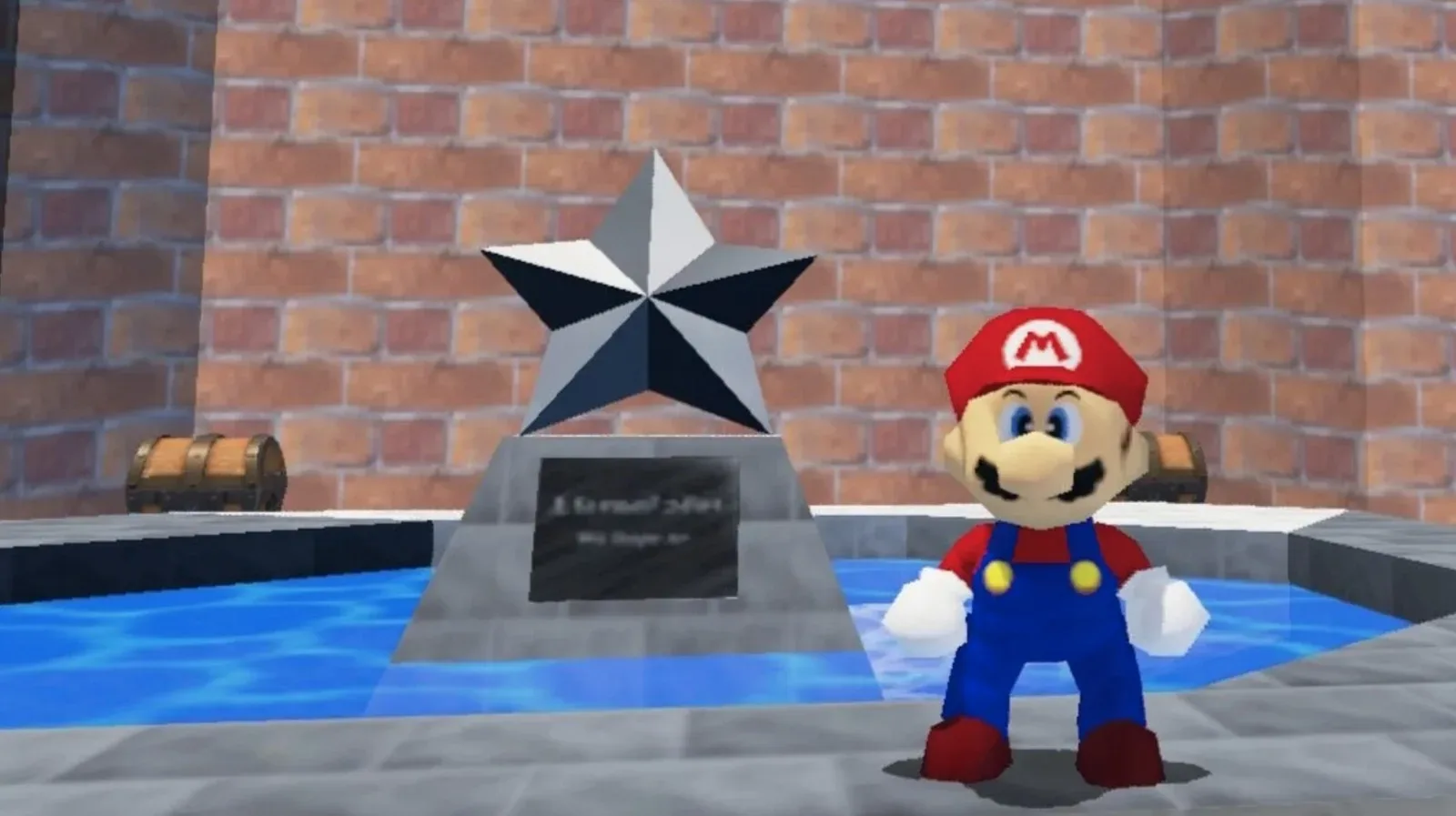
For nearly three decades, one tiny environmental detail in Super Mario 64 has invited a wildly outsized amount of scrutiny: the murky plaque positioned in Princess Peach's castle courtyard beneath the large star statue. Its lettering is so indistinct that players have spent years enlarging screenshots, adjusting contrast, producing mock-ups and proposing elaborate theories about what Nintendo might have hidden there.
Now, a programmer known as Mochi64 may have brought the community closer than ever to an answer. Using open-source computational analysis software rather than conventional image enhancement, Mochi64 tested huge numbers of potential word and font combinations against the plaque's available pixels. The closest matches produced by that process suggest that the upper line says "Eternal Star" and the lower line says "We hope so."
It is an intriguing result, especially because it offers a fittingly simple explanation for one of the Nintendo 64 era's longest-running mysteries. But it is not a definitive decoding. The text in the original game is exceptionally blurred, and no official confirmation has been provided by Nintendo. The analysis identifies the best matches from its comparisons, not an untouched high-resolution version of the texture hiding somewhere in public view.
Embedded X/Twitter post
A mystery built into a blurry corner of Peach's castle
Super Mario 64 launched in 1996 and became one of the defining games of the Nintendo 64 library, establishing a new language for 3D platformers while filling Peach's castle with secrets, shortcuts, paintings and cryptic details. The castle courtyard was particularly memorable because it was not simply a transition space. It was home to Boo encounters, the entrance to Big Boo's Haunt and a large star monument that naturally encouraged players to inspect its surroundings.
For useful background on this topic, read Pokémon Santa Cruz blind bag skateboards Sell Out as Resale Prices Surge.
At the base of that statue sits the plaque. On a standard-era television, it was less an unreadable sentence than a collection of vague shapes. Yet the impression that there was meaningful text proved enough to turn it into a continuing point of fascination. In a game packed with hidden stars and rumors of inaccessible content, an illegible sign looked like exactly the sort of clue that might lead somewhere important.
Later releases did not resolve the matter. Modern reissues still retain the same fundamentally unclear artwork, leaving fans without a cleaner official texture to examine. That is why this new attempt is notable: it does not claim that today's upscaling tools somehow recovered letters that were never visibly preserved. Instead, it approaches the question as a matching problem.
How the computational approach differs from upscaling
Image upscaling can make an old image look sharper, but it cannot reliably restore information that was not captured in the first place. With a plaque this blurred, an upscaler could easily invent plausible-looking edges and letter shapes, potentially making an uncertain answer appear more convincing than it really is.
Mochi64's method takes a different route. The software examined millions of possible arrangements involving words and fonts, comparing the resulting renderings against the shape and pixel distribution visible on the in-game plaque. Rather than treating the image as something that can be restored to pristine clarity, the process asks which candidate phrases most closely reproduce what players can already see.
That distinction matters. The result is still probabilistic, and it leaves room for another phrase to be correct. But a candidate that survives an enormous number of comparisons has more support than a reading based solely on a person staring at a fuzzy screenshot and seeing familiar letters.
The strongest output from the analysis is "Eternal Star" on the plaque's top line, followed by "We hope so" beneath it. Both phrases are short enough to fit the limited space, and the first has an obvious visual connection to the star statue directly above the sign.
Why "Eternal Star" makes thematic sense
"Eternal Star" sounds suitably ceremonial for the castle courtyard. The Power Stars are central to Super Mario 64: Mario's journey is structured around collecting them to open locked doors, access new worlds and eventually confront Bowser. A monumental star at Peach's castle could reasonably be labeled in reverent language, and "Eternal Star" has the compact, fantasy-themed flavor of a location marker or inscription.
The possible second line, "We hope so," is stranger at first glance. It could be a playful sentiment paired with the idea of an eternal star, perhaps expressing a wish that the star remains everlasting. Another interpretation is that it reflects the game's star-collecting premise: a hopeful little message from the developers or a fictional inscription tied to the statue's symbolism.
Neither explanation can be proven without Nintendo's input, and that uncertainty is part of the story. A close computational match is not the same as a documented asset description, a developer comment or a readable original texture file. Still, the prospective wording is far more mundane--and arguably more charming--than the phrase that dominated plaque discussions for years.
The long shadow of "L is Real 2401"
For many players, the courtyard plaque is inseparable from the famous "L is Real 2401" rumor. The theory held that the sign read that exact phrase and that it pointed toward a way to unlock Luigi in Super Mario 64. Since Mario's brother was absent from the finished game, the idea was irresistible: perhaps Luigi was not missing, but deliberately concealed behind an extraordinarily difficult secret.
The rumor spread well beyond playground conversations and early internet message boards. A $100 reward was offered by IGN to anyone who could demonstrate a legitimate Luigi unlock method. Nintendo Power also referenced the "L is Real 2401" idea in an April Fool's issue, helping ensure the joke and the speculation became entwined in the public memory of the game.
There were reasons for fans to keep believing. Shigeru Miyamoto later said that the development team had explored a two-player mode before abandoning the plan because of memory constraints. An early build that showed Mario and Luigi running through a sparse room gave the concept a tangible form. Once players knew Luigi had at least been considered in some capacity, the blurry plaque became a natural place to project hopes of cut or hidden content.
Over time, modders, dataminers and preservation-minded fans pulled apart much of what they could from Super Mario 64. The game's secrets have been studied so extensively that a complete hidden Luigi mode in the retail version is extraordinarily unlikely. Yet the plaque remained unusually resilient because its mystery was visual rather than mechanical. There was no button combination to disprove, no level geometry to fully explore--only blurred lettering that seemed to invite one more look.
An answer may not end the fascination
If "Eternal Star / We hope so" is ultimately the closest anyone gets, it offers a reminder of how legends can grow around technical limitations. The plaque probably was never meant to serve as a coded promise of Luigi. It may have been a small piece of decorative flavor that became unreadable through the low-resolution presentation of the Nintendo 64 version.
That does not make the decades of theorizing meaningless. The "L is Real 2401" myth is part of Super Mario 64's cultural history, reflecting an era when secrets traveled through magazines, playgrounds and nascent online communities with little immediate fact-checking. Its endurance also speaks to the game's design: Peach's castle made players believe almost every odd corner could matter.
And the newly suggested text retains a touch of ambiguity of its own. "Eternal Star" is an evocative phrase, while "We hope so" has an oddly human, humorous quality. It feels appropriate that a mystery associated with one of gaming's most analyzed worlds may have a conclusion that is less about a secret character and more about a fleeting developer joke or decorative sentiment.
Still no official final word
For now, the plaque should be considered a strong computationally supported interpretation rather than settled canon. Millions of font and phrase comparisons can narrow the possibilities dramatically, but they cannot replace direct confirmation from Nintendo or an original development record that plainly identifies the sign's text.
Nintendo may never address it, particularly given how small the asset is in the larger history of Super Mario 64. But after roughly 30 years of speculation, the analysis gives fans a plausible answer that connects naturally to the courtyard's star monument and requires no hidden Luigi conspiracy.
Whether players choose to accept "Eternal Star" and "We hope so" as the plaque's likely message or keep the mystery alive, the investigation has achieved something valuable: it has shifted the conversation from wishful decoding toward a methodical test of what the original pixels can realistically support. For a sign that once seemed to say anything, that may be the clearest result fans were ever going to get.
Community
Discussion
Start the conversation.
No comments have been posted yet.