

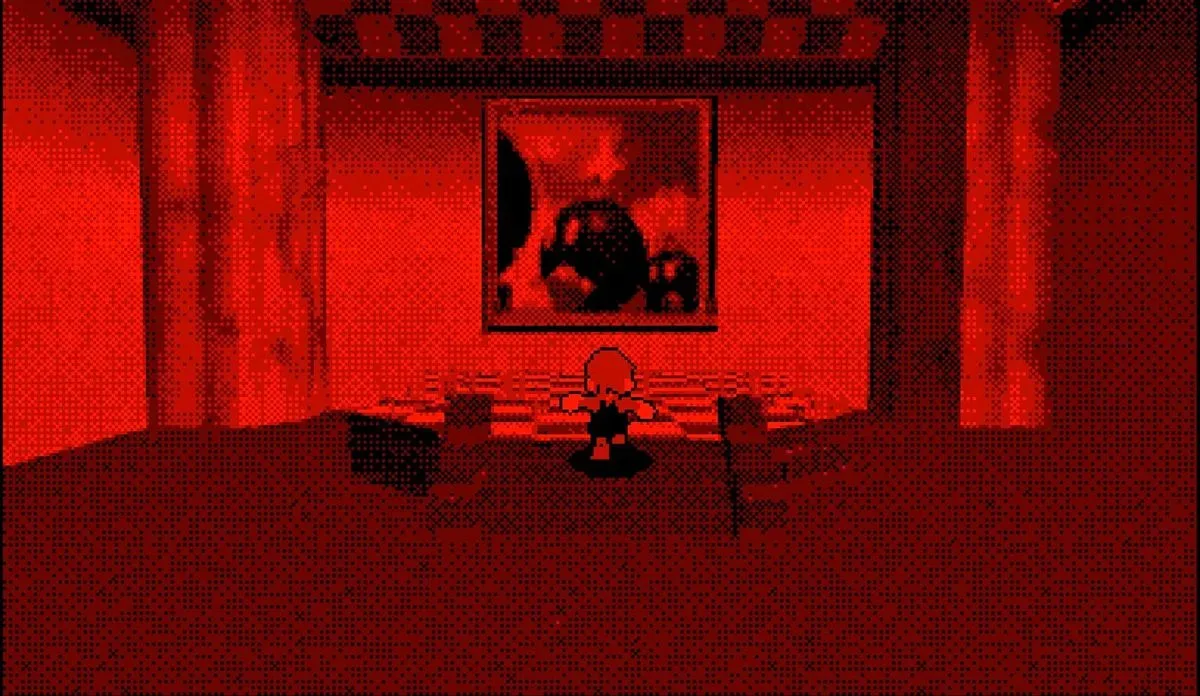
A remarkable fan project is pushing Nintendo's Virtual Boy far beyond what many people would expect from the short-lived 1995 system. Developer Mochi64 is adapting Super Mario 64 into a stereoscopic, red-and-black Virtual Boy experience that runs on genuine hardware at 50 frames per second.
The work-in-progress demo currently covers the game's recognizable opening sequence and continues through the King Bob-omb encounter. That is a modest slice of Nintendo 64's landmark 3D platformer, but the technical accomplishment is the real story: the game is not simply being shown through an emulator trick or a modern display filter. Its visuals and 3D effect are designed to function on the original Virtual Boy itself.
For a machine remembered as much for its unusual headset-like stand and monochrome red display as for its small software library, a fast-moving interpretation of one of the Nintendo 64's defining games makes for an especially unusual crossover between two very different eras of Nintendo hardware.
Embedded X/Twitter post
A Mario 64 world rebuilt for Virtual Boy
Super Mario 64 was built around colorful, fully 3D environments, analog movement, a dynamic camera, and a Nintendo 64 architecture designed to render polygonal worlds in real time. The Virtual Boy, meanwhile, uses a distinctive stereoscopic display made up of red illumination against a dark background. Its technical profile and limited commercial lifespan meant it never received anything close to a native equivalent of Nintendo's later 3D platforming showcase.
For useful background on this topic, read Pokémon FireRed Fan Project Rebuilds Kanto in Full 3D Using Original Game Logic.
Mochi64's project translates that contrast into its central visual identity. The bright environments associated with Super Mario 64 have been reshaped into the Virtual Boy's red-and-black presentation, while stereoscopic depth gives the world a tangible layered look. Rather than treating the system's display as a limitation to conceal, the demo embraces it as the basis for a new version of the Mushroom Kingdom.
The footage shared so far demonstrates the familiar start of Mario's adventure, from the iconic launch presentation to the first major boss confrontation with King Bob-omb. Seeing these elements reconstructed in the Virtual Boy's visual language is compelling even before considering the hardware constraints behind them. Mario remains a live, moving character within the scene, enemies are active, and the presentation aims for fluid movement at 50fps.
"From the iconic launch screen to King Bob-omb, everything runs on Virtual Boy hardware," Mochi64 said while showing the project's current state.
That distinction is important for retro enthusiasts. Virtual Boy homebrew and technical demonstrations have long highlighted what the hardware can still do in the hands of dedicated developers, but adapting a game with the scale and cultural weight of Super Mario 64 creates a particularly clear demonstration of both the system's potential and its boundaries.
Pre-rendering is the key to performance
The project does not attempt to force the Virtual Boy to render every part of a Mario 64-style world live. Instead, Mochi64 has described a hybrid approach built around pre-rendered scenery. Environments are ray-traced in advance and stored on the game cartridge, while Mario and the enemies encountered in the level are drawn in real time over those prepared backgrounds.
That method explains how the demo can pursue smooth 50fps action despite the Virtual Boy being far too limited to render the entire scene dynamically in the manner of the Nintendo 64 original. It also means the project is not a conventional one-to-one port in the strictest technical sense. It is a reconstruction carefully tailored to the target hardware, prioritizing the appearance, depth, movement, and recognizable structure of Mario's first 3D adventure while using an approach that the Virtual Boy can realistically handle.
Pre-rendered graphics have a long history in games, especially on systems where real-time 3D was expensive or impractical. The Virtual Boy project uses that philosophy in a particularly modern-looking way, with ray-traced scenes prepared before play and then combined with live character rendering. The result is intended to preserve the sense of moving through a 3D space, including the extra depth afforded by the console's stereoscopic display, without asking the machine to calculate every piece of level geometry on the fly.
It is also a reminder that frame rate alone does not tell the entire technical story. Achieving 50fps here depends on a specialized rendering pipeline and compromises made with the Virtual Boy's capabilities in mind. Still, the fact that those compromises can produce a responsive, stereo 3D Mario experience on original hardware is precisely what makes the demonstration notable.
ROM space is the project's biggest obstacle
The current goal is not yet a complete Virtual Boy conversion of Super Mario 64. Mochi64 plans to release a public demo after adding more levels and stars, giving players a broader look at the concept than the current opening-and-King-Bob-omb build.
The major bottleneck is storage. The project is presently working within a 16MB ROM limit, and that restriction matters enormously when level visuals are being rendered in advance and stored on the cartridge. Every additional stage requires more data, so expanding the playable content is not simply a matter of implementing another course. It is also a question of whether the needed scenery can fit in the available cartridge space.
Mochi64's current estimate is that roughly five levels may be feasible under the existing limit. A full-game effort would require a different arrangement. An emulator patch has already been prepared to permit larger ROM sizes in an emulated environment, but actual Virtual Boy hardware would need a custom cartridge solution to accommodate a complete version.
This creates a meaningful divide between a substantial demo and an eventual full-scale adaptation. Emulators can be modified to remove or relax certain storage restrictions, which is useful for development and experimentation. Original hardware, however, must still receive the data from physical media that works with the console. In this case, a purpose-built cartridge with greater capacity would be necessary before a complete Super Mario 64 interpretation could become practical on a real Virtual Boy.
How original-hardware players could try it
Once the demo is released, owners of Nintendo's original hardware are expected to be able to load it using a compatible flash cartridge, such as the Hyper Boy. Flash cartridges are an important part of the modern retro-development scene because they allow homebrew software and fan projects to run on the hardware for which they were made without requiring a traditional commercial cartridge release.
That option matters because the Virtual Boy's stereoscopic effect is core to this project's appeal. While emulation can make software more accessible and can support development features such as expanded ROM capacity, the experience on the system's original display is a different proposition. The machine's paired visual fields were designed to deliver depth directly through its dedicated viewer, and this demo is being built with that unique characteristic in mind.
Players should nevertheless keep expectations grounded until the public build arrives. The available material represents an ongoing fan-made demo, and the final number of included levels and stars has not been confirmed. A full release has not been promised for original hardware in its current form, given the ROM-space issue and likely need for a custom cartridge. The immediate plan is a larger demonstration rather than a confirmed complete remake.
A fitting experiment for Nintendo's strangest system
The Virtual Boy occupies an unusual place in Nintendo history. It is often remembered as a commercial failure and for a form factor that proved difficult for many players, but it was also an early and distinctive attempt to bring stereoscopic game visuals into the home. Its small catalog and unusual architecture have turned it into a fascination for collectors, preservationists, and homebrew creators decades later.
Reimagining Super Mario 64 for the system makes sense in that context. The original Nintendo 64 game helped define the future of 3D platformers, while the Virtual Boy represents an earlier, stranger branch of Nintendo's efforts with spatial visual technology. Bringing the two together does not erase the gap between their capabilities. Instead, it makes that gap part of the experiment, using precomputed scenes, live sprites and models, and the Virtual Boy's signature red stereoscopy to create something that could never have existed as a straightforward retail release.
For now, the project remains one to watch for fans of Mario history, Virtual Boy development, and ambitious retro conversions. The existing build has already shown that the concept can run at 50fps on the original machine, from its opening moments through King Bob-omb. The next milestone is a demo with additional levels and stars--and the longer-term question is whether storage solutions can eventually make a much larger Virtual Boy adventure possible.
Community
Discussion
Start the conversation.
No comments have been posted yet.