

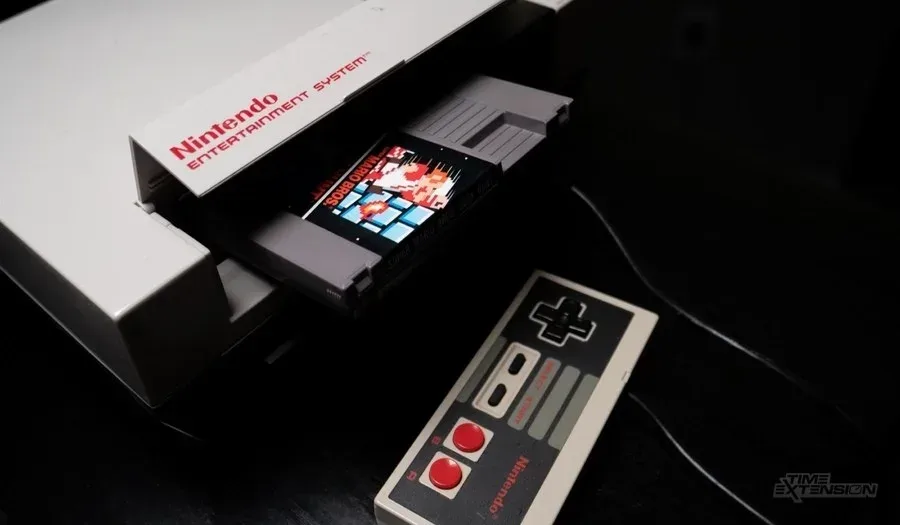
Few sounds in video games inspire instant regret quite like the Super Mushroom sliding away in the original Super Mario Bros.. It is a tiny disaster that has happened to players for decades: Mario hits a question block, the red-and-white power-up emerges, and then it bounces in precisely the wrong direction. Before Mario can reach it, the Mushroom tumbles off a ledge and vanishes into the void.
That familiar moment has made a recently spotlighted trick in the NES classic particularly surprising. In the opening level, World 1-1, it is apparently possible to rescue a Super Mushroom that falls from an upper platform by jumping off the top of the screen. Mario can wrap around from the upper boundary to the bottom portion of the playfield and intersect with the falling item, collecting it before it is gone for good.
The maneuver has been demonstrated in a clip shared on X by user @tyousameYSK. The footage shows Mario reach the elevated section of World 1-1, release a Mushroom from a block, and watch it fall beyond the lower ledge. Rather than accept the loss, the player leaps upward at the top edge of the screen. Mario reappears at the lower edge, touches the Mushroom, earns 1,000 points, and becomes Super Mario.
Embedded X/Twitter post
For many people who have replayed Nintendo's foundational platformer countless times, the result looks almost impossible. The power-up seems destined for a bottomless pit, while Mario appears to travel through a route the stage never clearly teaches players to use. Yet the trick is rooted in the game's screen-boundary behavior rather than a newly discovered level edit or a change to the cartridge.
For useful background on this topic, read Project Reignition Revives Sonic & The Secret Rings on PC With a Full Fan Remake.
A World 1-1 surprise hiding in plain sight
World 1-1 may be one of the most studied stages ever made. It functions as an iconic tutorial without explaining itself through text. The first Goomba teaches players to jump. Question blocks invite experimentation. A Mushroom demonstrates the value of collecting items. Pipes, pits, bricks, and stairs each establish rules that the rest of the game expands upon.
That reputation makes the Mushroom-saving moment more startling. Players know the level so well that an unusual interaction inside it can feel like a magic trick. The key is not that the Mushroom stops falling, turns around, or gains any special behavior. Instead, Mario uses an unusual vertical wraparound effect at the screen edges to meet the item from another direction.
In practical terms, Mario needs to be positioned on the stage's upper route when the Mushroom drops. By jumping beyond the top edge at the appropriate time, his sprite can cross the display boundary and overlap with the Mushroom near the bottom. The collision is registered, allowing the game to award the power-up as normal.
It is an especially amusing solution because it turns the screen itself into a shortcut. A player does not chase the Mushroom down the visible level geometry. Mario effectively goes over the top of the game display to reach an object that has slipped underneath it.
Why players are reacting with disbelief
Classic games are often treated as completely solved artifacts. Super Mario Bros. has been speedrun, reverse-engineered, ported, analyzed, and played by generations of fans since its 1980s debut. Its levels are part of gaming's shared vocabulary. As a result, it can be difficult to believe that a basic interaction involving the first major power-up could still be unfamiliar to so many players.
The clip prompted a mixture of amazement, skepticism, and memories from those who had encountered the behavior before. Some viewers questioned whether the demonstration was authentic, an understandable response when an old game's familiar visual rules suddenly seem to break. Others recognized the technique or were simply delighted to see a strange piece of long-standing game knowledge reach a wider audience.
There is an important distinction here: the attention around the maneuver does not necessarily mean the behavior has only just been found. @tyousameYSK said they first learned of it through Keibunsha's Great Encyclopedia, a line of Japanese hobby books that covered subjects including video games, anime, and manga during the 1980s. That history suggests the trick circulated in at least some enthusiast communities long before social media turned it into a fresh debate.
It is a useful reminder of how game knowledge traveled before online video archives and searchable databases. Secrets, strategies, rumors, and highly specific mechanical discoveries were often shared through magazines, books, playground conversations, store demonstrations, and handwritten notes. A fact could be well known within one region or group of players while remaining completely unknown elsewhere.
Vertical wraparound and the charm of old game behavior
The Mushroom rescue also highlights why older games continue to produce fascinating discoveries. Their rules are usually compact, but those rules can interact in unexpected ways. Hardware limitations, screen scrolling systems, sprite handling, and collision detection all contribute to the final behavior players see. What may look like an accidental oddity can become a practical technique once someone understands the conditions behind it.
In this case, the apparent screen wraparound is doing the crucial work. Mario's upper-screen position and the Mushroom's lower-screen position become close enough in the game's coordinate handling for their sprites to overlap. The result is not a separate item state or a hidden rescue animation. It is the ordinary collection rule activating in an extraordinary-looking position.
That sort of edge-case interaction is part of the long life of the NES library. Players have spent years learning routes that were not obvious during a casual run, investigating enemy patterns, identifying timer behavior, and finding ways to use movement systems more efficiently. Speedrunning communities, in particular, have helped document how even straightforward games contain layers of nuance beyond their original intended learning curve.
The Mushroom trick is less about shaving a route by a fraction of a second than it is about preserving a power-up during a moment that usually feels irreversible. That makes it accessible as a curiosity even to people with no interest in competitive play. Everyone understands the frustration of seeing a useful item disappear. Watching Mario retrieve it from what looks like outside the level is immediately satisfying.
A small trick with a big nostalgic payoff
The original Super Mario Bros. remains approachable because its basic goals are so clear: move right, avoid danger, reach the flagpole. Yet its enduring appeal also comes from moments that disrupt that simplicity. Secret blocks, warp zones, hidden 1-Ups, alternate routes, and unusual physics give players reasons to look again at spaces they thought they understood.
This Mushroom-saving technique fits neatly into that tradition. It does not rewrite World 1-1 or make the level unrecognizable. It simply asks players to view the boundaries of the screen differently. Where most players see the top and bottom edges as hard limits, the trick reveals a peculiar connection between them.
For anyone trying it, timing and positioning are likely to matter. The Mushroom must be falling at the right moment, and Mario needs to make the upper-boundary jump while he is already on the elevated portion of the stage. That specificity may explain why the interaction has escaped so many ordinary playthroughs. Most players react to a falling Mushroom by running after it, not by leaping out of the top of the display.
Whether the maneuver is news to a player or an old remembered tip from a guidebook, it offers one more reason to revisit World 1-1. Nintendo's opening lesson has endured for decades because it is elegantly designed, but the Mushroom sky save shows that even its most famous seconds can still hold a surprise. The next time that power-up appears ready to plunge away, Mario may have one last, very strange route to reach it.
Community
Discussion
Start the conversation.
No comments have been posted yet.