

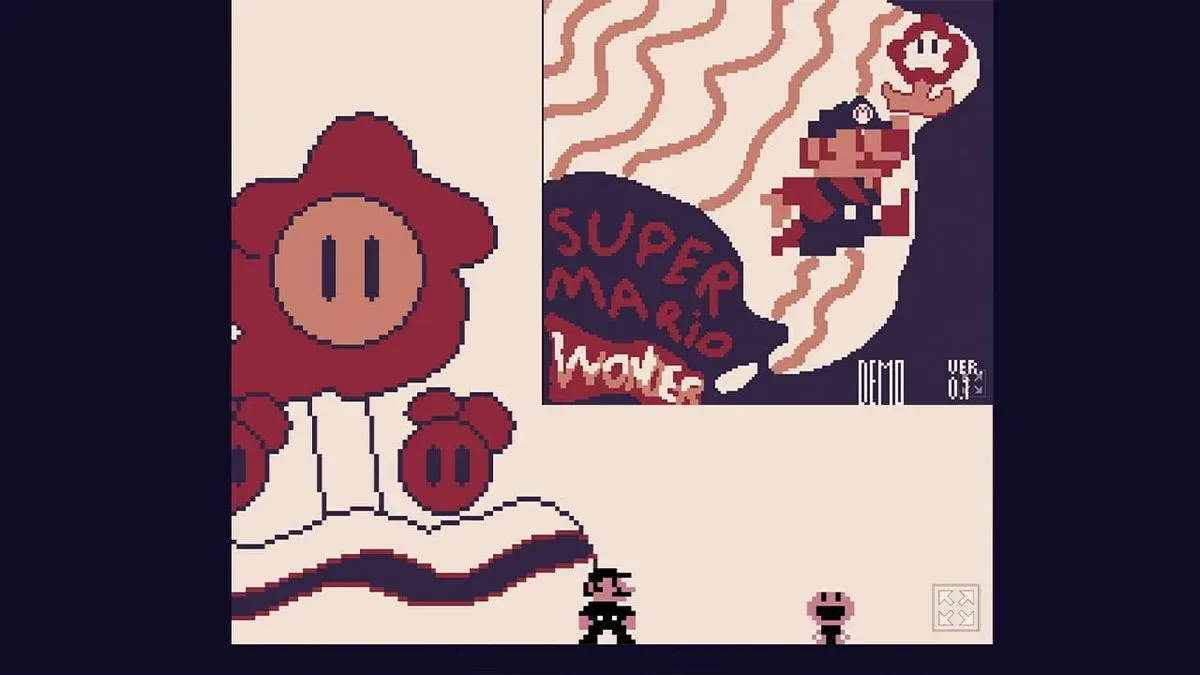
A fan-made Super Mario Bros. Wonder Game Boy demake is taking one of Nintendo's bright, busy modern platformers in a radically different direction: a compact, monochrome-style experiment inspired by the original Game Boy. The project, created by developer Ostakere, is currently a very short demo that can be played through a browser, but its appeal lies less in its length than in the process behind it.
Ostakere has been upfront about the prototype's rough edges. The current version is brief, janky by the creator's own admission, and takes roughly two minutes to finish. It is not attempting to be a complete recreation of Super Mario Bros. Wonder, nor is it presenting itself as a polished commercial-quality Game Boy release. Instead, it is a learning project made with GB Studio, the accessible development tool used to build games in the style of Nintendo's classic handheld.
One point the creator has emphasized is that the project was made without AI. That detail has become part of the discussion surrounding the demake because the game is framed as an individual developer learning a new craft step by step, rather than using generative tools to rapidly produce an approximation. In that sense, the small demo is as much about the developer's progress as it is about translating a recent Mario adventure onto 1989-era hardware constraints.
From a modern Mario game to original Game Boy limitations
Super Mario Bros. Wonder was designed around exuberance. Its colorful worlds, expressive animation, transforming stages, and Wonder Effects depend on ideas that would be difficult--or, in many cases, impossible--to reproduce directly on the original Game Boy. That hardware has a small screen, a limited color palette, restricted memory, and far less audio and visual flexibility than a Nintendo Switch title.
For useful background on this topic, read Xbox Hardware Spending Jumps 42% in October as Gears and GTA Interest Lift Sales.
A demake does not need to mirror every feature of its inspiration to be interesting. In fact, the challenge is usually deciding what to preserve when nearly everything must be simplified. A Game Boy reinterpretation can focus on a familiar movement feel, a compact level structure, recognizable enemies or visual cues, and the broader rhythm of a side-scrolling Mario stage. The goal is not necessarily exact replication. It is to imagine how an idea from a newer game might have been presented within older technical boundaries.
That makes Super Mario Bros. Wonder a particularly fitting candidate for this kind of fan experiment. The original game's identity comes partly from surprise, playful presentation, and constantly shifting expectations. A Game Boy version cannot reproduce the full spectacle, but it can explore how much of that playful spirit might survive through simplified layouts and design choices.
A deliberately small first step
The currently available build should be understood as an early prototype rather than a substantial fan game. Ostakere's demo is short enough to complete in approximately two minutes, and the developer has described it as an intentionally imperfect effort. That honesty is useful context for anyone going in expecting a full-length retro conversion.
There is still value in a short prototype, especially for someone new to a development environment. Before a creator can build a larger adventure, they need to work through basic but essential tasks: building a level, handling player movement, setting up collisions, placing objects, managing transitions, and making the game readable on a tiny screen. Even a simple platforming sequence represents a collection of design and technical decisions.
GB Studio has helped lower the barrier for creators interested in making Game Boy-style games, but it does not eliminate the work involved. Tools can make the process more approachable, yet an aspiring developer must still learn how to communicate rules to the player, how to arrange a stage, and how to identify and fix problems. A small, finished demo can teach more than an enormous plan that never reaches a playable state.
Ostakere has also suggested that community interest could influence whether the prototype receives additions or further updates. There is no confirmed scope for a future expanded version, and no promise that the project will become a complete adaptation. For now, it remains an early learning exercise with room to grow if its creator chooses to continue developing it.
Why demakes remain compelling
Demakes have long occupied a special place in retro-gaming communities. They can be technical showcases, affectionate tributes, design exercises, or simply playful alternate-history projects. The question at their center is easy to understand: what would a contemporary game look and feel like if it had arrived decades earlier?
Sometimes the answer is visual. Developers may redraw characters with a few shades of green, reduce elaborate backgrounds to sparse tile sets, and reinterpret detailed animation through a handful of frames. Sometimes it is mechanical. A modern open world might become a series of fixed screens, while a complex action game could be rebuilt as a much simpler top-down adventure. Other times, the most interesting part is the sound, as creators try to convert recognizable musical ideas into the limited channels available on old hardware.
There is also an important distinction between a demake and a straight port. A port attempts to move a game to another platform while retaining as much of the original as possible. A demake is more interpretive. It accepts that the older machine cannot do everything and uses those restrictions as a creative framework. The resulting game can feel less like a reduced version of a modern release and more like a parallel version from an imaginary past.
The Super Mario Bros. Wonder prototype fits squarely into that tradition. Its tiny scale means it cannot yet offer a definitive answer to what a full Game Boy version might have been. However, it provides a glimpse of the approach: take a familiar modern game, filter it through retro limitations, and see which parts remain recognizable.
The significance of making it without AI
Ostakere's decision to highlight the absence of AI use is notable in a moment when developers, artists, and players are actively debating what generative tools mean for creative work. The discussion can sometimes become overly broad, treating every use case as identical. This project presents a more specific perspective: a newcomer choosing to build skills through hands-on experimentation.
For a first-time or learning-focused project, the process is often the reward. Creating art assets, testing mechanics, making mistakes, and revising a level all contribute to an understanding that cannot be separated from the finished build. A generative shortcut might produce ideas or code-like output quickly, but it would not necessarily give the creator the same understanding of why a platforming sequence works, why a sprite is readable, or why a collision setup fails.
That does not mean a two-minute prototype must be judged as though it were competing with professionally produced games. It means its context matters. The demake is a visible record of someone practicing game creation with an established retro-focused toolset. The roughness is part of that record, not something to conceal.
The project's current form is modest, but it reflects a classic path into game development: start small, finish something playable, learn from it, and decide what to make next.
Browser play now, possible Game Boy compatibility later
The demo currently runs in a browser, making it easy for interested players to try without specialized hardware. Ostakere has said the game will probably work on a Game Boy, though that should be treated as a possibility rather than a confirmed final hardware release. Browser compatibility and physical hardware support are related but not identical goals, particularly when a project is still in development.
If the build does eventually run on original Game Boy hardware, that would add another layer of authenticity to the experiment. Playing on the original device means dealing with the hardware's screen, controls, and performance characteristics rather than merely viewing a retro-styled game through a modern browser. For many fans of homebrew development, that tangible connection is a major part of the appeal.
Still, the immediate takeaway is simpler: the demo exists, it is playable in its current online form, and it represents the beginning of a potential larger project rather than its final destination. Players who enjoy retro experiments should approach it with expectations suited to an early build.
A promising learning project, not a finished replacement
No short fan demake is going to replace Super Mario Bros. Wonder, and it does not need to. Nintendo's Switch game is built around an enormous amount of polished content, visual variety, and inventive design. Ostakere's Game Boy-inspired version is operating on a completely different scale and for a different purpose.
What makes it worth watching is the enthusiasm behind it. The developer has chosen an ambitious piece of inspiration, acknowledged the current prototype's limitations, and shared it while learning GB Studio in public. That is often how hobbyist projects develop: a tiny proof of concept earns feedback, the creator gains confidence, and later versions become more capable.
For now, the Super Mario Bros. Wonder Game Boy demake is a short, rough, and distinctly personal retro experiment. Its two-minute runtime is not the whole story. The more interesting part is the possibility of what Ostakere may learn--and potentially add--after this first small jump.
Community
Discussion
Start the conversation.
No comments have been posted yet.