

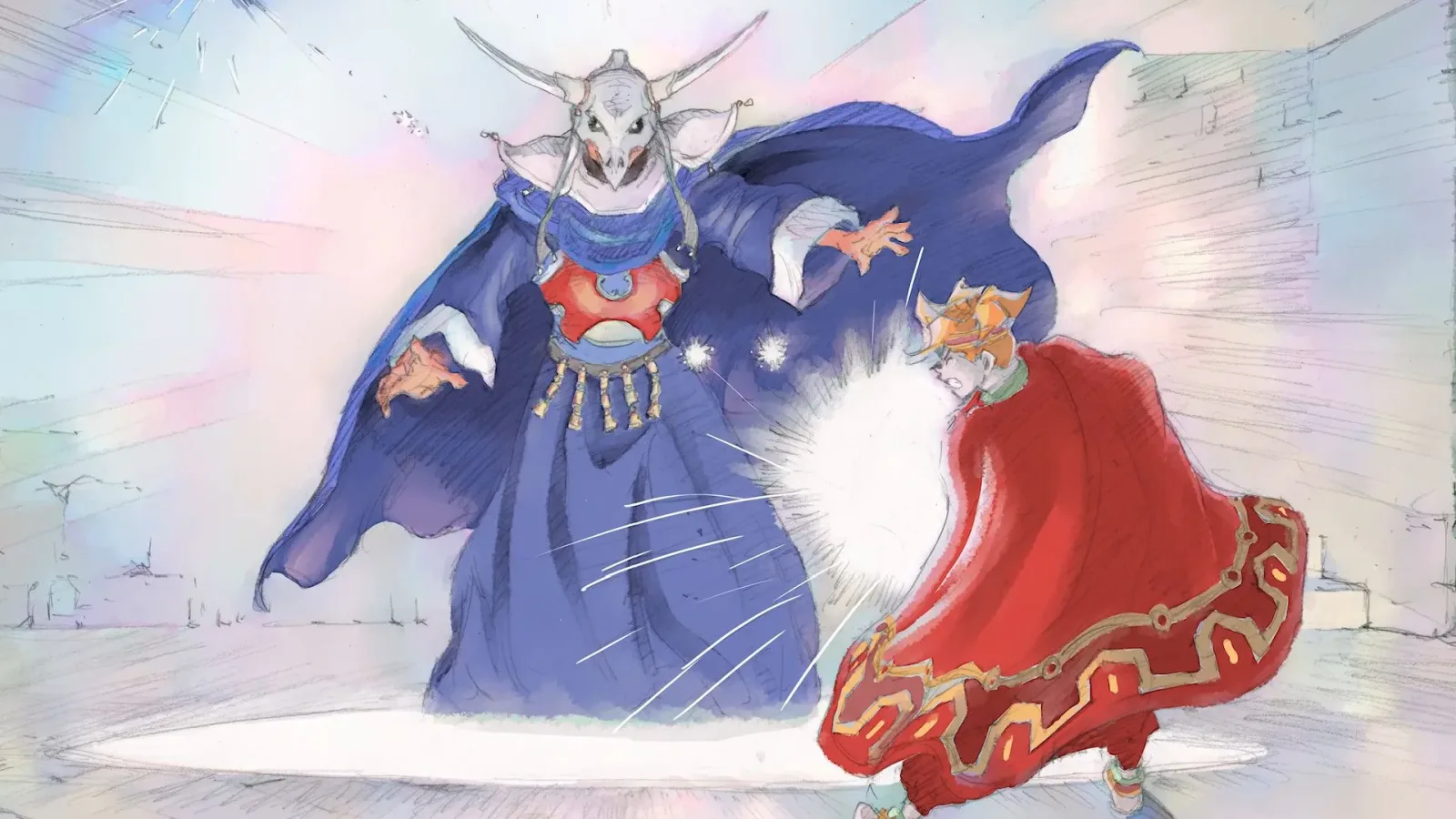
Terranigma, one of the most celebrated and elusive 16-bit action RPGs, is set to return on January 14 in a remastered edition that will also bring it to North America for the first time. The revival covers a notably wide range of platforms: PlayStation 5, PlayStation 4, Xbox Series X/S, Switch 2, Nintendo Switch, PC via Steam, and PC via GOG.
For a game that has spent decades outside official North American availability, the announcement is significant on its own. The more encouraging detail, however, is the approach being taken with the remaster. Rather than replacing the older game wholesale, the new release will provide an Original Mode aimed at preserving the original balance and save structure, plus an Arranged Mode that adjusts progression and difficulty while adding conveniences expected from a modern retro re-release.
Physical editions are planned for the current console versions. Collectors looking for the largest package can choose the $200 Gaia Edition, which includes a Yomi figure, music box, art book, cloth world map, soundtrack CD, and additional items. Pre-orders are being handled through Limited Run Games in the United States and through Clear River Games in Europe.
A major return for a long-missing 16-bit RPG
Originally developed by Quintet and published by Enix, Terranigma arrived during the Super Nintendo era, though its history has always been complicated by regional availability. Quintet was also responsible for other well-regarded games of the period, including ActRaiser and Illusion of Gaia. Enix, of course, later became one half of Square Enix.
For useful background on this topic, read PS5 Disc Drives Gain New Appeal as Players Reconsider Physical Games.
Yet while its reputation endured through word of mouth, imports, and the wider retro-game community, Terranigma never received an official North American launch at the time. That made it an especially conspicuous absence in a genre full of heavily revisited Super Nintendo classics. Licensing questions and the passage of time appeared to leave the game in a difficult position, with no straightforward path to an official revival.
This January release changes that. More importantly, it does not appear to treat the game merely as a museum piece. The announced feature set suggests an effort to make an older design more approachable without taking away the option to experience it in a form close to its original presentation.
Original Mode prioritizes the classic structure
The remaster's Original Mode is built around "untouched balance" and the game's original save system. That distinction matters for players who want the challenge curve, resource management, and general rhythm of the Super Nintendo release to remain intact. Retro reissues can sometimes alter fundamental pacing in the name of accessibility, changing the feel of an RPG even when its story and levels remain the same. Preserving an unaltered balance option gives returning players confidence that the original structure is still there.
Original Mode will not be completely bare-bones, though. The remaster adds a sidebar next to the 4:3 gameplay display. This area shows current money and experience, placing information that may otherwise require menu navigation in a more immediately readable position. It also introduces quick-access controls for switching equipped items.
Those may sound like small refinements, but they can have a substantial effect in an action RPG. Easy item swapping can reduce interruptions during exploration and combat, while a persistent display of currency and experience gives players a clearer sense of their immediate progress. Crucially, these additions aim to streamline interaction rather than rewrite encounters, character growth, or the game's broader systems.
The result is a potentially useful middle ground. Players can retain the original rules while benefiting from interface improvements that were not practical or common in the 16-bit era. It is an approach that recognizes fidelity is not always the same as forcing every limitation of old hardware and old interface conventions onto modern players.
Arranged Mode brings modern safety nets
Players who would rather have a less rigid experience can select Arranged Mode. This alternative includes enhanced progression and adjusted difficulty, although the full details of those changes have not been outlined. The wording leaves room for a wide range of possibilities, from smoother advancement to a revised challenge curve intended to reduce friction for newcomers.
What has been confirmed is the inclusion of quick saves and rewind functionality. Both have become increasingly common in retro compilations and remasters, and they can dramatically lower the barrier to entry for games designed around older save limitations. Quick saves are especially helpful when playing in shorter sessions, while rewind makes it possible to recover from a mistake without repeating a long section.
Purists will naturally have the option to stay with Original Mode, but the presence of a clearly separated arranged option is valuable. It allows the release to serve people discovering Terranigma for the first time, including those who may not have the patience for every convention associated with 1990s console RPG design. Providing separate paths is often more respectful than imposing a single modernized version on every player.
The remaster also adds a minimap showing the player's location within the current area. For an adventure built around exploration, this could be one of the most consequential changes. A map does not necessarily solve every puzzle or reveal every secret, but knowing one's position can remove the kind of disorientation that can turn exploration from exciting into exhausting. It is a practical tool for both first-time players and veterans returning after years away.
A model for handling classic RPGs?
The feature list highlights a recurring debate around remasters of older role-playing games: how much should be changed, and how much should be left alone? There is no universal answer. Some players want restored visuals and exactly the same systems they remember. Others want faster menus, improved navigation, flexible saving, rebalanced encounters, and tools that acknowledge how people play games today.
Terranigma appears positioned to offer both perspectives. Original Mode preserves its legacy-minded foundations, while Arranged Mode provides an alternate route with progression, difficulty, quick-save, and rewind changes. At the same time, the new sidebar, item shortcuts, and minimap demonstrate that usability upgrades do not have to be treated as enemies of authenticity.
That design philosophy is particularly notable when compared with other major 16-bit RPG revivals. Square Enix's Final Fantasy Pixel Remaster line has given players accessible versions of foundational games, but its visual and gameplay changes have not appealed equally to every longtime fan. For some, a stronger remaster model is one that offers meaningful optional tools while keeping the original balance and core identity readily available.
Terranigma's two-mode setup could provide that kind of compromise. Its success will ultimately depend on execution, including how extensive the arranged changes prove to be and whether the new interface features feel unobtrusive. Still, the announced options point toward a release that understands different audiences have different priorities.
The Gaia Edition is built for dedicated collectors
Alongside the standard release, the Gaia Edition targets fans who have waited years for an official return. At $200, it is a premium collector's package rather than a casual purchase, but its contents are substantial. The set includes a Yomi figure, a music box, an art book, a cloth world map, and a soundtrack CD, along with further extras.
The physical console editions will be available across the supported console lineup, while the PC release is planned for both Steam and GOG. That gives the re-release unusually broad coverage across current gaming ecosystems, from PlayStation and Xbox players to Nintendo audiences and PC collectors.
For many fans, the central appeal will not be the expensive edition or even the newly added conveniences. It will be the simple fact that a revered game, long absent from official North American shelves and storefronts, is finally receiving a legitimate and thoughtfully considered return.
Terranigma launches January 14 for PS5, PS4, Xbox Series X/S, Switch 2, Nintendo Switch, Steam, and GOG. Between its preservation-focused Original Mode and accessibility-minded Arranged Mode, the release is shaping up to give one of the Super Nintendo era's most overlooked RPG landmarks a much broader second life.
Community
Discussion
Start the conversation.
No comments have been posted yet.