

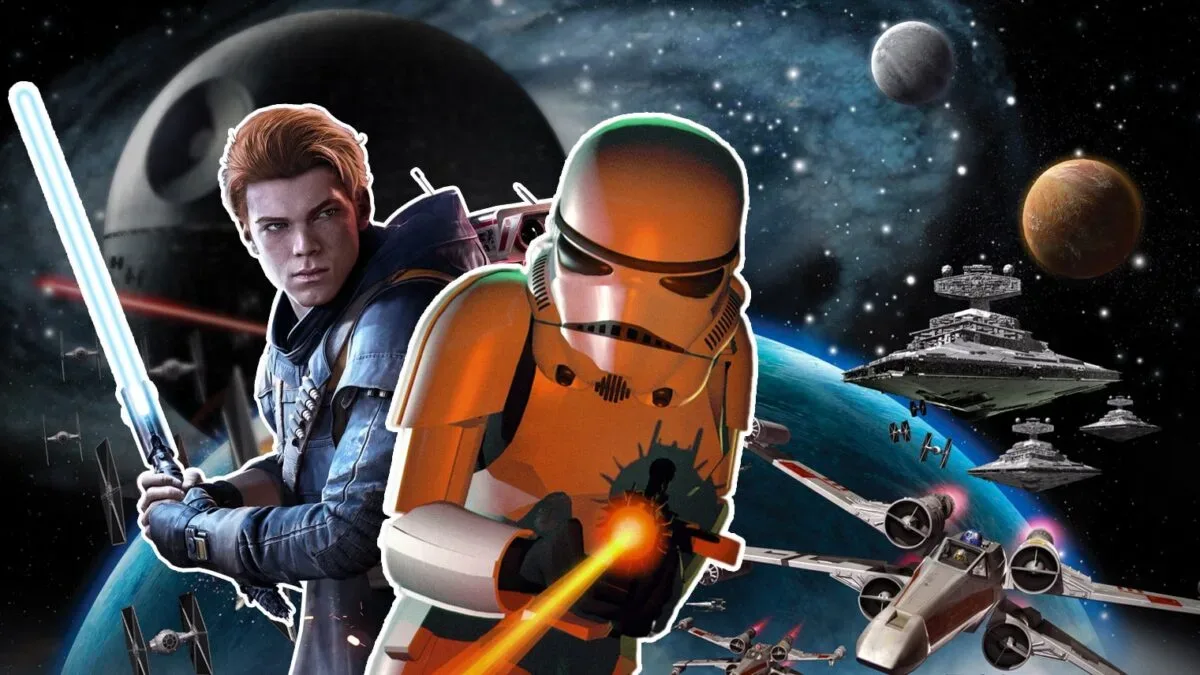
May the Fourth is once again a natural excuse to revisit one of gaming's most unusually broad licensed catalogs: Star Wars. The franchise has appeared in games for decades, across arcade cabinets, home consoles, computers, handhelds and modern multi-platform releases. That history makes any conversation about the best Star Wars games both entertaining and nearly impossible to settle.
There is no single definition of what a great Star Wars game needs to be. For some players, the ideal experience means piloting an X-wing through a desperate space battle. Others want a lightsaber duel, a tactical campaign, a podrace, an arcade blaster, or a playful co-op adventure built out of plastic bricks. A game can capture the atmosphere of the films with cinematic action; it can also succeed by using the setting as a foundation for strategy, racing, flight simulation or role-playing systems.
That variety is why the very best entries continue to inspire debate long after their original releases. The strongest Star Wars games do more than place familiar characters, spacecraft and sound effects into an established genre. They make players feel as though they are participating in a corner of the galaxy far, far away. Sometimes that means wielding a blaster in cramped Imperial corridors. Sometimes it means managing armies. Sometimes it means simply surviving one more frantic lap at impossible speed.
There is no one platform for Star Wars greatness
A broad all-time discussion has to account for more than one generation of players. Star Wars games have been important on PC, Nintendo systems, PlayStation platforms, Xbox hardware, handheld devices and retro machines. Ports, remakes and revisions complicate matters further. A player who remembers a game from a particular console may have encountered a different version from somebody who played it on a computer or another machine entirely.
For useful background on this topic, read The Best Games of 2025 So Far: A Crowded Year Nears Its Finish.
That does not make comparisons meaningless. It does mean that technical fidelity, controls and available features should be considered in context. An older release does not need to look or play like a current blockbuster to remain exceptional. Likewise, a newer game cannot rely on modern production values alone. Longevity comes from a memorable core loop, confident use of the Star Wars setting and enough character to keep players returning after the novelty of seeing a familiar universe has faded.
It is also worth recognizing that licensed games are judged differently from wholly original properties. Faithfulness matters, but it is not everything. A game can be deeply respectful of Star Wars and still be dull. Conversely, an imaginative reinterpretation can be successful if it understands the joy, scale and drama that audiences associate with the franchise. The best examples find a balance: they feel recognizably Star Wars while remaining worthwhile games in their own right.
Dark Forces and the appeal of the Star Wars blaster fantasy
Star Wars: Dark Forces remains a key name in any discussion of the franchise's gaming history. Its importance comes partly from its place among early first-person action games, but its lasting appeal is rooted in the fantasy it offers. Rather than centering only on the saga's most famous heroes, Dark Forces lets players approach the universe through a more grounded blaster-wielding perspective.
That point of view changes the feel of Star Wars. The galaxy is not only a place for grand Jedi destinies and climactic starfighter runs; it is also filled with bases, troopers, secrets, machinery and dangerous missions. Dark Forces helped demonstrate how well the setting could support tense on-foot action. Its identity is built around exploration and combat, making Imperial installations feel like places to infiltrate instead of scenery to admire from a distance.
Its legacy also reflects the value of games that expand a fictional universe through play. Star Wars is full of visual and audio cues that players instantly understand: humming equipment, recognizable weapons, ominous architecture and the contrast between the Empire's harsh order and the scrappier side of rebellion. Dark Forces could draw on that language while giving players active control over the action. For many fans of retro PC gaming, that remains a powerful combination.
Rogue Squadron proves that flying is central to the fantasy
If Dark Forces represents the blaster side of Star Wars, Rogue Squadron 2 represents the dream of climbing into a cockpit. Starfighter combat is inseparable from the franchise's identity, and a game built around aerial and space action has a direct route to the excitement of the films. The appeal is immediate: iconic ships, high-speed maneuvering and missions where one well-timed attack can turn a battle.
Rogue Squadron 2 is regularly remembered as an especially strong example of that formula. Its reputation speaks to how difficult it is to make a flight-focused game feel accessible without losing the sense that the player is operating a powerful but demanding machine. The most memorable Star Wars flight games create a feeling of motion and danger while still letting players appreciate the scale of the conflict around them.
There is also something uniquely satisfying about Star Wars vehicle design in interactive form. The franchise's ships are recognizable silhouettes, from the practical military shapes of rebel craft to the disciplined menace of Imperial hardware. A successful flight game turns those shapes into responsive tools. It gives the player reasons to learn how they move, where they are vulnerable and what kind of mission each vehicle fantasy can support.
Galactic Battlegrounds takes the conflict to a larger scale
Star Wars: Galactic Battlegrounds is an important reminder that a galaxy-wide war can work just as well as a strategy experience as it can as direct action. Rather than focusing on a single hero or vehicle, strategy games ask players to think in terms of territory, resources, units and long-term decisions. That is a compelling fit for a setting defined by rival factions, planetary campaigns and military escalation.
The strategic perspective offers something action games cannot: command. Players are not merely surviving a sequence of encounters; they are considering how forces should be assembled and deployed. For fans who enjoy the political and military side of Star Wars, that structure can be every bit as immersive as holding a lightsaber or firing from a cockpit.
Its inclusion among notable Star Wars games also illustrates the franchise's flexibility. The setting is large enough to accommodate intimate stories, but it is also large enough to support the logistics of conflict. Galactic Battlegrounds shows why the catalog should not be narrowed to action-adventure releases alone. The best games use genre to reveal a different facet of the same universe.
Racing games bring speed, spectacle and a different kind of competition
Racer Revenge and Jedi Starfighter underline another major strength of Star Wars games: they can translate cinematic spectacle into focused arcade-style play. Racing is a natural match for a universe packed with exotic worlds, dangerous courses and vehicles designed to look fast even when standing still. A great Star Wars racer has to sell velocity, but it also needs routes and handling that make improvement feel earned.
Racer Revenge is a reminder that the franchise can support competitive, repeatable gameplay outside the usual combat formats. Players can chase faster times, learn tracks and master risk-reward decisions in a way that differs completely from a campaign-driven adventure. The setting adds personality, but the racing still has to work on its own terms.
Jedi Starfighter, meanwhile, belongs to the enduring tradition of Star Wars games that put aircraft-like vehicles at the center of explosive encounters. Its presence alongside Rogue Squadron 2 shows that there is room for more than one approach to flight combat. Different hardware, control styles, campaign structures and eras of the saga can all shape how a starfighter game feels.
Lego Star Wars shows the value of a lighter touch
Newer entries such as Lego Star Wars have earned their place in the broader conversation by taking a radically different tone. Where some Star Wars games seek drama, danger or simulation-like intensity, Lego Star Wars embraces comedy, collectability and approachable cooperative play. It treats familiar moments with affection while making room for slapstick and experimentation.
That approach matters because it broadens the audience without reducing Star Wars to a checklist of references. The Lego interpretation works when its playful mechanics and visual humor complement the material rather than simply borrowing its costumes and locations. It gives families, younger players and co-op partners an inviting way to explore stories that can otherwise feel intimidatingly vast.
The existence of Lego Star Wars beside Dark Forces, Rogue Squadron 2 and Galactic Battlegrounds is evidence of how unusually adaptable the license has been. These games are not trying to deliver the same emotional experience. They do not need to. Each succeeds by identifying a particular fantasy within Star Wars and building systems around it.
Why rankings will never be final
Any top-ten list will leave out games that deserve passionate defenders. Star Wars Arcade, Rogue Squadron 2, Galactic Battlegrounds, Racer Revenge and Jedi Starfighter are all examples of titles that remain worthy of recognition even when a strict ranking forces difficult cuts. Players will naturally value different qualities: historical influence, technical achievement, replayability, storytelling, local multiplayer, personal nostalgia or simply the thrill of hearing a familiar sound effect at exactly the right moment.
That disagreement is not a weakness of the catalog. It is proof of its range. Star Wars games have survived changing hardware and shifting design trends because the underlying universe contains so many playable fantasies. Players can be smugglers, pilots, commanders, racers, droids, Jedi or ordinary fighters caught in extraordinary conflicts. Few film franchises have provided such a wide set of interactive possibilities over so many years.
So the best Star Wars games are not defined solely by whether they reproduce a favorite scene. They are the releases that understand what makes that scene exciting, then turn that excitement into something players can control. Whether the goal is clearing a hostile corridor, winning a race, directing a campaign, surviving a dogfight or laughing through a cooperative adventure, the enduring standouts make the galaxy feel alive.
And that is why the debate is likely to continue every May the Fourth and well beyond it. The definitive ranking may never exist, but the games that inspire the loudest arguments are usually the ones that gave players the strongest reason to believe they had briefly stepped into Star Wars themselves.
Community
Discussion
Start the conversation.
No comments have been posted yet.