

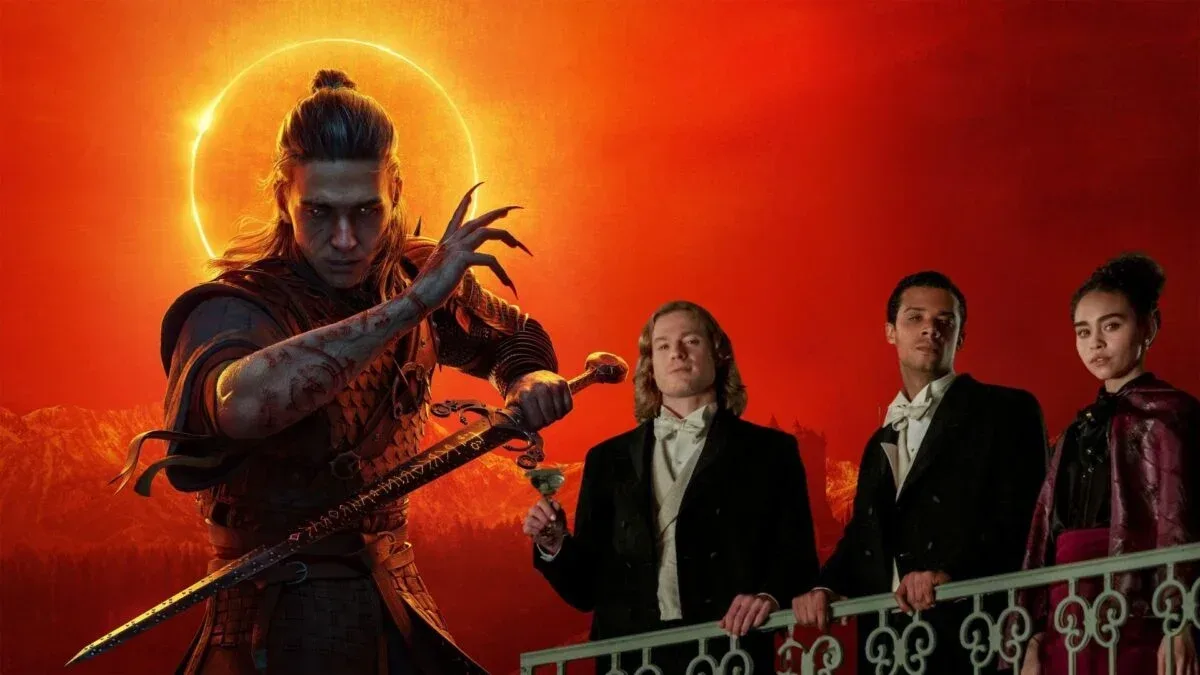
The Blood of Dawnwalker already has plenty of dramatic vampire material to work with: a cursed protagonist, a family in danger, a cruel ancient ruler, religious spectacle, supernatural hunger, and a clock counting down toward catastrophe. But the game's first several hours also leave room for quieter business. There are villagers to meet, work to do, animals to find, supplies to gather, and a medieval world to understand before the major bloodshed begins.
That mixture of intimate RPG routine and operatic undead melodrama makes it especially entertaining to imagine how a particularly opinionated group of vampires might respond. In a playful crossover setup, Daniel Molloy, Armand, Louis de Pointe du Lac, Lestat de Lioncourt, and Claudia de Lioncourt de Pointe du Lac gather to watch the opening seven hours of Rebel Wolves' game. Their reactions turn into a running argument over vampire aesthetics, religious hypocrisy, family, romance, immortality, and--naturally--the question of whether a hero can really be expected to defeat an ancient vampire lord within a month.
A medieval vampire story begins with a very human crisis
The Blood of Dawnwalker is set in a world shaken by plague and social collapse. Its protagonist, Coen, is not introduced as an all-powerful immortal already standing above humanity. He begins as someone caught in a crisis affecting his family and his community, with vampirism becoming both a source of strength and a terrifying complication.
That context immediately invites commentary from viewers accustomed to vampire stories where transformation is never merely a power-up. Louis is alarmed by the prospect of a child receiving the "Dark Gift," while Claudia sharply objects to being patronized. Their exchange underlines one of the enduring tensions in vampire fiction: physical transformation may stop aging, but it does not resolve the trauma, anger, or loss that came before it.
For useful background on this topic, read Tetris Company Disavows White House 'Build the Wall' Game and Flags Copyright Concerns.
Lestat, meanwhile, is less interested in moral caution than in the setting's potential for spectacle. A story unfolding in the aftermath of the Black Plague is exactly the sort of historical upheaval that should be irresistible to him, even if he affects boredom at first. The game's grim medieval backdrop gives its vampire premise a different texture from contemporary urban stories. Disease, poverty, fear, and religion are not simply scenery; they shape how ordinary people interpret the arrival of something monstrous and powerful.
Not every early-game task has fangs
One of the funniest objections raised during the imagined play session comes when the opening hours ask Coen to do decidedly unglamorous things. Chopping wood and searching for a lost pig do not immediately resemble the work of a legendary vampire hunter--or a newly cursed figure headed toward a collision with an immortal tyrant.
Daniel, the journalist of the group, wonders whether this amounts to a medieval "Peasant Simulator." Claudia is equally impatient for the vampire plot to return. Yet these quieter tasks serve an important purpose in a role-playing game built around a threatened family and a vulnerable settlement. Before Coen becomes extraordinary, the player needs a sense of the ordinary life endangered by the broader conflict.
There is also a practical contrast at work. The Blood of Dawnwalker is not only about having supernatural abilities; it is about navigating the demands of a world that still expects labor, favors, exploration, and human connection. A game can ask players to deal with everyday concerns precisely so later displays of blood magic, flight, or monstrous violence feel more disruptive. The mundane moments may not satisfy vampires who want instant intrigue, but they make Coen's changing place in the world more legible.
The Blood Mass and the vrakhiri's violent ritual
When the Blood Mass begins, the game gives its vampire threat a public, ritualized face. The vrakhiri are not presented as a secretive lone predator lurking in an alley. Their power is tied to a larger social and religious structure, one capable of turning fear and authority into something organized.
Lestat is immediately cynical about the use of religion to excuse terrible acts, calling the idea familiar and tiresome. Armand, with his own history involving the Children of Satan, finds himself dragged into an uncomfortable comparison. The joke works because both reactions point to a recognizable vampire-fiction theme: supernatural monsters frequently justify themselves through institutions, doctrines, or grand moral narratives.
Claudia, however, is more interested in the mechanics of transformation. The vrakhiri's method requires the vampire to remove one of its fangs and use it to pierce a human heart. It is a grisly process, deliberate rather than seductive, and it makes vampirism feel bodily and costly. Rather than treating a bite as a simple exchange of blood, the ritual builds violence into the very act of creating another vampire.
That detail earns Claudia's approval because it has intention. Transformation is not an accident and not a vague mystical flourish; it is a conscious act with physical consequences. In a game where vampirism is intertwined with power struggles and survival, that brutality fits the setting.
Coen's curse creates a useful daylight twist
Coen's unusual condition is central to the game's premise. Exposure to silver has left him with an affliction that changes his relationship with daylight. Rather than simply burning under the sun like a conventional vampire, he can move during the day because of this sickness, even as it remains a serious part of his condition.
Daniel sums up the idea with a blunt medical comparison: the protagonist's silver-related illness functions as a clever explanation for why he can operate in daylight. The observation highlights one of The Blood of Dawnwalker's more distinctive narrative tools. Coen is caught between states. His curse gives him access to abilities and circumstances unavailable to an ordinary human, but it does not remove his vulnerability.
That vulnerability becomes the subject of another argument when Coen can still die, including from an animal attack. Lestat questions why a person granted vampiric healing would remain susceptible to being mauled by a bear. Daniel's answer is a familiar gaming one: it may simply be a matter of player performance.
The exchange gestures toward a basic challenge for supernatural RPGs. If a protagonist has too much power too early, danger disappears. If they have too little, the vampire premise loses its impact. The Blood of Dawnwalker's early design appears to embrace that unstable middle ground. Coen can be remarkable without being invincible, and his condition opens new possibilities without freeing him from every earthly threat.
Power, hunger, and a limited time to save a family
The game's central pressure point is its 30-day limit. Coen must find a way to save his family while facing the influence of an ancient vampire lord. That deadline draws the strongest skepticism from Armand, who questions whether a newly made vampire could reasonably gain enough strength in such a short span to challenge an elder opponent.
It is a fair concern from someone who views immortality in decades and centuries. The difference between a fledgling and an ancient vampire is usually enormous in vampire fiction, measured not just in raw power but in knowledge, influence, patience, and experience. A 30-day mission therefore gives The Blood of Dawnwalker a deliberately urgent fantasy structure: Coen does not have the luxury of waiting until he is fully prepared.
Louis responds to the situation through the game's emotional core. Before Coen can indulge every possibility offered by his new state, he has people to rescue. That sense of obligation separates the protagonist from vampires who might treat immortality as freedom from human attachment. Lestat predictably dismisses family concerns, only to be reminded of his own complicated history.
The group's comments also touch on blood hunger. Lestat recognizes the impulse to drain someone close in the middle of an otherwise ordinary conversation, identifying it as one element the game gets right. Hunger is more interesting when it is not limited to combat. If vampirism is going to matter as a condition, it should intrude on relationships, decision-making, and moments that would otherwise be safe.
A promising setup for vampire RPG drama
The first seven hours of The Blood of Dawnwalker appear designed to establish both sides of Coen's existence. He is a son trying to protect his family in a damaged world, but he is also becoming something dangerous. He can take on practical tasks in a village one moment and confront the rituals of a vampire regime the next. He may have access to extraordinary gifts, including the ability to fly, but he still carries a curse, a deadline, and the risk of failure.
For this imagined audience of immortal critics, the game earns points for its violent transformation ritual, its hunger-driven vampire behavior, its witchy suspicions, and its willingness to place personal drama inside a larger structure of plague, belief, and oppression. It also earns complaints for making players do chores, granting unusual powers to a fledgling, and asking audiences to accept a rapid rise against an ancient enemy.
Those disagreements are part of the fun. Vampire stories have always invited arguments about rules: who can walk in daylight, how transformation works, whether immortality heals anything emotional, and how much power a young vampire should possess. The Blood of Dawnwalker is entering that tradition with its own answers--and, if this chaotic couch-side panel is any indication, answers provocative enough to keep the undead talking.
Community
Discussion
Start the conversation.
No comments have been posted yet.