

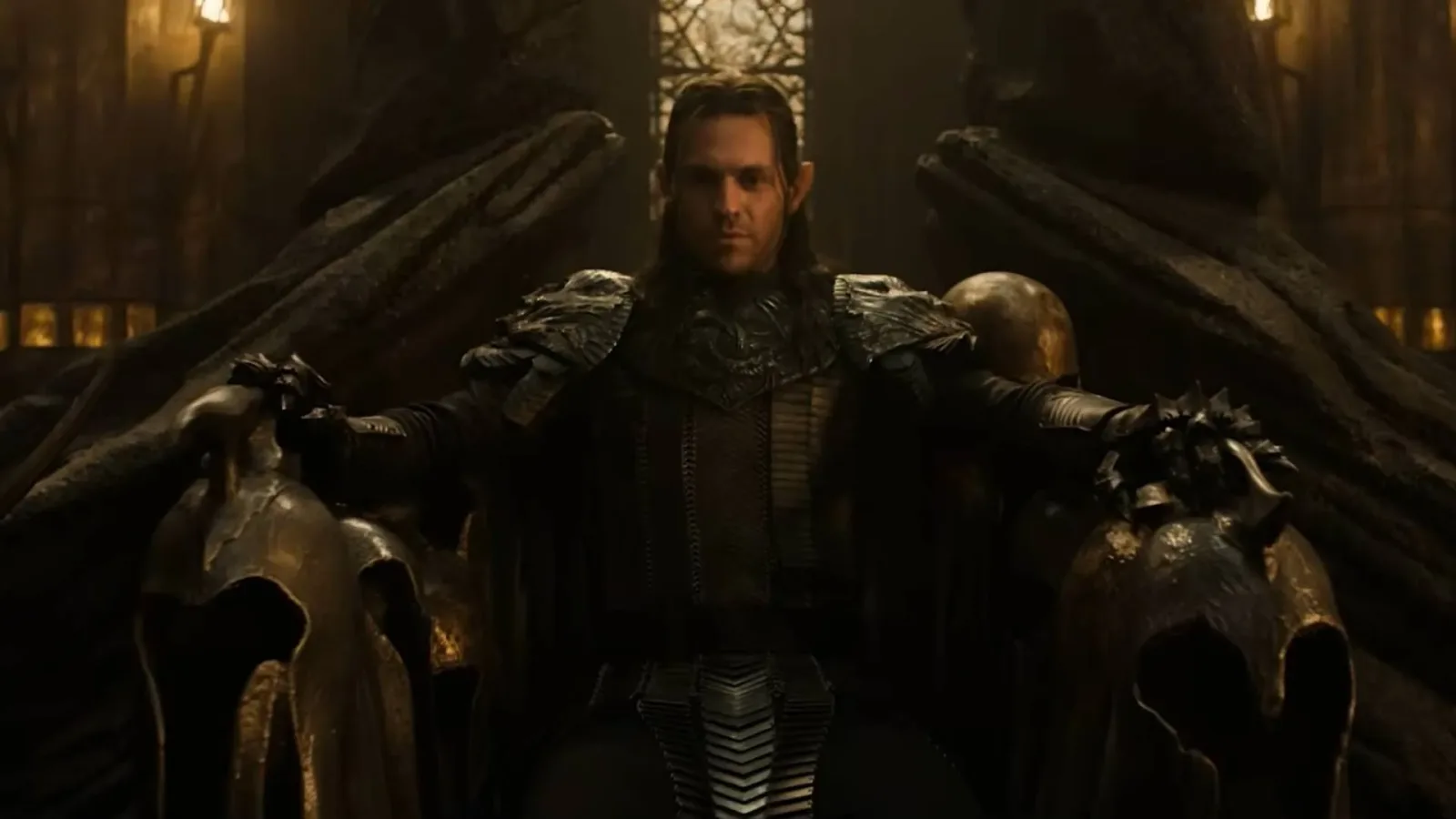
Warning: This article contains major spoilers for The Rings of Power season 3, including the ending of episode 4.
The Rings of Power season 3 has reached a brutal turning point. Episode 4, one of the first four installments released on Prime Video, ends with the death of Arondir, the elf whose story has long been tied to the Southlands, Bronwyn, and her son Theo. The loss is not simply another casualty of Middle-earth's widening war. It is a deeply personal tragedy, because Theo is the one who kills him.
The sequence brings together several major threads at once: Sauron's growing power, Galadriel's dangerous mission, the return of Celeborn, the corrupting force of the evil rings, and Theo's apparent descent into something far darker than the troubled young man audiences have known. Arondir's death is therefore both an emotional farewell and a potentially pivotal event for the larger Second Age conflict.
Arondir dies in the season 3 episode 4 climax
Arondir is killed during an expedition to Mount Gundabad, a threatening orc stronghold in the mountains. He travels there alongside Galadriel and Marnûkh, the orc who has become an unlikely companion on the mission. Their purpose leads them into the fortress itself, where the group makes a startling discovery: Celeborn, Galadriel's husband, is alive after having been missing for centuries.
For useful background on this topic, read Rockstar Says 'Never Say Never' to a Grand Theft Auto Set Outside America.
That revelation alone would be a major development for Galadriel's story. Instead, it becomes part of a desperate escape from a place filled with danger. As the party tries to flee Mount Gundabad, they are confronted by one of the Nazgûl. The masked figure is then revealed to be Theo.
The sight leaves Arondir shaken. Theo is not merely a familiar face caught on the wrong side of a conflict. He is Bronwyn's son. Bronwyn, Arondir's human lover, died in season 2, and Arondir has occupied an important place in Theo's life. Their relationship has carried an unmistakable father-and-son dimension, even if it has never been uncomplicated.
In this confrontation, Theo urges Arondir to leave. Arondir has a chance to escape, but the shock of seeing Theo transformed and aligned with the Nazgûl prevents him from simply taking that opportunity. His hesitation is understandable. He is facing the son of the woman he loved, a young man he has tried to protect, now standing before him in the presence of evil.
Sauron turns Theo into the weapon that kills Arondir
The situation becomes even more hopeless when Sauron arrives. His attention is not fixed on Arondir. Instead, Sauron's priority is Galadriel, whom he wants to capture. Arondir is treated as an obstacle of little consequence, and Sauron gives Theo a direct order: kill him.
Theo is wearing one of the evil rings, and the command is followed immediately. He runs Arondir through with his sword, seemingly under Sauron's influence or compulsion. Arondir falls, bringing his long story to a sudden and merciless conclusion.
It is an especially cruel outcome because the death does not arrive during a grand battle against an anonymous enemy. Arondir is murdered by someone whose life has been intertwined with his own. The scene turns their bond into a source of pain, with Sauron effectively exploiting Theo's corruption to destroy someone who once served as a protector and parental figure.
Arondir's final conflict is not about whether he can defeat an enemy in combat. It is about whether he can bring himself to abandon Theo after seeing what has been done to him.
That distinction makes the moment land differently from a conventional heroic sacrifice. Arondir's inability to run is not framed as a simple tactical error. It comes from compassion, grief, history, and the possibility--however faint--that Theo might still be saved. Sauron uses that vulnerability with devastating efficiency.
Galadriel and Celeborn escape, but the danger is far from over
Arondir's death gives Galadriel and Celeborn the chance to get away. The pair escape on the back of an eagle, moving beyond Sauron's immediate reach. For Galadriel, the escape is significant for more than one reason. She has regained Celeborn after centuries of believing him lost, but that reunion is inseparable from the violent loss of Arondir.
The episode's ending places Galadriel in a newly complicated position. Celeborn's return changes her personal story and introduces questions about where he has been, what he has endured, and how the two will navigate the war against Sauron together. At the same time, Galadriel has now witnessed the destruction of another ally at the hands of a corrupted Theo.
The eagle escape also ensures that the confrontation remains unfinished. Sauron fails to take Galadriel, but his influence has still produced a major victory. He has removed Arondir, strengthened the sense that Theo is no longer acting freely, and demonstrated the terrifying reach of the rings in his service.
For the surviving characters, leaving Mount Gundabad does not solve the central crisis. It only postpones the next encounter. Sauron remains focused on Galadriel, Theo remains within the Nazgûl's orbit, and the consequences of Arondir's death will likely follow every member of the group that escaped.
Why Arondir's death matters so much
Arondir has been one of the show's key original elven characters. His perspective connected the series' sweeping conflicts to the people trying to survive them, especially in the Southlands. He was defined by loyalty, restraint, and a willingness to stand between vulnerable people and overwhelming threats.
His relationship with Bronwyn gave his story another layer. Their love crossed the divide between elf and human, while Theo introduced a difficult but meaningful family dynamic. Bronwyn's death in season 2 had already left a profound absence. Now, with Arondir gone as well, Theo has lost both of the central figures who could have anchored him to a better path.
That does not necessarily mean Theo's fate is settled. The episode presents his attack on Arondir in the context of an evil ring and Sauron's order, making the degree of Theo's agency an essential question. He performs the act, but the scene strongly suggests that he is being controlled, manipulated, or driven by a power beyond his ability to resist.
Still, the murder cannot be separated from the emotional weight of their shared history. Theo is left carrying--or being forced to carry--the act of killing a man who loved his mother and had become a kind of father figure to him. Whether he can ever return from that point is one of season 3's most consequential mysteries.
Theo's Nazgûl future becomes an even bigger question
The reveal of Theo as one of the Nazgûl intensifies long-running speculation around his eventual place in Sauron's forces. In Middle-earth history, the Witch-king of Angmar stands as the leader of the Ringwraiths. Theo's trajectory now appears to point more strongly toward that possibility, though it has not been confirmed that he will become the Witch-king.
Episode 4 supplies reasons to wonder. Theo is already associated with the Nazgûl, wears an evil ring, and commits a terrible act under Sauron's command. If Arondir's death drives him further into despair, fear, or dependence on the power of the ring, it could mark another stage in his transformation.
There is also a grim narrative logic to the idea. Theo began as a young character exposed to darkness and temptation, and his story has repeatedly placed him near the consequences of Sauron's influence. The loss of Bronwyn and now the killing of Arondir create an emotional void that Sauron could exploit. A figure who offers power, certainty, or relief from pain can be especially dangerous to someone who has been left isolated by grief.
However, season 3 has not completed Theo's story. The fact that he tells Arondir to leave before Sauron appears may matter. It may indicate that some part of Theo remains aware of what is happening and does not want Arondir harmed. The tragedy is that this impulse is overwhelmed once Sauron takes control of the moment.
A shocking loss at a crucial point in season 3
The first four episodes of season 3 establish multiple storylines, including Sauron's effort to discover the secret of the Elven rings, unrest and rebellion in Númenor, and the unexpected arrival of Durin's brother. Yet Arondir's death at the end of episode 4 stands apart because it condenses the season's larger concerns into one awful decision.
Power is used to corrupt. Love and loyalty become weaknesses for a ruthless enemy to exploit. Characters are separated from the people who might save them. And even a narrow escape comes at a terrible cost.
Arondir almost leaves Galadriel and Marnûkh behind earlier in order to search for Theo, only to return and help them. That choice underlines who he is until the end: someone unable to ignore people in danger, even when doing so would be safer. His final moments preserve that defining quality, but they also show how devastatingly expensive compassion can become in Sauron's Middle-earth.
With Arondir gone, Galadriel and Celeborn alive but on the run, and Theo seemingly bound to darkness, season 3 has positioned its remaining episodes around a painful uncertainty. The immediate tragedy is clear. What remains unknown is whether Theo can be saved, whether Sauron's hold can be broken, and how the survivors will answer a death that has changed all of their stories.
Community
Discussion
Start the conversation.
No comments have been posted yet.