

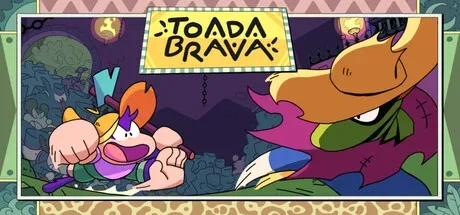
Toada Brava, a hand-drawn role-playing game drawing from Brazilian history, folklore, music and wildlife, is approaching the closing stretch of its Kickstarter campaign. As of November 9, the campaign had raised more than $26,000, placing it at approximately 75% of its $35,000 funding target with four days remaining.
The crowdfunding drive is scheduled to end on November 13 at 9 AM PT / 11 AM CT / 12 PM ET / 2 PM BRT. For players who want to get a feel for the project before the deadline, a free public demo is currently available on Steam.
Developed with a deliberately animated, cartoon-like visual identity, Toada Brava combines traditional turn-based RPG battles with timing-based actions, while its central story positions a young monkey named Kako against the forces trying to take his family's home. The game's creators cite classic Japanese RPGs including Chrono Trigger and Super Mario RPG among its inspirations, though its setting and themes are rooted in a distinctly Brazilian perspective.
A rescue mission begins with Kako
The game follows Kako, described as a good-natured little monkey whose life changes after his mother challenges the Duke of Santacrúz. The Duke seeks to claim their land for gold mining, and his efforts to seize it place Kako's family directly in harm's way.
For useful background on this topic, read Ranchonauts-brings-alien-sheep-herding-and-space-western-chaos-to-pc-in-2027/">Ranchonauts Brings Alien Sheep Herding and Space-Western Chaos to PC in 2027.
After his mother is imprisoned, Kako infiltrates the Duke's estate in an attempt to intervene. The plan goes badly: Kako is captured and thrown into jail himself. From there, the young hero must escape, seek out allies and form a crew capable of rescuing his mother while confronting the escalating dangers surrounding Santacrúz.
That setup gives the adventure a personal stake from the outset, but the game's larger ideas reach beyond one family's plight. Its narrative explores colonization, imperialism, rebellion and popular resistance through a fantasy world informed by Brazilian history. Gold mining is not simply a backdrop for an opening conflict; it is part of the pressure driving the story and the conflict over who has power over land, communities and livelihoods.
RPGs often use kingdoms, empires and rebellions as familiar genre scenery. Toada Brava's premise appears to use those elements to foreground a particular cultural and historical lens, tying a broad political conflict to Kako's immediate determination to save his mother.
For another perspective on this story, read Toada Brava Kickstarter Passes 75% of Its $35,000 Goal With Four Days Left.
A Brazilian world in hand-drawn motion
Toada Brava's visual presentation is one of its most defining features. The game uses frame-by-frame hand-drawn animation for both its characters and its expressive cartoon world. Rather than pursuing realism, the design leans into an illustrated style that can make even the stranger inhabitants of the setting feel lively and theatrical.
The announced cast of creatures includes groups with names such as the Junk Rats and Krazy Kats, along with police dogs called Beleguins. These names suggest a world that balances the serious themes at its core with whimsical character design and a playful, animated sensibility.
The setting also draws on Brazilian wildlife and folklore, two elements that can give the game a visual and narrative identity beyond its stated inspirations. While classic JRPG structure provides a useful reference point for prospective players, Toada Brava is aiming to filter that structure through its own regional influences, from the people and creatures encountered to the music and political concerns woven into the plot.
Frame-by-frame animation can be especially effective in an RPG because it brings personality to actions that players see repeatedly: walking through locations, reacting during conversations, initiating abilities and clashing in combat. In Toada Brava, that visual approach is intended to support a setting where charm, absurdity and tension can sit side by side.
Music is part of the magic system
Music is not only an atmospheric component of Toada Brava's Brazilian-inspired world. It is also built into the gameplay. Each of the main playable characters uses a musical instrument to cast a distinct kind of magic, placing performance and sound at the center of the party's abilities.
That choice gives the combat system a strong thematic throughline. Rather than treating spells as detached fantasy powers, the game connects them to the instruments wielded by its heroes. It also creates an opportunity for each party member to feel mechanically and visually distinct, since different instruments can suggest different forms of magic and different roles in battle.
The exact range of instruments, party members and spell types has not been detailed here, but the core idea is clear: music is intended to be an active part of strategy, not merely an accompaniment to exploration and story scenes. It is one of the ways Toada Brava seeks to combine its cultural touchstones with the systems expected from a party-based RPG.
Turn-based battles with player timing
Combat in Toada Brava is turn-based, but it will ask for more from players than selecting commands from menus. Its battle design includes timing mechanics that can improve attacks or reduce incoming damage. Well-timed inputs can allow players to score extra hits, while defensive timing can help block enemy attacks.
This style of system gives a turn-based format a more immediate rhythm. Decisions still matter before an action is chosen, including which abilities to use and how to approach an encounter. Once an attack or defense is underway, however, player execution can alter the result. The feature may be familiar to fans of RPGs that add small interactive challenges to attacks, but it remains a useful way of keeping routine battles engaging.
Paired with the instrument-based magic system, timing mechanics could make encounters feel closely tied to Toada Brava's musical identity. The game has not laid out every combat rule or party-building option in its campaign details, so players will have to look to the Steam demo for a more direct sense of how the systems work in practice.
What the Kickstarter milestone means
Reaching roughly three quarters of a funding target is a significant point for any crowdfunding campaign, though it does not guarantee that the final goal will be met. With more than $26,000 pledged against a $35,000 target, Toada Brava still needs to close the remaining gap before its November 13 deadline.
The final days of a campaign are often crucial, particularly for projects that have already demonstrated a clear concept and playable material. Toada Brava has both a concise narrative hook and a demo that lets potential backers examine its tone, art direction and early gameplay rather than relying solely on descriptions.
Its campaign arrives at a time when independent RPGs increasingly stand apart through specific cultural settings and artistic approaches. Toada Brava's combination of Brazilian folklore, history and music with hand-drawn animation and classic turn-based design gives it a recognizable pitch, while Kako's mission provides a grounded emotional reason to explore the broader conflict.
Whether the campaign crosses its target before time expires remains uncertain. What is already established is the game's creative direction: an animated Brazilian fantasy RPG where a monkey hero gathers allies, instruments become conduits for magic, and resistance to the Duke of Santacrúz's ambitions drives the journey forward.
Players interested in seeing that concept in action can try the free Steam demo while the Kickstarter campaign remains open through November 13.
Community
Discussion
Start the conversation.
No comments have been posted yet.