

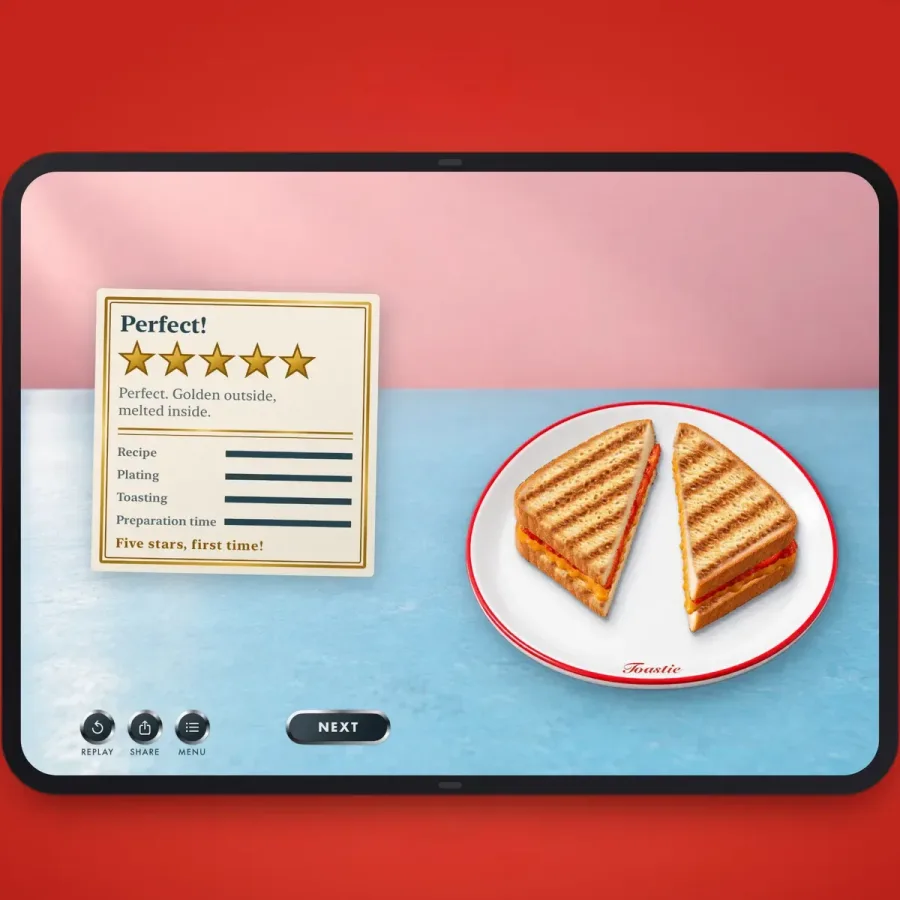
Foldable phones have spent years inviting the same question: beyond making a bigger screen fit in a pocket, what can developers actually do with the hinge? Toastie offers one of the most playful answers so far. The compact cooking game transforms Apple's recently revealed iPhone Duo into a virtual grilled-cheese maker, asking players to assemble a sandwich, close the device, and let the foldable form factor sell the illusion of pressing it between hot plates.
It is an intentionally strange concept, particularly when played on a device positioned at the premium end of the phone market. Yet that is also why Toastie stands out. Rather than treating the iPhone Duo's folding display as a purely practical feature for multitasking, the game turns the physical action of closing the phone into the centerpiece of a small, tactile joke. The player is not simply tapping a button labeled "cook." They are shutting their handheld sandwich press.
Toastie costs $3 and comes from developers Tom Szykulski and Cyprian Brytan. It includes 10 orders, three types of bread, and 14 ingredients that can be placed inside them. Those modest numbers suggest a focused, snack-sized game rather than an enormous restaurant-management simulation, but the structure gives players room to experiment with different fillings and ways of preparing each order.
Embedded X/Twitter post
A foldable phone becomes the kitchen appliance
The basic loop is simple: choose bread, add ingredients, close the iPhone Duo, and toast the sandwich. The visual gag depends on the phone's fold, with each half of the display helping evoke the two sides of a grill or toastie maker coming together. It is an idea that could only work quite this neatly on a foldable handset, because the hardware itself completes the performance.
For useful background on this topic, read Razer Barracuda V2 Pro review: Premium Wireless Audio Without the Gamer Look.
That approach separates Toastie from games that happen to run on a device with an unusual feature. Here, the unusual feature is the game's main prop. Closing the Duo is not merely an optional shortcut or a way to pause play; it is part of preparing the meal. A phone hinge is ordinarily an engineering detail. Toastie reframes it as a culinary tool.
There is an obvious novelty factor to that design, but it also speaks to a broader challenge for software creators working with new hardware. When a device introduces a fresh physical behavior, early apps frequently demonstrate it through practical uses: expanded workspaces, split views, improved media playback, or flexible camera modes. Games can make the same behavior memorable through fantasy. Turning a fold into a sandwich press may not be essential technology, but it is immediately understandable and difficult to forget.
More than a one-button cooking gag
Toastie does not end when the sandwich has browned. Finished creations receive a star rating that evaluates recipe, plating, toasting, and preparation time. That means players are being judged on more than whether they remembered to shut the device. Ingredient choices matter, presentation matters, the amount of browning matters, and moving efficiently through an order matters as well.
Those categories give the game's deliberately goofy hook some welcome structure. A player trying to earn a stronger rating may need to balance an appealing combination of ingredients against the customer's requested order, avoid undercooking or overcooking the bread, and keep their preparation from dragging on. Even with just 10 orders, the scoring system encourages a little replay value: a completed sandwich can be functional without necessarily being the best possible version.
The three available loaves and 14 fillings are also enough to support recognizable choices without drowning the concept in an overwhelming pantry. Cooking games often live or die by the clarity of their actions. Toastie's limited ingredient set should make the results easy to read, especially on a mobile device where immediate interaction is more important than managing a huge inventory.
Its $3 price likewise places it in the territory of a small premium mobile game. There is no indication that Toastie is trying to become an endlessly updated service or a large-scale food-business simulator. Instead, its appeal is in delivering a specific interaction that is difficult to duplicate elsewhere: using a foldable phone to pretend it is making lunch.
iPhone and iPad players are not left out
While the iPhone Duo version supplies the most obvious punchline, Toastie can also be played on standard iPhone models and iPad. Players on those devices will not have the physical closing action that makes the Duo edition especially cute, but the broader sandwich-building and scoring game remains available.
That is a sensible choice for a small game with a hardware-driven identity. Restricting Toastie entirely to the foldable model would make the project an extremely narrow curiosity. Supporting iPhone and iPad gives more people access to the orders, ingredients, and cooking challenges, while allowing the Duo to function as the playful "best way" to experience it. The game can be a cooking diversion on conventional Apple hardware and a charming showcase of the foldable design on the Duo.
It also avoids making the fold the only reason to play. The hardware gesture may attract attention, but recipe assembly, timing, presentation, and ratings provide the actual game layer. That balance is important. A novelty interface can be delightful for a few minutes, but a scoring system and defined set of orders give players a reason to make another sandwich after the initial surprise has worn off.
Designed after many evenings of development
Szykulski and Brytan have said Toastie was developed across more evenings than either had expected. That detail fits the game's personality: it sounds like a project built around a sharply observed bit of hardware comedy and then expanded just enough to make the bit playable. The best small games often begin with one clear question--in this case, what if closing a foldable phone felt like closing a toastie maker?--and follow it through with commitment.
There is something refreshing about seeing an early foldable-phone game embrace absurdity rather than attempting to prove the platform's seriousness. New devices can produce a wave of software that is technically impressive but emotionally familiar. Toastie goes in the other direction. It recognizes that a $2,000 folding phone can be a powerful piece of personal technology and, for a few minutes, a very expensive pretend appliance.
Toastie's central trick is simple enough to explain in seconds: fill a sandwich, fold the phone, and toast it. The rest of the game exists to make that tiny act satisfying.
What Toastie says about the iPhone Duo's early software
Apple revealed the iPhone Duo in September, and the first wave of apps is naturally exploring how its foldable design changes familiar software. Some experiments will likely focus on productivity, media, and communication. Toastie represents a different but equally useful kind of early app: one that gives the device a distinctive personality.
Hardware features are easier for people to understand when they can be felt, not just listed on a specification sheet. A hinge can enable a larger display, but a sandwich game makes users physically close that hinge for a purpose. That does not make Toastie a defining reason to buy an iPhone Duo, nor does it need to be. It is a concise demonstration that unusual hardware can inspire unusual interaction design.
It may also point toward a category of games that works particularly well on foldables. Developers could treat the two sides of a device as facing pages, opposing control panels, mirrored play spaces, lids and containers, or surfaces that meet when the phone closes. Not every idea will be as immediately comedic as a grilled-cheese press, but Toastie illustrates how designers can build mechanics around the object in a player's hands rather than only around the pixels on its screen.
A small game with a very specific appeal
Toastie will not be for everyone. Players seeking a deep cooking-management game, dozens of systems, or a lengthy campaign may find its compact list of orders and ingredients too slight. Its core appeal is precision-engineered around a single, knowingly ridiculous premise. But for players who enjoy offbeat mobile games, food-themed score chasing, and hardware-specific ideas, that premise is exactly the point.
The game's strongest quality may be its clarity. It does not need a complicated elevator pitch or a long tutorial to communicate what makes it special. The title, the ingredients, the fold, and the toasted result tell the whole story. On iPhone and iPad, Toastie remains a simple sandwich-making game. On iPhone Duo, it becomes a miniature performance between software and hardware.
For $3, Toastie is a reminder that not every app for a newly launched device needs to be grand, utilitarian, or packed with features. Sometimes the most memorable early experiment is the one that looks at an expensive folding phone and sees a grilled cheese maker waiting to happen.
Community
Discussion
Start the conversation.
No comments have been posted yet.