
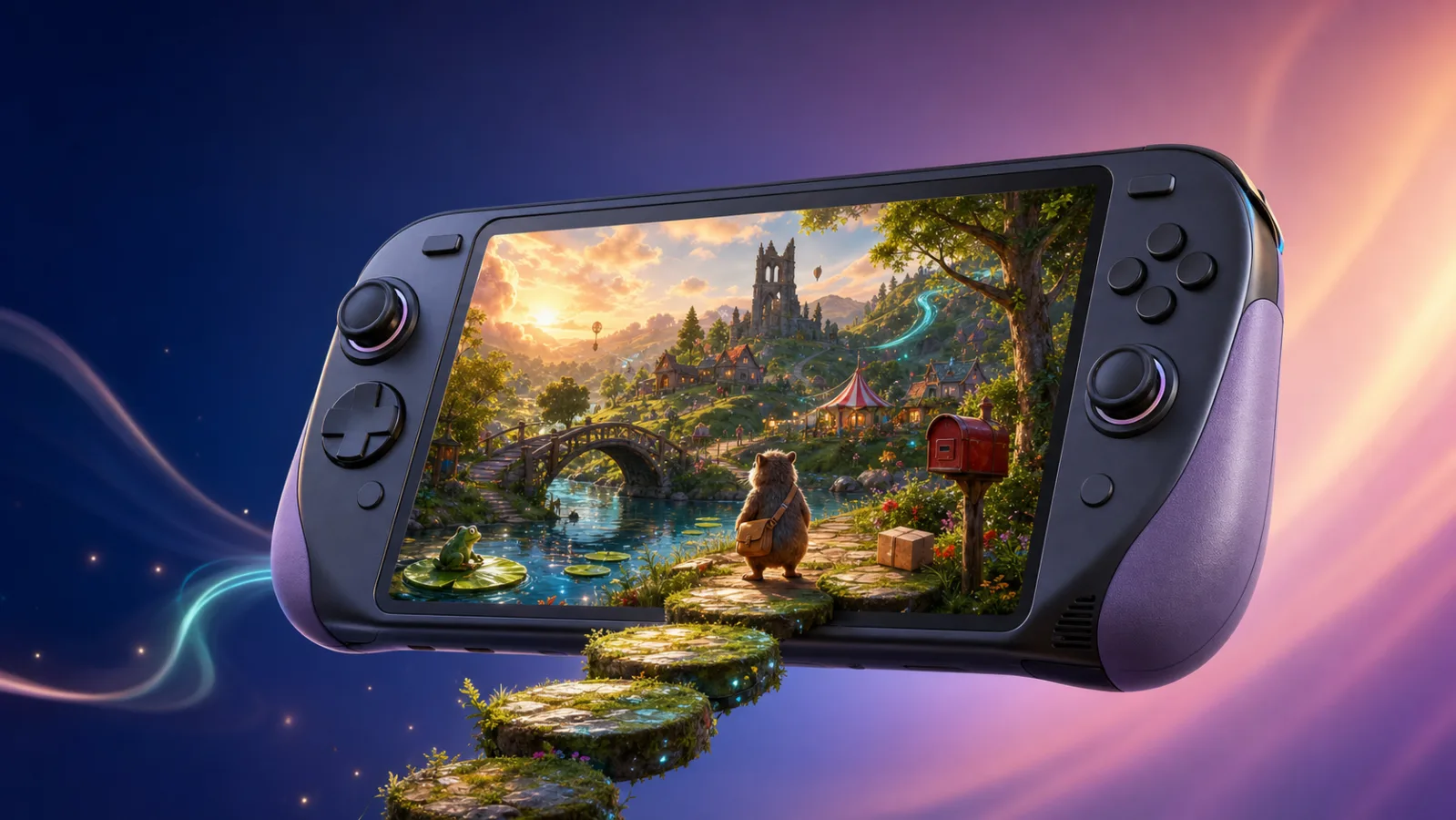
Handheld gaming is not one genre, one hardware generation, or one kind of player. It is a way of fitting games into real life: a focused twenty-minute run during a break, a slow evening of exploration with headphones on, or a familiar arcade challenge revisited until the route finally clicks. The strongest portable games understand that rhythm. They offer immediate inputs, readable goals, memorable spaces, or an atmosphere compelling enough to make a small screen feel like a complete world.
This list ranks five games from the supplied selection that best match that portable ideal. The ranking weighs more than whether a title appears on a handheld platform. It considers how naturally its structure supports stop-and-start play, whether its visual identity stays clear on a compact display, how much variety it can offer across repeated sessions, and what type of player will get the most from it. That creates room for polished action-platforming, a quiet-looking simulation with a deadline, a mysterious horror adventure, and retro arcade design.
Not every game here is trying to deliver the same experience. Forma.8 is for the player who wants to get lost in an alien world. Freedom Planet makes a case for expressive movement and character-led combat. Tanuki: Pon's Summer approaches portable play through daily routines and community building. Becrowned favors tension and dreamlike unease, while Frogger represents the enduring appeal of a direct, score-chasing challenge. Read the ranking as a guide to finding the right game for your own idea of handheld play, rather than a claim that every player should begin in the same place.
1. Forma.8
Best for: explorers who want a substantial solo adventure on a portable screen.
Forma.8 takes the top place because its central premise and design priorities align exceptionally well with the strengths of handheld gaming. You play as a small exploration probe stranded on an alien planet after being separated from its companions. The goal is urgent--recover a powerful lost energy source before time runs out--but the journey is built around the pleasures of methodical discovery. It is an action-adventure Metroidvania with a huge open world, secrets, ancient mysteries, power-ups, dangerous enemies, and powerful bosses. That is a lot of adventure-game substance in a format that can still be approached one new path, upgrade, or encounter at a time.
The key portable appeal is progression through curiosity. Metroidvania structure makes even a shorter session meaningful: you might map a previously inaccessible corner, solve a small environmental puzzle, acquire an ability, or identify a barrier to revisit later. There is a satisfying loop between immediate exploration and longer-term knowledge of the world. Handheld players often benefit from games that let them make measurable progress without demanding an entire uninterrupted evening, and Forma.8 has the right ingredients for that style of play.
Its presentation is another advantage. The game uses hand-drawn vector graphics at 60 frames per second. On a handheld display, a clean visual language matters. Detailed environments can be wonderful, but readable silhouettes, motion, and boundaries are especially valuable when playing on a smaller screen or in changing light. The alien setting and cryptic lore also give the journey a strong identity. This is not merely a mechanical scavenger hunt for upgrades; it is a voyage through a world shaped by ancient civilizations and dystopian visions.
There is also real breadth in where it fits. Forma.8 is listed for Nintendo Switch, PlayStation Vita, Android, iOS, PC, Mac, Wii U, PlayStation 4, and Xbox One. The Switch, Vita, and mobile versions are particularly relevant to a handheld-focused conversation, but the broad platform footprint means that players who move between home and portable ecosystems can still keep it in mind. Its core appeal does not rely on a novelty control scheme or a social feature. It relies on exploration, atmosphere, and gradual mastery.
Choose Forma.8 if you enjoy a game that asks you to observe, remember, and return. It is the best pick here for someone who wants their handheld game to feel expansive rather than disposable. Players looking only for immediate, uncomplicated action may prefer a more linear option below, but for a portable adventure with secrets to uncover over time, it is the standout selection.
2. Freedom Planet
Best for: action-platform fans who want speed, combat, and character variety.
Freedom Planet earns second place by embracing a very different kind of handheld energy. It is a cartoony, combat-based platform adventure set in Avalice, where Lilac, Carol, and Milla fight to defend their world from Lord Brevon and robotic minions. The basic platforming foundation is familiar, but the three playable heroes turn it into more than a single-move-set journey. Each character has a distinct approach to enemies and obstacles, which gives the game an immediate replay and experimentation hook.
Lilac attacks with her hair and uses the Dragon Boost to move through the air at high speed. Carol relies on punches and kicks, then can summon a motorcycle that rides up walls and ceilings. Milla creates blocks to throw at enemies and uses a psychic shield to reflect attacks. These are not small cosmetic differences. They suggest three different ways to read a stage: aerial momentum and speed with Lilac, forceful close-range movement and unconventional traversal with Carol, or more defensive and construction-minded problem solving with Milla. That variety makes Freedom Planet particularly suitable for players who do not want to settle into a single routine.
For handheld sessions, a strong action-platformer needs responsive-feeling priorities: clear movement, visually distinct hazards, and enough excitement that even a brief play period feels satisfying. The information available here points squarely toward that kind of experience. The game has both an Adventure mode with fully voiced cutscenes and a Classic mode that lets players tackle the stages in order. That distinction is useful. Adventure mode serves players who want narrative context around the heroes' battle, while Classic mode better suits a direct stage-by-stage rhythm. Depending on mood and available time, the same game can support a more story-driven evening or a concentrated run of pure platform action.
The Nintendo Switch version makes it a natural choice for current handheld-minded players, and it is also listed for PC, Mac, Linux, Wii U, and PlayStation 4. That flexibility is welcome, but the compact Switch format fits its bright, kinetic style especially well. A game with multiple heroes and a stage-based framework can remain appealing after the first completion because the question changes from "what happens next?" to "how does this section work with a different character?"
Freedom Planet is the best fit for someone who likes platform games with personality and wants more than a passive sightseeing tour. It is likely to reward players who enjoy learning movement options, adapting to enemy encounters, and choosing a favorite hero. It ranks just behind Forma.8 because its appeal is more specific: it is built for players who actively want energetic action. For that audience, however, it may be the number-one choice.
3. Tanuki: Pon's Summer
Best for: players who prefer gentle routines, community stories, and low-pressure goals.
Tanuki: Pon's Summer deserves a high place on a handheld radar because it centers on an idea that portable play handles beautifully: the satisfying completion of small, human-scale tasks. Pon is a well-meaning but somewhat lazy tanuki who works part-time at the Post Office. With the Tanuki Festival one month away and the local shrine in disrepair, Pon has a summer to deliver packages, befriend people, and help restore the shrine for the celebration. It is an indie simulation game built around place, routine, and a looming seasonal objective.
There is a useful balance in that setup. Delivering packages gives the game a practical loop and a reason to move through the village. Befriending residents introduces social texture. Preparing the shrine links those smaller activities to a larger communal purpose. The festival deadline prevents the premise from becoming shapeless: there is a concrete event ahead, and the summer has meaning because it leads somewhere. For a handheld player, that can be ideal. A brief session can be a few deliveries or a conversation; a longer session can be devoted to building toward the shrine's restoration.
The tone is important, too. Not every portable game has to be a challenge machine. There is value in a game that lets players enter a local setting, learn its rhythms, and gradually become more connected to its people. Pon's characterization as well-meaning but lazy suggests that the game's warmth may have room for humor rather than treating every task as solemn obligation. That makes the premise inviting for players seeking something calmer than boss fights, horror, or score attacks.
Tanuki: Pon's Summer is listed for Nintendo Switch, PC, Xbox One, and Xbox Series X|S, with a listed release date of December 31, 2026. Because it is a future-facing pick, it belongs on a radar rather than in an immediate-play recommendation. Still, its Switch listing makes it directly relevant to handheld gaming, and its simulation focus makes the match feel natural rather than incidental. It has the potential to be the kind of game players return to in small stretches, allowing the village and its festival preparations to unfold at a comfortable pace.
This is the choice for players who enjoy the feeling of a summer project. Pick it if you like the idea of tangible errands that feed into friendships and a shared restoration effort. Those who want fast technical demands should look toward Freedom Planet or Frogger; those who want an atmosphere of quiet progression and local connection should keep Pon firmly in view.
4. Becrowned
Best for: horror players who want an unsettling, introspective portable adventure.
Handheld play is often associated with comfort, but small-screen gaming can also be remarkably intimate. Headphones, darkness, and a display held close can make an atmospheric horror game feel more personal than a big television presentation. That is why Becrowned makes the list. It is a surreal survival horror adventure set in a realm suspended between reality and dreams, where fire no longer burns. The player explores this terrifying dark world, unravels its mysteries, confronts fears, and seeks a way to escape.
That "world without fire" concept is immediately evocative. Fire is normally a source of warmth, visibility, and safety in dark settings. Removing its function creates a powerful sense of instability before any particular enemy or puzzle has been described. The premise positions darkness as more than decoration; it is part of the world's logic and part of the threat. For players who appreciate horror that leans into disorientation and symbolism rather than only action, this is the most distinctive mood piece in the ranking.
Portable suitability here is about controlled intensity. A survival horror adventure may not be a game to play casually in a noisy queue, but its mystery-oriented structure can work well in deliberate solo sessions. There is also an advantage to being able to stop after a tense area, reflect on what has been learned, and return when ready. The broad promise of exploring and escaping gives players a clear reason to push forward, while the reality-and-dreams framing leaves room for ambiguity and interpretation.
Becrowned is listed for Nintendo Switch 2 as well as Mac, PC, PlayStation 5, and Xbox Series X|S, with a listed release date of December 31, 2026. Like Tanuki: Pon's Summer, it should be treated as one to watch rather than one to assume is ready to play now. Its handheld relevance depends on the Switch 2 version, but the concept is compelling enough to warrant attention for players who want future portable horror with a more surreal edge.
It ranks fourth not because the premise lacks promise, but because survival horror is inherently less universal as a handheld fit. Players who value relaxation, quick mechanical satisfaction, or family-friendly travel entertainment will likely prefer other entries. Choose Becrowned if you want a game that makes solitude and uncertainty part of the experience.
5. Frogger
Best for: arcade purists who want instant rules and endlessly repeatable tension.
Frogger is the most direct game in the ranking, and that is exactly why it belongs here. Released in 2015 for Atari ST and Handheld Electronic LCD, this action, arcade, and platform game asks players to guide Frogger home through a highway of fast-moving cars and trucks, then across a swirling river populated by frog-eating creatures. Its appeal lies in clarity. You understand the danger at a glance, make a decision, commit to a movement, and immediately learn whether your timing was right.
That stripped-back loop remains one of the purest expressions of handheld-friendly design. There is no need to reacquaint yourself with a sprawling map or remember a long chain of story events. Each attempt starts with a recognizable objective and becomes a compact test of judgment. When a game is built around traffic patterns, moving hazards, and precise hops, the player's improvement is easy to feel. A route that looked impossible can become manageable through rhythm, patience, and better timing.
The Handheld Electronic LCD platform listing also gives Frogger a special place in this selection. It represents a different branch of portable gaming history from the Switch, mobile, or Vita-style games elsewhere on the list. Dedicated handheld electronic games reduce play to essential interactions, and that constraint highlights the arcade heart of the experience. The player does not need a huge world or elaborate system to feel tension; a crossing, an obstacle, and a narrow safe space can be enough.
Its limitations are also why it sits at number five. Compared with the character choice in Freedom Planet, the wide exploratory world of Forma.8, or the unfolding premises of the two upcoming games, Frogger offers a more narrowly focused experience. It is not the pick for someone seeking a lengthy narrative journey. But for players who appreciate old-school immediacy, it can outlast more elaborate games precisely because the challenge is so readable and repeatable.
Choose Frogger when you want to play rather than prepare to play. It is for the arcade-minded handheld fan who sees a short session not as a compromise, but as the perfect amount of time to chase one cleaner run.
How to Choose the Right Pick
- Choose Forma.8 if you want exploration, upgrades, bosses, and a mysterious world that can hold your attention over many sessions.
- Choose Freedom Planet if you want colorful, combat-heavy platforming and the ability to approach obstacles through three very different playable heroes.
- Keep Tanuki: Pon's Summer on your radar if delivery tasks, friendships, village life, and a festival-centered summer goal sound more appealing than combat.
- Keep Becrowned on your radar if you want surreal survival horror and are drawn to dreamlike mystery, darkness, and escape-driven tension.
- Choose Frogger if you want concise arcade play based on reflexes, timing, and the pleasure of mastering a simple but dangerous route.
The best handheld game is ultimately the one that respects the way you play. Some players want to disappear into a strange planet. Some want a stage that demands sharper movement, a village that invites a daily visit, a nightmare that lingers after the screen goes dark, or a classic arcade loop that starts delivering tension in seconds. These five picks cover that spectrum well. Their shared strength is not that they all feel the same in portable form; it is that each offers a clear reason to pick up a handheld and make the next session count.
Community
Discussion
Start the conversation.
No comments have been posted yet.