
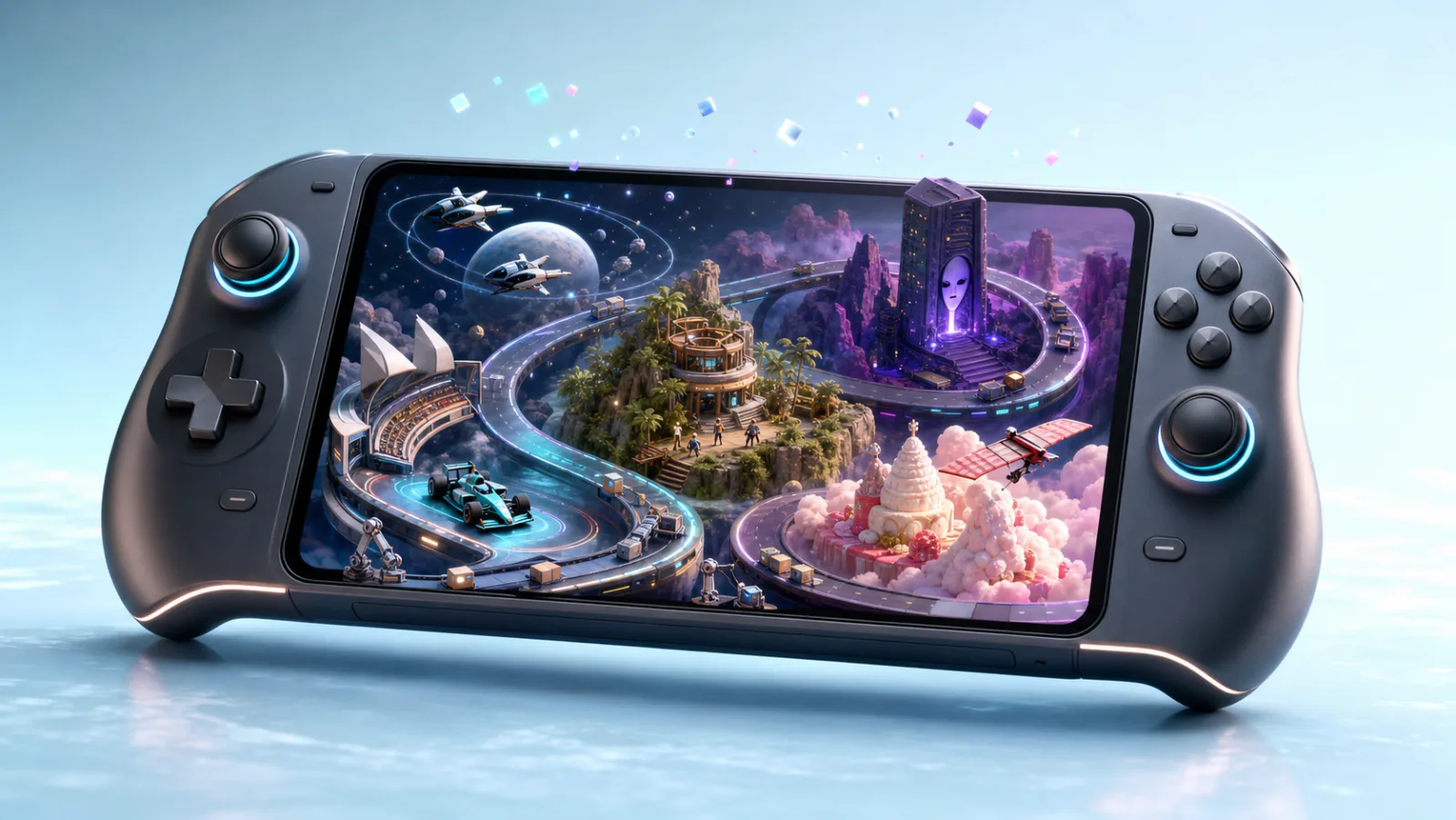
Handheld gaming is at its best when a game understands the realities of portable play. Sometimes that means short, self-contained stages that can fill a few spare minutes. Sometimes it means a puzzle that stays in your head after the screen is off. And sometimes it means a simple arcade challenge with enough pressure, color, and replay value to make another attempt immediately tempting.
This ranking looks at five games from the supplied list that make the strongest case as handheld gaming picks. The order is not a claim that every player will enjoy the same experience equally. Rather, it weighs portability, clarity of purpose, platform fit, replay appeal, and the distinct kind of play each game brings to a portable library. The result includes modern puzzle design, a dark narrative adventure, colorful arcade shooting, a film-inspired retro platform game, and a racing title built around the Indianapolis Motor Speedway.
There is also useful variety here. If your handheld library is full of fast action, one of these picks can slow things down and make you think. If it is mostly long-form role-playing or open-ended games, another can give you direct level-based action. A strong portable collection benefits from contrast. The games below are worth considering not because they all do the same thing, but because each can occupy a different and valuable space in a player's rotation.
How these handheld picks were ranked
The list favors games with confirmed portable-oriented platform options in the supplied records, including Android, iOS, Nintendo Switch, PlayStation Vita, Nintendo Game Boy, Handheld Electronic LCD, and Tiger Game.com. Nintendo Switch appears often because it supports both quick portable sessions and longer, more settled play without changing the game's basic identity.
That does not mean every entry is equally easygoing. Difficulty, tone, and complexity are important parts of the recommendation. A game can be an excellent handheld choice precisely because it offers a serious challenge or a heavier story, as long as the player knows what they are choosing. The ranking therefore explains not only what each game is, but who should put it on their radar.
- Human Resource Machine
- I Have No Mouth, and I Must Scream
- Ice Cream Surfer
- Home Alone 2: Lost in New York
- Indy 500
1. Human Resource Machine
Best for: puzzle fans, curious beginners to programming logic, and players who want a portable game with lasting mental challenge.
Human Resource Machine earns the top spot because its core idea is unusually well suited to the stop-and-start rhythm of handheld gaming. The game asks players to program a small office worker to complete tasks assigned by a boss. Every level is a new job to automate, and successful completion leads to promotion and another year in the office. It is a clear premise that gradually opens into deeper logical challenges.
Its strength is that it frames programming as a puzzle language rather than as a technical barrier. You are not expected to arrive with programming experience. Instead, the game gives you a goal and asks you to assemble a sequence of instructions that gets the worker from input to output. That makes the process approachable while still respecting the player's intelligence. A solution that works is satisfying; a cleaner or more efficient solution can be even more satisfying.
For portable play, that structure is ideal. A player can tackle a single job during a short break, then return later with a fresh perspective if a solution refuses to appear. Unlike a game that relies entirely on quick reflexes, Human Resource Machine rewards contemplation away from the device as well. A stalled puzzle can become a small problem to mentally untangle while commuting, waiting, or winding down.
The game is available on Android, iOS, Nintendo Switch, and Nintendo Wii U, alongside PC, Mac, and Linux. Android and iOS make obvious fits for players seeking a puzzle game on a phone or tablet, while Nintendo Switch is an especially natural home for anyone who likes button-based control and a dedicated game device. The office presentation also has a practical advantage on a handheld screen: the game's focus is on understanding a contained workspace and the logic behind it, rather than tracking a crowded battlefield.
The presence of extra challenges gives Human Resource Machine another layer of long-term value. Players who simply want to reach the next promotion can focus on functional answers. Players who enjoy refining systems can push further. That split makes it a smart recommendation for mixed-experience households or anyone who wants a game that can grow from friendly introduction to more demanding puzzle exercise.
It is not the pick for someone seeking immediate explosions, racing, or a dramatic story. Its pleasures are methodical. But for a handheld game that can remain rewarding well beyond the first few sessions, it is the most versatile choice in this group.
2. I Have No Mouth, and I Must Scream
Best for: players who want a dark, story-focused portable adventure and are comfortable with unsettling themes.
I Have No Mouth, and I Must Scream is dramatically different from the number-one pick, and that difference is exactly why it belongs near the top. This is a dark adventure, point-and-click, and puzzle game based on a collection of short stories by Harlan Ellison. Its setting centers on AM, the Allied Mastercomputer, which holds the last five humans prisoner after computers from the United States, Russia, and China take control of the world. AM forces the survivors through virtual adventures tied to their pasts, fears, and weaknesses.
That premise immediately establishes the game as a narrative experience rather than a relaxing distraction. The game's subject matter is bleak, and its appeal lies in confronting difficult scenarios, examining characters under pressure, and working through puzzles within a hostile world. Players looking for cheerful portable escapism should choose Ice Cream Surfer instead. Players looking for a game that leaves a stronger emotional impression may find this the most compelling title in the ranking.
Portable play suits point-and-click adventure design for a simple reason: it encourages attention rather than speed. It is easy to spend a session examining a scene, considering dialogue and puzzle connections, then pause once a new question has been established. The game does not need to be reduced to a few minutes at a time, but it can accommodate deliberate play in chapters. That makes it a strong candidate for evening sessions on a phone, tablet, or Switch.
The supplied platform list is broad: Android, iOS, Nintendo Switch, PlayStation 4, PlayStation 5, Xbox One, Xbox Series X|S, DOS, Windows, Mac, Linux, and ScummVM. For handheld-minded players, Android, iOS, and Nintendo Switch are the key options. The availability of both touch-oriented mobile platforms and a dedicated hybrid handheld gives players room to choose the interface and screen size that best fits their preferences.
Its rank reflects a necessary warning as much as a recommendation. This is not a game to select casually based only on its puzzle and adventure labels. The story is built around captivity, torment, fear, and personal weakness. Those ideas are central to its identity. Yet for the right player, that focus can make it an excellent addition to a handheld library: a compact, thoughtful adventure that asks for attention and delivers a very different tone from the usual portable action game.
3. Ice Cream Surfer
Best for: arcade shooter fans, players who want upbeat pixel-art action, and anyone seeking stage-based portable sessions.
Ice Cream Surfer is the most immediately cheerful entry in this top five. It is an arcade shooter adventure about saving the Flavor galaxy from evil Broccoli and an army of vegetables. The Ice Cream Surfer joins four super tasty friends to fight across the Gourmet Universe and reach the No-Flavor Zone. The premise is playful, but the structure is direct: travel through six worlds, fight unique enemies, and face a giant final boss in each world.
That six-world setup gives the game a strong portable rhythm. Worlds, enemy encounters, and bosses provide natural points to stop or continue. A handheld game does not need to be small to be convenient, but clearly defined objectives make it easier to fit into real life. Ice Cream Surfer's arcade framework should appeal to players who like to sit down, make progress through a focused stretch of action, and return later for the next challenge.
The game's 16-bit-inspired pixel graphics and arcade-inspired soundtrack further reinforce its place in a portable collection. Pixel art has a natural connection to handheld gaming because it emphasizes readable forms, bold visual identity, and concentrated screen action. The important point is not nostalgia by itself. It is that Ice Cream Surfer adopts an aesthetic built for immediacy: players can quickly understand its colorful world, identify the game's comic threat, and get on with shooting through it.
Ice Cream Surfer is available on Nintendo Switch and PlayStation Vita, two especially relevant options for dedicated handheld players. It is also listed for PlayStation 4, PlayStation 5, Xbox One, Wii U, Mac, and PC. The Switch and Vita versions matter most in this context because they place the full arcade-shooter identity in a device designed for personal, portable play.
Why does it land at number three rather than higher? Its appeal is more specialized than Human Resource Machine's broad puzzle hook, and it does not offer the same narrative depth as I Have No Mouth, and I Must Scream. But that is not a weakness for its target audience. For the player who wants a lively shooter with a humorous food-themed setting, six distinct worlds, and boss encounters, Ice Cream Surfer may be the first game in this list to install or revisit.
4. Home Alone 2: Lost in New York
Best for: retro players, Game Boy collectors, and fans of simple 8-bit action-platform games tied to a familiar film premise.
Home Alone 2: Lost in New York takes a recognizable holiday-film setup and converts it into an action-platform game. The supplied record identifies a 1992 Nintendo Entertainment System version in which players control Kevin while navigating New York City and avoiding Harry and Marv, the Sticky Bandits. Its eight levels are loosely based on locations from the film, including Central Park, an abandoned toy store, and the Plaza Hotel. The game also emphasizes traps and items as part of getting past its threats.
For handheld gaming, the key detail is that it is listed for Nintendo Game Boy and Handheld Electronic LCD as well as the NES, Sega Genesis, and Super Nintendo Entertainment System. That makes it one of the most directly portable-minded historical entries available in the supplied records. It comes from an era when games had to communicate quickly through compact levels, straightforward objectives, and recognizable visual hooks.
There is a particular pleasure in bringing a film adaptation into a retro handheld rotation. The appeal is not that it recreates every detail of the movie. The supplied description makes clear that the levels are loosely based on its locations. Instead, the attraction is the translation itself: a familiar chase-and-traps premise reshaped into platforming challenges. Kevin's situation gives the game an immediate purpose, while the changing New York settings provide a simple route through the adventure.
This is a recommendation with a clear audience. Players who want a modern game with expansive systems should not start here. Players who expect the exact rhythm of the film should also approach it as its own game rather than a scene-by-scene adaptation. But retro games can be valuable precisely because they are concise, mechanically focused, and tied to a specific time in gaming history. Home Alone 2 offers that type of experience while retaining a portable connection through the Game Boy and handheld electronic versions.
It ranks fourth because its strongest pull is nostalgic and specialized. The game is likely to mean the most to players who already enjoy 8-bit design, movie adaptations, or the Home Alone setting. For those players, however, its place on the radar is easy to justify. It is a compact action-platform curiosity with a distinctly seasonal atmosphere that can be revisited whenever a retro handheld mood strikes.
5. Indy 500
Best for: retro racing fans, Indianapolis Motor Speedway enthusiasts, and players curious about unusual handheld electronic and Game.com releases.
Indy 500 completes the ranking as the most historical and hardware-specific recommendation. Released in 1996, it is a racing game centered on the Indianapolis Motor Speedway. Players race around the track while dealing with hazards and weather conditions. The game includes a choice of cars, multiple gameplay options, speech, sound and animation, plus hidden cars and other bonuses.
The record lists Handheld Electronic LCD and Tiger Game.com alongside Sony PlayStation. Those first two platforms give Indy 500 a particularly distinctive place in a handheld gaming conversation. Rather than being a modern game that happens to work on a portable device, it is connected to dedicated handheld electronic play and to Game.com. That makes the game notable for collectors and players interested in the broad, sometimes unusual history of portable racing games.
Racing games are naturally suited to quick sessions: select a car, take to the track, react to conditions, and push for a better performance. Indy 500 adds more than a bare racing premise through hazards, weather, multiple options, and hidden content. Those features suggest a game intended to reward repeated attempts, experimentation, and return visits. Hidden cars and bonuses are especially useful in a portable format because they turn casual replay into a small discovery hunt.
It is important to frame this pick correctly. Indy 500 is not ranked fifth because racing has less value on handhelds. It is fifth because its platform identity and retro focus will be narrower than the more broadly accessible games above it. A player with a Nintendo Switch, phone, or PlayStation Vita may find a more direct route to the first three picks. Indy 500 is for a player who specifically enjoys older racing concepts, is drawn to the Indianapolis Motor Speedway setting, or wants to explore the range of handheld hardware represented by electronic LCD games and Tiger Game.com.
That specificity is also its charm. Handheld gaming history is not defined only by one platform or one genre. It includes specialized racing games, electronic devices, and experiments built around familiar sports settings. Indy 500 is worth keeping on the radar as a reminder that portable racing has long been about making speed, pressure, and repeatable competition work within a compact format.
Choosing the right game for your handheld library
The best pick depends less on the number beside it and more on what you want from your next portable session. Choose Human Resource Machine if you want puzzles that reward patience, logic, and experimentation. Choose I Have No Mouth, and I Must Scream if you want an unsettling narrative adventure with a heavy science-fiction premise. Choose Ice Cream Surfer if you want colorful, boss-driven arcade shooting. Choose Home Alone 2: Lost in New York if retro platforming and Game Boy-era curiosity are the priority. Choose Indy 500 if a racing game with an unusual handheld history sounds most appealing.
Platform ownership can make the decision even easier. Android and iOS players have direct portable options for Human Resource Machine and I Have No Mouth, and I Must Scream. Nintendo Switch players have access to those two as well as Ice Cream Surfer. PlayStation Vita players should focus on Ice Cream Surfer, while retro handheld enthusiasts can look toward Home Alone 2's Game Boy connection and Indy 500's Handheld Electronic LCD and Tiger Game.com versions.
A balanced handheld library does not need every game to be a massive commitment. In fact, it is often better when it is not. Keep one game for concentration, one for story, one for immediate arcade energy, and one for retro flavor. These five picks collectively cover that range. Whether you are solving office puzzles, surviving a grim virtual nightmare, shooting through the Gourmet Universe, navigating New York as Kevin, or racing at Indianapolis, each offers a different reason to keep a handheld close by.
Community
Discussion
Start the conversation.
No comments have been posted yet.