

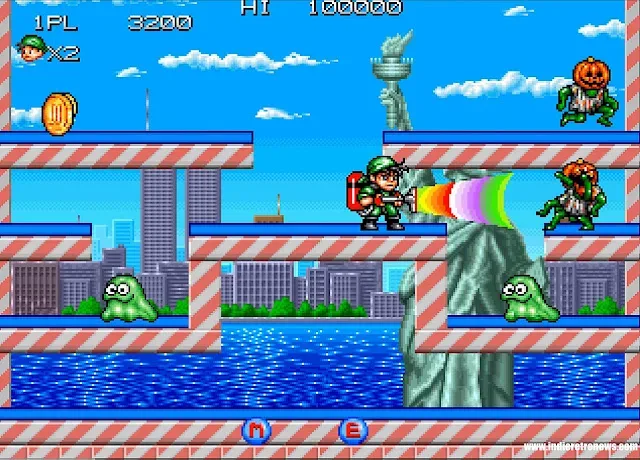
Tumblepop, Data East's quirky and well-regarded 1991 arcade platformer, is heading to the Commodore Amiga through an unofficial new conversion from developer Acidbottle. The project aims to bring the coin-op game's distinctive ghost-hunting action, globe-trotting stages, and enemy-vacuum mechanic to one of retro computing's most enduring platforms.
For players who remember the arcade original, the appeal is immediately clear. Tumblepop was never simply another platform game about reaching the end of a stage while avoiding hazards. Its central tool gave it an identity of its own: the protagonists could vacuum up enemies, then send them flying back into the level as bouncing projectiles. That simple idea created chain reactions, rewarded positioning, and made crowded screens feel chaotic in a way that was playful rather than overwhelming.
Acidbottle's Amiga version is intended as a faithful recreation of that experience, translating a cult arcade favorite to hardware with a long history of receiving enthusiastic homebrew projects. The conversion is unofficial, but it represents the kind of preservation-minded development that continues to give classic machines fresh software decades after their commercial peak.
A 1991 Arcade Game With a Memorable Hook
Originally created by Data East and designed by Makoto Kikuchi, Tumblepop places players in control of two determined ghosthunters on a mission to save the world. Rather than limiting its action to a single spooky setting, the game sends its heroes across a variety of international locations, facing monsters and navigating platforms that become increasingly dangerous as the journey continues.
For useful background on this topic, read Crazy Cars 2+ Revives an Amstrad CPC Racer With Faster Performance and New Driving Aids.
The heroes' vacuum devices are the centerpiece. Players use them to pull enemies toward their character, capturing them before releasing them back into the stage. A launched enemy becomes a destructive bouncing ball, capable of knocking into other foes and helping to clear a packed area. It is a mechanic that asks players to think about more than immediate survival. Capturing a monster is only the first step; deciding when and where to fire it can be just as important.
That design gives Tumblepop an energetic rhythm. A player may initially retreat from a group of enemies, find a safe angle to use the vacuum, and then turn the pressure around by launching a captured creature through the rest of the room. The resulting bounce can transform a single successful capture into a much larger screen-clearing move. This mixture of platforming, crowd control, and arcade scoring potential is a large part of why the game developed a cult following.
Why the Amiga Is a Natural Home for the Project
The Commodore Amiga remains a particularly active retro platform because its community has never stopped making, refining, and celebrating games for the system. New productions range from original releases designed around the machine's strengths to conversions that revisit arcade and console favorites that never received an official Amiga edition.
Tumblepop fits that second category. The arcade original's colorful sprites, compact stages, and fast-moving action make it the kind of game that can be especially appealing for an Amiga conversion. Its moment-to-moment structure is easy to understand, yet its enemy interactions provide enough depth to encourage repeat plays and score chasing. It also supports the sort of immediate pick-up-and-play design that has always suited short sessions on classic hardware.
A successful recreation will have to preserve more than the basic premise, however. Tumblepop's character comes from the relationship between movement, enemy behavior, platform layouts, and the bouncing physics of released monsters. If those elements feel responsive, players can create the satisfying cascading attacks that define the original. If they do not, the game's most distinctive ideas risk losing their punch.
Acidbottle's stated goal of recreating the arcade game suggests an effort to retain that familiar coin-op feel rather than radically reinterpret it. For retro players, that focus matters. Arcade conversions are often judged on how they handle both surface-level presentation and the subtler timing that makes an older game memorable.
Faithful Recreation Meets Modern Homebrew Development
There is an interesting contrast at the center of the project. Tumblepop belongs to the early 1990s arcade era, while this Amiga edition is being built in the current homebrew scene. The game itself reflects a period when arcade developers regularly experimented with immediately understandable gameplay hooks. Meanwhile, its new platform reflects a present-day community still interested in challenging technical work on legacy systems.
That combination makes projects like this more than nostalgia exercises. They give players an opportunity to experience a familiar design through different hardware, controls, and display setups. They can also invite new audiences to discover games that may have been difficult to encounter outside of arcades, specialist collections, or older home versions.
The conversion's announcement also makes clear that the work is not being presented as completely finished or universally stable. Development has been AI-assisted, and Acidbottle has cautioned that the game may currently crash or run either too quickly or too slowly depending on the machine being used. Further optimization and debugging may still be needed.
The current build may crash or perform at an inconsistent speed on some machines, with more optimization and debugging potentially required.
That warning is important context for anyone interested in trying the project during development. Amiga configurations can vary substantially, and software that behaves well on one setup may need additional work on another. Performance issues are especially significant for an arcade-style platformer, where movement speed and timing are fundamental to the feel of play.
AI Assistance and the Importance of Transparency
The developer's disclosure that AI assistance was used is also notable. Regardless of the tools involved, transparency helps players understand the circumstances surrounding a fan-made or homebrew production. In this case, the key measure for the community will ultimately be the quality and stability of the resulting Amiga conversion: how it controls, how reliably it runs, and how effectively it captures the energy of the 1991 original.
The disclosure does not change Tumblepop's established design legacy. Data East created the arcade game, with Makoto Kikuchi credited as its designer, and the Amiga project is an unofficial recreation rather than a newly authorized entry in the series. Still, it gives the conversion a place in a modern conversation about how retro projects are produced and how developers communicate their methods and limitations.
For prospective players, the practical takeaway is straightforward: this is a work that may benefit from patience. Those testing it should expect that performance can differ across hardware and that further updates may be necessary before the conversion reaches its most polished state.
What Makes Tumblepop Worth Revisiting
Tumblepop endures because its core system remains appealing. The act of drawing in an enemy is satisfying, but the game does not stop there. Turning that enemy into a projectile adds a tactical second phase, letting players use the environment and enemy formations to their advantage. It creates moments where a stage that seemed dangerous seconds earlier can suddenly become manageable through one well-placed launch.
The game's two-player ghosthunting premise also contributes to its arcade identity. Even when discussed as a solo challenge, the presence of two heroes evokes the cooperative coin-op energy of the era. The global journey, monster-filled environments, and exaggerated action all serve a lighthearted concept that distinguishes Tumblepop from more conventional platformers of its time.
- Platform action: Players traverse hazardous stages filled with enemies and obstacles.
- Vacuum-based combat: Monsters can be captured rather than merely avoided or defeated with a standard attack.
- Bouncing projectiles: Captured foes can be fired back out to hit other enemies.
- Arcade-style escalation: Positioning, timing, and screen management become more valuable as levels grow more demanding.
- Worldwide adventure: The ghosthunters travel through varied locations during their mission to save the world.
A Promising Addition to Amiga's Living Library
Whether Acidbottle's conversion becomes a definitive way to play Tumblepop on Commodore Amiga will depend on the remaining optimization and debugging work. The acknowledged crashes and speed inconsistencies mean that the project should presently be viewed with appropriate caution. Yet the underlying idea is compelling: an unofficial recreation of a beloved arcade platformer for a machine whose fans remain eager for new software.
For the Amiga scene, every project like this reinforces the fact that the platform's library is not frozen in history. New games, ports, technical experiments, and rediscovered concepts continue to appear because developers and players remain invested in the hardware. Tumblepop's unusual vacuum-and-launch gameplay makes it a particularly welcome candidate for that treatment.
As development continues, retro fans will be watching to see how closely the Amiga version can reproduce the arcade game's responsiveness and lively screen-clearing action. If the outstanding technical issues are addressed, this could become a charming new way to revisit Data East's 1991 cult classic on original Commodore hardware.
Community
Discussion
Start the conversation.
No comments have been posted yet.