

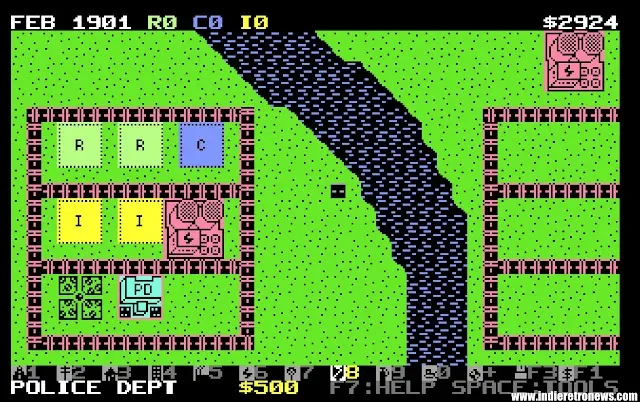
MicroCity v1.9, an urban-planning simulation from developer Jammet, has officially been released for the Commodore 64. Designed around the enduring appeal of city-management games, the new C64 title puts players in the role of a mayor responsible for transforming an untouched stretch of land into a thriving urban center.
The central goal is familiar in the best possible way: begin small, make decisions about a developing settlement, and guide it toward the visual and civic ambition of a full-scale metropolis. MicroCity starts its mayors with the modest beginnings of a single home, then asks them to oversee the growth that can eventually lead to lines of towering skyscrapers.
For retro players, that premise alone is notable. City builders are often associated with the scale, processing power, and elaborate interfaces of later computer hardware, but MicroCity v1.9 brings the satisfaction of planning, expansion, and urban progression to the Commodore 64. It is a new release built for one of gaming's most beloved home computers, rather than simply a retrospective curiosity about the platform.
A City Starts With One House
MicroCity's structure is rooted in the classic fantasy of being placed in charge of a blank map and being told that its future is entirely in the player's hands. The available description positions every player as the mayor, beginning with an empty plot and a humble home before pursuing the larger objective of a bright, bustling cityscape.
For useful background on this topic, read How to Clear the Cache on Xbox Series X and When to Reset It.
That gradual rise is fundamental to the appeal of urban simulation. A city does not arrive fully formed; it is the result of many stages of development. The earliest phase carries its own importance because every successful metropolis must first establish a foundation. Even the transition from one small residence to a growing community gives players a tangible sense that their choices are producing visible changes.
As development continues, the prospect of skyscrapers offers a clear image of long-term success. High-rise buildings are more than an attractive final visual in city-management games: they represent a dramatic contrast with the sparse starting point. MicroCity v1.9 frames its progression around that contrast, from near-empty land to dense urban development.
For a Commodore 64 game, the city's visual evolution may be especially satisfying. The machine's distinctive graphics and sound capabilities have long encouraged developers to find expressive ways to communicate big ideas within a compact technical environment. A city growing from a single home into a glowing metropolitan skyline is precisely the kind of transformation that can make every step forward feel meaningful.
For another perspective on this story, read MicroCity v1.9 Brings City Planning to Commodore 64.
Inspired by a Defining Simulation Formula
MicroCity v1.9 takes inspiration from the legendary mechanics associated with SimCity. That lineage immediately establishes the game's broad creative territory: city growth, planning decisions, and the challenge of balancing development over time. Rather than centering on a single character or a linear campaign, this type of simulation makes the settlement itself the ongoing project.
The most enduring city simulations make players think at two levels at once. There is the immediate task of getting something built and seeing the map change. Then there is the wider question of what kind of place is emerging from those choices. A single structure can be a beginning, but a metropolis requires a sense of direction and the patience to build toward it.
MicroCity's mayoral framing places that responsibility directly on the player. The game is not merely about observing buildings appear. Its premise is about guiding a town through the stages between its earliest settlement and its eventual skyline. The player's role is therefore one of stewardship, with the city serving as both the playground and the record of progress.
It is important to distinguish inspiration from imitation. MicroCity v1.9 is presented as a comprehensive urban planning simulation influenced by the celebrated city-building model, but its identity is tied to its own developer, its Commodore 64 target hardware, and its focus on taking an empty plot through a complete-looking arc of urban growth.
Why New Commodore 64 Games Matter
The Commodore 64 remains a remarkably active platform for developers and enthusiasts who continue to create software for original hardware and compatible setups. New projects for the system regularly demonstrate that retro gaming is not only about preserving older releases. It is also about continuing the creative conversation that those machines started.
MicroCity v1.9 fits that ongoing tradition particularly well because urban simulations are ambitious by nature. They ask a game to represent change across a map, communicate the status of a settlement, and give the player an understandable way to shape a much larger whole. Bringing that concept to the C64 emphasizes the appeal of designing within a platform's specific constraints instead of treating those constraints as a reason to avoid complex genres.
There is also something fitting about a city builder arriving on a computer platform. The Commodore 64 has a long-standing place in the history of home computing and game development, and a planning-focused simulation highlights the machine's identity as more than a vehicle for arcade action. It offers a slower, more reflective kind of play, where the reward comes from watching an organized space become larger and more alive.
That does not mean MicroCity needs to be approached only as a historical novelty. Its basic premise remains evergreen. The appeal of creating a settlement, seeing it expand, and aiming for a skyline is just as understandable now as it was when city-management games first captured players' imaginations. The C64 setting gives that familiar appeal a different character.
From Empty Land to a Glowing Metropolis
The language surrounding MicroCity v1.9 emphasizes a city that becomes both thriving and glowing. That description suggests that the destination is not simply numerical growth or a collection of buildings. The desired result is a place that feels active, developed, and visibly transformed from the undeveloped land where the process began.
A glowing metropolis is one of the genre's most recognizable images. It conveys activity, prosperity, and density in a single look. Reaching that point after starting with a lone home gives the game a natural sense of scale, even if the player's work unfolds one decision at a time.
This is why city planning remains such a durable game concept. It combines creativity with structure. Players can appreciate the aesthetic side of a developing settlement while also engaging with the more strategic satisfaction of growth. The city is a reflection of the player's direction, whether the focus is on a careful beginning, steady expansion, or the pursuit of a dramatic urban skyline.
MicroCity v1.9's concept also makes it approachable for players who enjoy simulations but want a clear objective. The starting point is easy to understand: there is empty land. The long-term vision is equally clear: build toward a major city. Everything between those points is where the planning experience lives.
An Invitation for Retro City-Building Fans
Jammet's release will likely draw interest from Commodore 64 owners, retro-computing fans, and players who have always enjoyed the foundational ideas behind city-management games. Its premise offers a recognizable route into the genre while placing that route on hardware with a dedicated community and a distinctive technical personality.
MicroCity v1.9 is also a reminder that the retro scene still has room for genres beyond platformers, shooters, and conversions of familiar arcade formats. Urban planning asks for a different kind of attention. It rewards players who want to oversee a process, monitor the evolution of a map, and enjoy the gradual payoff of a settlement becoming a city.
At its heart, the game's promise is uncomplicated and appealing: take charge as mayor, begin with almost nothing, and build toward something imposing. From a single humble home to rows of skyscrapers, MicroCity v1.9 gives Commodore 64 players a fresh opportunity to pursue the enduring dream of making a city rise from the ground up.
Community
Discussion
Start the conversation.
No comments have been posted yet.