


The Video Game History Foundation has expanded its free Digital Library with the Colin Williamson Photography Collection, a newly digitized archive containing more than 300 images of Japanese video game culture from the late 1990s and early 2000s. Available from October 21, 2026, the collection offers an unusually immediate visual record of an era often remembered through game boxes, magazine scans, commercials and trade-show announcements rather than candid photographs of the places and people around them.
Williamson worked as a games journalist during that period, including writing for publications such as IGN and PC Gamer, while living and working in Japan. His camera accompanied him to major industry gatherings including the Tokyo Game Show and the JAMMA Show, but the archive is not limited to exhibition floors. It also captures developer interviews, city promotions, arcade landmarks, retail-adjacent displays and ordinary scenes from Akihabara and other Tokyo gaming districts.
That broader view is what gives the collection much of its historical appeal. Big reveals and glossy booths tend to survive in official promotional material. The daily surroundings of the industry--building exteriors, signage, rows of aging displays, people moving through a show or a promotion taking over a city street--are much easier to lose. Williamson's photographs put games back into the physical spaces where players, developers, retailers and publishers encountered them.
A Visual Record of a Defining Transition
The years covered by the archive were a particularly important period for the medium. Consoles and arcades remained major pillars of Japanese game culture, while the industry was also moving deeper into 3D production, larger development teams and global blockbuster releases. The photographs preserve the atmosphere surrounding that shift without reducing it to a list of hardware specifications or sales figures.
For useful background on this topic, read Witchspire's Dormant Powers Update Adds Familiars, Sigils and Weapon Overhaul.
Among the recognizable material are trade-show exhibits for Gran Turismo 3: A-Spec and Shenmue. The latter is represented with a detail that will be immediately familiar to fans of Sega's ambitious adventure: a forklift. Such images provide context for the scale and character of a game's public presentation, showing how companies translated a title's identity into physical booths, props and show-floor spectacle.
The collection also includes a street promotion for Space Channel 5 featuring producer Tetsuya Mizuguchi. It documents Nintendo's Space World presentations as well, including material connected with the Game Boy Advance. Elsewhere, the photos preserve advertising for titles including Jet Set Radio and Final Fantasy IX, two games that remain strongly associated with the creative identity of the era despite representing very different publishers, aesthetics and audiences.
For players who experienced this period firsthand, the archive may inspire recognition. For younger audiences, it provides a useful corrective to the clean, isolated version of history often presented by promotional images. Game culture was not only a sequence of famous releases. It was also neon signage, crowded events, stacks of CRT televisions, temporary displays, arcade entrances and the visual noise of a district built around electronics and entertainment.
For another perspective on this story, read Colin Williamson's Japan Gaming Photos Join VGHF Digital Library.
Akihabara and Sega Landmarks in the Frame
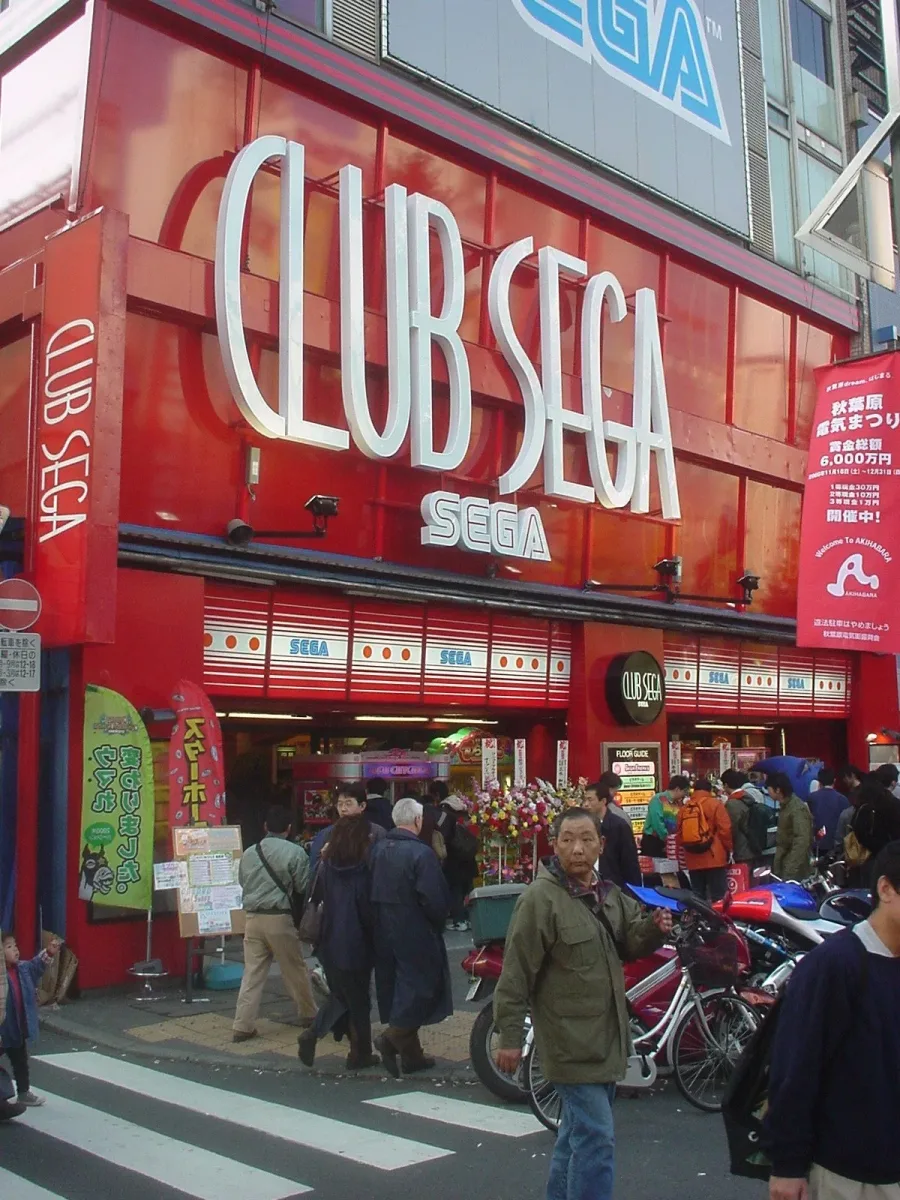
Several of the photographs focus on cultural landmarks and streetscapes that are meaningful beyond any individual game. The archive includes images of the exterior of Club SEGA, SEGA Hi Tech Land signage and banks of CRT displays. These are the kinds of details that can become more valuable as years pass, especially as storefronts change, businesses close, display technology disappears from public spaces and neighborhoods are rebuilt around new trends.
Arcades have long been central to the story of Japanese video games, yet the visual history of their everyday operation is often fragmented. Official materials usually prioritize a cabinet, a logo or a game screen. Williamson's work instead helps convey the setting around those objects: the urban landscape, the scale of a venue and the visual language used to draw people inside.
The photographs of Akihabara and other Tokyo game districts similarly show that the history of gaming cannot be separated from the places that cultivated it. These neighborhoods served as commercial centers, gathering places and symbols of technological culture. A sign for a game, a tower of monitors or a storefront that might once have seemed unremarkable can now function as evidence of how games occupied public life at the time.
Images of everyday surroundings can become essential historical records precisely because they were not originally treated as history.
That idea is central to the value of a photographic collection like this one. A convention booth can explain how a company wanted its game to be seen. A street-level photo can show how the public actually encountered the wider culture surrounding it. Together, both kinds of images make a stronger record than either could alone.
Why Preservation Extends Beyond Games Themselves
Video game preservation is frequently discussed in terms of playable software: cartridges, discs, prototype builds, source code and hardware. Those materials are indispensable, but they are only part of the historical picture. Documentation such as magazines, catalogs, advertisements, photographs and correspondence helps future researchers understand the creative, commercial and social world in which games were produced and played.
The Video Game History Foundation's Digital Library is built around that broader preservation mission. The organization says its library has grown substantially since launching in December 2025. It now contains more than 8,000 cataloged items comprising roughly 61,000 individual files. The addition of Williamson's images gives visitors another type of primary material to explore: photographs created in the moment rather than retrospective accounts assembled years later.
Library Director Phil Salvador described the value of the collection in terms of its ability to show both the headline-making events and the ordinary scenes that become historically significant over time. That distinction matters. It is easy to identify a major trade show as an important occasion. It is harder to predict which storefront, poster, display arrangement or street promotion will later offer the clearest evidence of a vanished cultural moment.
Executive director Frank Cifaldi has also pointed to the public response to the free Digital Library since its debut. A freely accessible collection can support more than nostalgia. Researchers, students, game developers, historians and curious players can use these materials to investigate subjects that are difficult to reconstruct from memory alone, from the evolution of branding to the relationship between arcade spaces and console culture.
An Expanding Archive of Game History
The release of the Colin Williamson Photography Collection arrives alongside the foundation's 2026 Annual Impact Report, which outlines several other preservation efforts. Among the notable projects is the 2024 recovery of source code for Xcavator, an unfinished NES game, from the family of programmer Chris Oberth. Restoration and publishing support for that project involved Mega Cat Studios and iam8bit.
The report also highlights the acquisition and digitization of Computer Entertainer, an early American gaming magazine. Like the photo archive, that work emphasizes the importance of preserving materials that may not fit the narrowest definition of a video game but are critical to understanding the medium's development. Publications document what players were told, what hardware and software were available, and how the industry presented itself to audiences at a particular time.
Williamson has discussed his years in Japan and the photography collection on the foundation's Video Game History Hour podcast. An extended bonus segment about the collection is available for the organization's Patreon members. The conversation provides added context for images that may initially appear self-explanatory but can carry much deeper stories about the events, workplaces and city spaces in which they were taken.
More History Work Ahead
The foundation is also preparing its annual Winter Fundraiser, scheduled to begin on December 1, which is Giving Tuesday. The month-long campaign is set to include new videos and blog posts examining influential and canceled projects from video game history.
For now, the Williamson archive is a reminder that preservation can begin with looking closely. A Game Boy Advance presentation, a Sega arcade facade, a promotional campaign for Space Channel 5, or a line of CRT screens can each tell part of the same larger story: games were made, marketed and played within a living culture that changed rapidly at the turn of the millennium.
By making these photographs available through its Digital Library, the Video Game History Foundation has added another valuable window into that culture. The collection preserves not only famous games and industry events, but also the texture of the world around them--the details that are often invisible until they are gone.

Community
Discussion
Start the conversation.
No comments have been posted yet.