

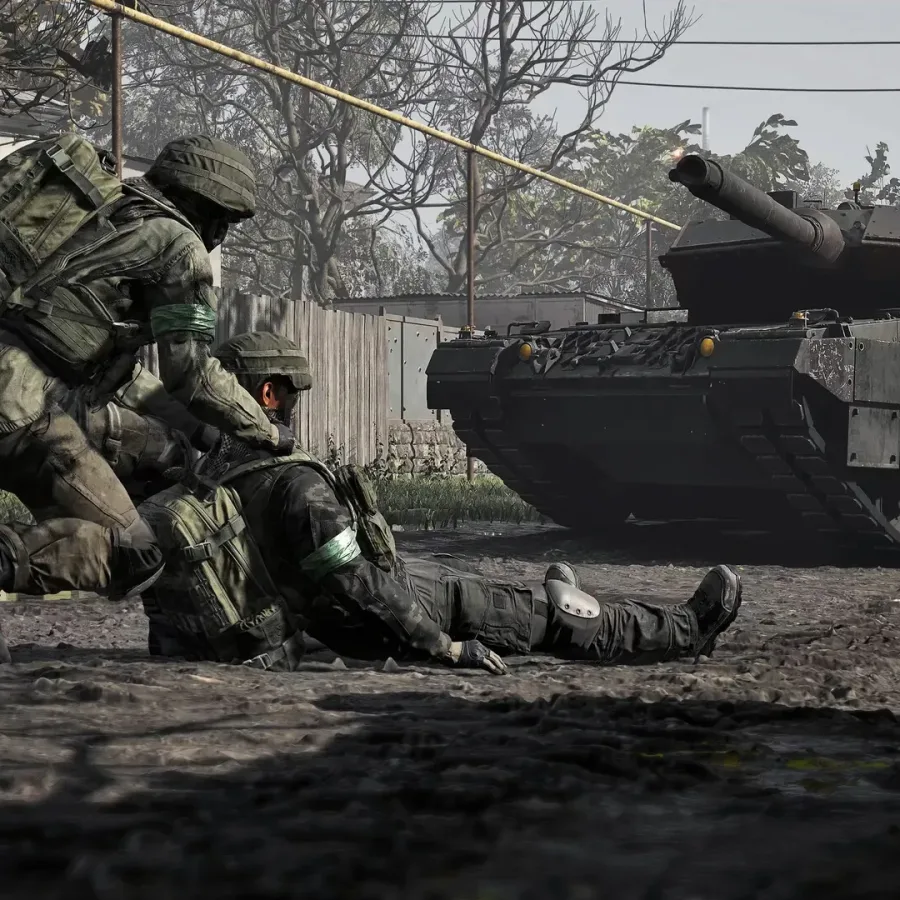
Wardogs' Blue Team is losing badly, and the numbers suggest the community meme is not merely exaggerating a few unfortunate matches. In the free-for-all sandbox military game, three factions compete over a shifting central zone across huge battlefields: Valkyra in red, Manticore in green, and Lonestar in blue. They may have distinct looks and fictional identities, but each side is intended to have access to the same equipment and the same fundamental opportunity to win.
That is not how the results have played out. Lonestar, the Blue Team, has become notorious among players for chaotic defeats, ill-fated vehicle use, missed shots, accidental friendly fire, and the sort of battlefield mishaps that quickly turn into highlight montages. The faction's reputation has reached the point where many players appear to avoid it before a round even starts. And developer-supplied figures indicate that the perception has a real statistical basis: Blue is currently winning around 15% of games, compared with approximately 36% for Red and 49% for Green.
Those are enormous gaps for a three-team contest. Even after an apparent player-led push to improve Lonestar's standing, a 15% win rate leaves Blue far behind its rivals. At the height of the "Blue Team bad" phenomenon, the faction reportedly won only about 10% of matches.
The immediate joke is that Blue players simply cannot be trusted with tanks, helicopters, artillery, mortars, or revives. But the more interesting explanation involves Wardogs' early balance history, the lasting effect of player perception, and a feedback loop in which capable players choose the other factions because they expect Blue to lose.
For useful background on this topic, read Build an Ant Empire codes: Active Rewards and Redemption Steps.
Three factions, one unexpectedly lopsided war
Wardogs creates a particularly visible environment for faction-based reputation. Its battles are large and noisy, with heavy equipment, proximity chat, and plenty of opportunities for a single bad decision to become everyone's problem. A crashed helicopter before it reaches the front line is memorable. So is an errant shot, a poorly timed defibrillator, or an ambitious vehicle charge that ends with a squad stranded far from the objective.
Lonestar's defeats have consequently become part of the game's culture. Videos and compilations circulate around its apparent disasters, reinforcing an image of Blue as a faction filled with players who are either brand new, uncoordinated, or choosing the least efficient possible way to fight a war.
Still, the faction identities themselves do not automatically explain the imbalance. Red's Valkyra has a Soviet-inspired look, Green's Manticore uses Persian-influenced gear, and Blue's Lonestar resembles a Western private military company. These visual differences may attract players with particular aesthetic preferences, but they are not supposed to create a mechanical advantage. The core issue is not that Blue has weaker weapons or lacks access to the same tools available to Red and Green.
Instead, the imbalance seems to have become social. Once a team is widely believed to be the losing team, experienced players have a reason to go elsewhere. Their departure makes the team weaker in practice, which validates the original belief and encourages even more players to leave. What begins as a reaction to a real disadvantage can become a self-perpetuating matchmaking problem.
Early alpha balance may have set the pattern
Howard Philpott, Wardogs' UI director, has traced the roots of the problem back to the game's alpha period. Before release, Blue was reportedly the most popular faction. Its limited early lore and American PMC-style aesthetic drew many players in, including a large number of newcomers.
At the same time, early alpha versions had a genuine map advantage that pushed more competitive players toward Red and Green. The exact nature of that advantage is not detailed, but its long-term consequence is clear: players seeking better odds began to associate Red and Green with winning, while Blue increasingly became associated with inexperienced recruits.
That association did not disappear when Wardogs moved beyond those early builds. Instead, it spread through player discussion and became ingrained in the wider community. An expectation that Blue would fail made people less likely to select it, especially when entering a match with friends. Players want to join the same faction as their group, and if friends are already choosing Red or Green to avoid Lonestar, the remaining Blue roster is less likely to benefit from organized squads and veteran leadership.
This is a common dynamic in competitive games, though Wardogs presents an unusually stark example because the faction labels are persistent, highly visible, and tied to color. A poor reputation can be hard to shake even after the balance conditions that helped create it have changed. Numbers become stories, stories become jokes, and jokes start influencing genuine player decisions.
Spawn placement is another major suspect
Players have also pointed to map geography. Blue's spawn is positioned in the middle of the map, while Red and Green begin on opposite sides. That layout can make Lonestar feel as though it is under pressure from two directions. Red and Green may each perceive a more straightforward front, whereas Blue can find itself between competing forces as both enemies converge on the central area.
Whether that geography is the primary cause of the win-rate gap is uncertain, but the Wardogs team is treating it seriously enough to make changes. For Season 2, the developers are moving team spawns on the Bakuriani map. The adjustment is intended to address the concerns around Lonestar's position and the perception that Blue faces a two-front war by default.
Spawn placement matters in games built around territorial control. It determines travel time, early access to key positions, the routes vehicles can use, and how easily a faction can recover after losing momentum. Even a subtle positional edge can compound over the course of a round, particularly when players are already inclined to believe one team has the worst starting circumstances.
The forthcoming changes will be an important test. If Blue's performance rises substantially after Bakuriani's spawns are reworked, the faction's central location may have been a major contributing factor. If it remains well behind Red and Green, then player selection and social momentum may be the harder problem to solve.
Why blue itself probably is not the culprit
With the teams divided so clearly by color, it is natural to ask whether color psychology plays a role. Blue is often linked with calmness, trust, intelligence, and thoughtfulness. Red is frequently treated as urgent, energetic, or aggressive, while green can carry associations with balance and peace. Could those ideas subtly affect the kinds of players each faction attracts?
Color behavioural design and color psychology specialist Karen Haller does not see the evidence pointing to blue as the reason Lonestar loses. After seeing the selection screen, Haller noted that people would ordinarily be expected to pick the first available option rather than skip it and move toward later choices. Yet that is what Wardogs players are doing: Blue remains visibly available while players deliberately select Red or Green.
For Haller, the situation looks less like a color-driven outcome and more like a self-fulfilling prophecy. She suggested that it would be interesting to compare results if Lonestar used a different shade of blue, or even another color entirely, but the available information does not support the conclusion that blue inherently creates a losing mindset.
In fact, blue's common associations can be spun in the opposite direction. Haller described blue as a color connected with the mind, intellect, and smart play. The joke, then, is that perhaps Lonestar is not incompetent at all; perhaps its players are engaged in an elaborate strategic plan that is simply too advanced for everyone chasing the zone.
That is obviously a playful interpretation of a serious imbalance, but it gets at the core distinction. The color may have helped make the meme distinctive and easy to repeat, yet it does not appear to have created the problem. The more likely cause is the accumulated behavior of players who have learned to expect failure from the faction.
Season 2 faces a perception battle as much as a balance battle
Wardogs' developers are not only changing Bakuriani's team spawns. They are also framing Season 2 as a kind of social experiment designed to change how the community sees Lonestar. That wording is telling. Mechanical adjustments can alter the battlefield, but repairing Blue's status requires changing player expectations.
Improved map positioning could make Blue feel less exposed. A more favorable opening could give Lonestar squads time to organize before they are squeezed from multiple sides. Better results may then encourage more experienced players to take a chance on the faction. In turn, stronger squads and more coordinated vehicle crews could make the faction more inviting to the next group of players.
But the reverse is also possible. If players continue selecting Red and Green on the assumption that Blue is doomed, then Lonestar may still begin many matches at a talent and coordination disadvantage. Community behavior can outlast patches, especially when a joke has become a shared identity marker. Some players may even choose Blue specifically for the chaos, while others avoid it because they do not want their own match decided by a faction's reputation.
For now, the statistics are hard to dismiss. A 15% win rate is a real problem, even if it represents progress from the faction's earlier low point near 10%. Red and Green are not merely ahead; they account for the overwhelming majority of victories. The planned Season 2 changes offer Lonestar an opportunity to prove that it is more than Wardogs' designated punchline.
Whether Blue can escape that role will depend on more than a new spawn location. It will require players to believe that choosing Lonestar is no longer an invitation to disaster. Until then, Blue's greatest enemy may not be Red, Green, or even the geometry of Bakuriani. It may be the assumption, shared before the first shot is fired, that Blue was always going to lose.
Community
Discussion
Start the conversation.
No comments have been posted yet.