

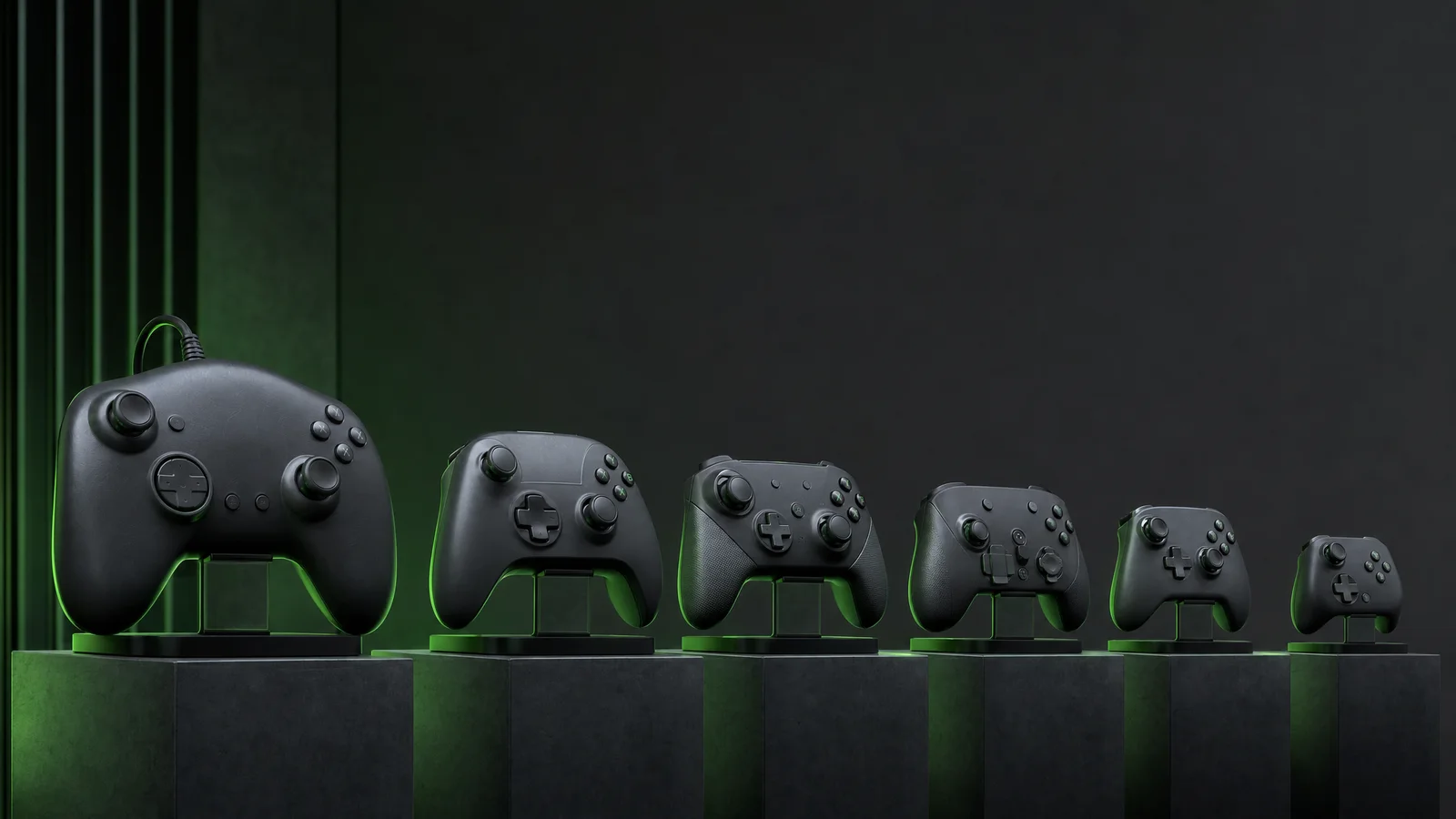
From the enormous Duke to the newly announced Nano, Xbox controller history is less a straight race toward “better” than a series of answers to the same question: how should a game feel in different hands?
The original Xbox arrived in 2001 with a large wired pad whose offset sticks gave Microsoft a recognizable silhouette. Controller S reduced the reach and made that layout more approachable. Xbox 360 brought wireless play and a central Guide button into the mainstream Xbox experience in 2005. The familiar arrangement survived because players could move to a new console without relearning where everything lived.
More than a console accessory
Microsoft’s XInput software interface helped Xbox-style controls become a common language for Windows games. DirectInput and newer GameInput remain part of the PC picture; compatibility is not magic or universal. But predictable button prompts and a familiar mapping explain why an Xbox pad is a frequent default recommendation for someone who plays on both console and PC.
Later hardware split into several useful branches. Xbox One revised the shape and added impulse triggers; later variants gained Bluetooth. The Elite family offered remappable paddles and trigger adjustments to players who wanted more control over the pad itself. Elite Series 2 refined that premium package with adjustable-tension sticks and a rechargeable battery, while the Core edition changed the included component bundle rather than starting a wholly new generation.
The Xbox Adaptive Controller broadened the story beyond a handheld shell. Its ports support individualized combinations of switches and inputs. It does not solve every accessibility problem, but it challenges the notion that one standardized controller shape can fit everyone. The mainstream Series X|S pad, meanwhile, refined the familiar form with textured surfaces, a hybrid D-pad and a Share button.
The Nano’s smaller proposition
Microsoft announced the Xbox Nano on October 14, 2026. The company says it is a little over five inches long, weighs 3.5 ounces, keeps all 18 standard gameplay inputs, adds a programmable Action Button, and offers rechargeable power plus Xbox Wireless and Bluetooth. At a stated US$49.99, it is available for preorder in select markets with November availability planned. Price and availability vary by region. Those are announcement details, not proof of comfort, reliability or long-session suitability.
Buyers should compare hand fit, platform support, battery arrangements and warranty rather than treating any one generation as a universal winner. Joking Joystick’s full Xbox controller timeline from Duke to Nano explores the design changes, the Elite and Adaptive branches, and why Xbox’s Windows familiarity remains a strong—but subjective—part of its case.
Community
Discussion
Start the conversation.
No comments have been posted yet.