

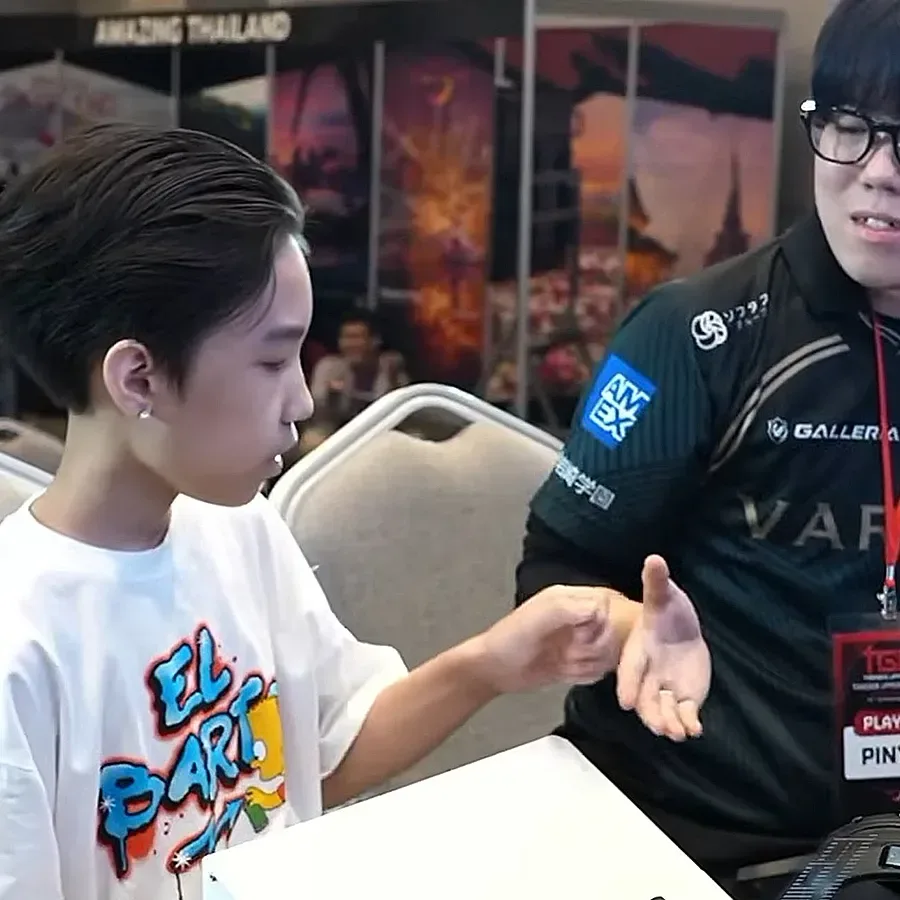
A remarkable run from 13-year-old Tekken competitor Martinski became one of the biggest talking points to emerge from this year's Thaiger Uppercut tournament in Thailand. The Filipino player defeated established Japanese professional Pinya in a 2-0 set, sending a long-time high-level competitor into the losers' bracket and immediately drawing the attention of the wider fighting game community.
The result would have been noteworthy on its own. Martinski's age, tournament placement, and presentation gave the story an extra spark, however. He competed with a sharply styled hairstyle that strongly resembled the iconic swept-up look of Kazuya Mishima, the former Tekken protagonist who has become one of the series' defining antagonists. The visual comparison quickly spread alongside clips and discussion of his upset victory.
More importantly, the appearance did not overshadow the substance of the performance. Martinski made the Top 48 in a difficult field and ultimately finished in 25th place from a bracket containing 187 other players. That is an impressive outcome for anyone attending a major event, and it is especially striking for a player at the beginning of his teenage years competing against experienced regional and international opponents.
Embedded X/Twitter post
Embedded X/Twitter post
A breakthrough set on a major stage
Thaiger Uppercut, often shortened to TGU, is a major annual fighting game event held in Thailand during the fall. It has developed a reputation for bringing together elite competitors across several games, with players traveling from different parts of the world for bracket runs, prize money, recognition, and the opportunity to measure themselves against a strong international field.
For useful background on this topic, read Magic: The Gathering Has No Current Plans for More Star Trek Sets.
In that environment, Martinski faced Pinya, a Japanese Tekken player with a long history at the top level. Pinya has competed prominently since the Tekken 7 era, making the 2-0 result a particularly meaningful one. Tournament upsets are part of what makes fighting games compelling, but a clean win over a seasoned player can instantly alter how a rising competitor is viewed by fans and potential future opponents.
Martinski's victory placed Pinya in the losers' side of the bracket, while the young player continued his own run into the Top 48. His eventual 25th-place finish shows that the headline-grabbing win was not simply a single isolated moment. He was able to navigate enough of the event's demanding bracket to finish ahead of a large portion of the 187-player field.
After the tournament, Martinski reflected positively on the experience, saying he was proud of the run and grateful for the chance to compete. He also emphasized a familiar fighting game principle: every tournament provides a lesson, whether the final result is a title, a deep placement, or an early elimination. For a player who has already had a major upset attached to his name, that mindset may be just as important as the result itself.
Kazuya-inspired style helps make a memorable debut
Competitive results tend to make players visible, but distinctive personality can make them memorable. Martinski's hairstyle did exactly that. Its resemblance to Kazuya Mishima's famously pointed hair gave viewers an immediate Tekken-specific image to connect with his run, creating a fitting visual for a newcomer defeating an established name.
Kazuya has been central to Tekken's identity for decades. His role in the Mishima family conflict, his fierce rivalry with other members of the bloodline, and his recognizable design have made him one of the fighting genre's most enduring characters. For longtime spectators, seeing a young competitor take down a veteran while sporting a Kazuya-like hairstyle was an easy moment to celebrate.
Still, the viral appeal should not reduce Martinski's tournament to a novelty. Competitive fighting games leave little room for luck over the course of a lengthy bracket. Players must manage matchup knowledge, reactions, movement, mental composure, adaptation between games, and the pressures that come with playing under observation. To emerge with a Top 48 appearance at an event of TGU's stature requires a level of preparation and poise that stands apart from a single stylish photo or clip.
Strong showing in the teams bracket, too
Martinski also entered Thaiger Uppercut's 3v3 team competition. His squad, named Martinski's Magic Light Team, finished ninth out of 24 teams. The team result adds another dimension to his weekend, demonstrating that he was active beyond the main singles bracket and able to contribute in a different competitive format.
Team brackets ask for more than individual execution. Players must work around team order, prepare for a broader range of possible opponents, and handle the changing momentum that comes when one teammate hands a set to the next. A ninth-place finish in a 24-team field is another respectable mark from a tournament weekend that has already put Martinski on many viewers' radars.
The next generation is already making noise
Martinski's breakthrough fits into a wider pattern visible across modern fighting games. Younger competitors are increasingly appearing in serious tournament brackets, particularly in Tekken 8 and Street Fighter 6. Their success does not mean experience has stopped mattering; veteran players still bring years of matchup knowledge, event experience, and composure. But the gap between established stars and younger challengers can be narrowed quickly by online competition, accessible training resources, replay analysis, and a willingness to play frequently against strong opponents.
Tekken has already seen another notable teen rise this season. Sixteen-year-old player Neia made the Top 24 in Tekken 8 at Evo France, one of the year's deepest events. During that run, she defeated recognized professionals Hakim "Skywalker" Touré and Jonathan "Tibetano" Medina. Those victories helped establish her as one of the scene's emerging names, and Martinski's TGU performance now offers another reminder that the next wave is not waiting quietly on the sidelines.
The trend is also clear in Street Fighter 6. Chilean competitor Blaz, now 17, recently helped his team 2Game win the Street Fighter League Americas Finals. His record of success started earlier, as he had already been taking on tournament competition at 15 and claimed second place at Capcom Cup 11 only a few months after turning 16.
Another Chilean talent, Craime, has followed a similarly eye-catching path. At 15, he made the Top 8 at Evo Las Vegas this year, though he had been entering tournaments since he was 13. Earlier in the year, he won the Esports World Cup in Street Fighter 6, a victory that firmly positioned him among the game's major threats.
These stories are not identical. Different games place different demands on players, and every region has its own tournament culture, infrastructure, and access to practice partners. Yet the shared theme is difficult to miss: talented teenagers are no longer merely promising names for the distant future. They are beating known professionals, placing highly at enormous events, and influencing the current competitive conversation.
Why runs like Martinski's matter
A finish outside the final rounds can sometimes disappear from public memory once a tournament concludes. Martinski's placement may be 25th, but the context gives it longer-lasting significance. He beat an experienced professional 2-0, reached the Top 48, competed successfully in the team event, and did it all at 13 years old in a major international setting.
That does not guarantee a specific future result. Fighting game careers are unpredictable, and one excellent tournament is only one stage in a player's development. The strongest scenes are full of talented competitors who must keep improving as strategies evolve and opponents study their play. Martinski will face that reality if he continues to enter major events.
For now, though, Thaiger Uppercut has given Tekken fans a compelling new competitor to follow. His Kazuya-inspired hair may have helped introduce him to a wider audience, but the reason people will remember the weekend is much simpler: Martinski earned attention in the bracket. At 13, he has already shown he can stand across from a veteran player, win convincingly, and leave a major tournament with a result worth celebrating.
Community
Discussion
Start the conversation.
No comments have been posted yet.