

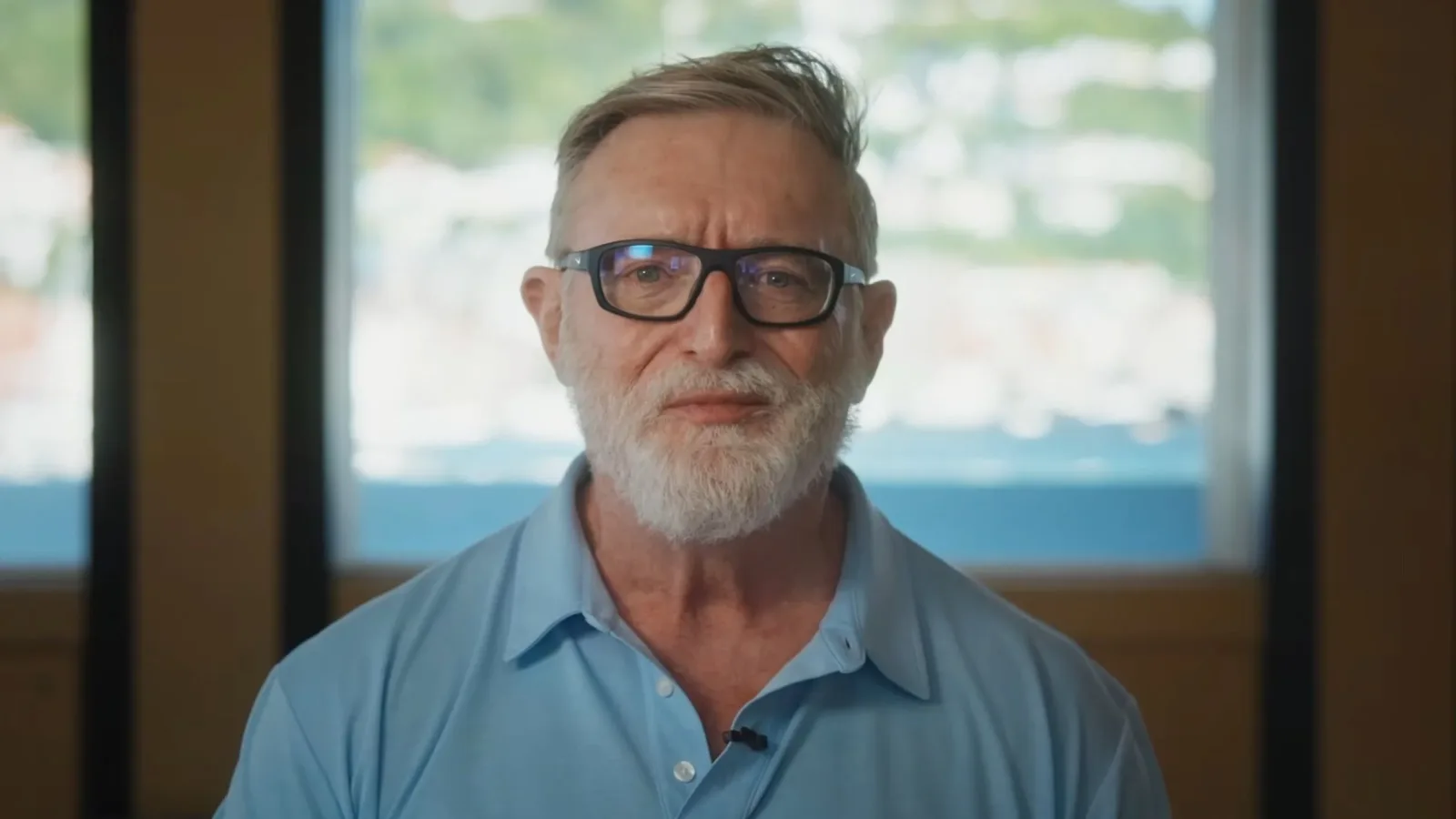
Valve co-founder and Steam leader Gabe Newell is again drawing attention from the gaming community, though this time it is not because of a Valve announcement, a Steam feature, or an update for one of the company's games. A newly released tour of his superyacht, Leviathan, has put the spotlight on the vessel's unusual approach to crew spaces, employee development, and even PC gaming.
The $500 million yacht has been presented as a particularly unconventional entry in the ultra-luxury sailing world. Its striking facilities include high-end diving capabilities and palatial guest areas, but the points attracting the strongest reaction are the spaces that are not reserved solely for Newell and his visitors. The walkthrough emphasizes that many decisions aboard Leviathan are designed around the people who operate the vessel every day.
That distinction may sound basic outside the context of superyachts. Within that industry, however, it is presented as highly unusual. The tour repeatedly contrasts Newell's arrangements with the more traditional division between owner, guest, and crew areas seen on vessels of this scale.
A lounge designed for the crew rather than guests
One of the clearest examples is a large, lavishly appointed lounge that would ordinarily serve as a yacht's main guest saloon. Instead, Newell reportedly chose to make the space the crew mess: the central area where staff can eat, relax, and spend time together. He also reportedly joins the crew for meals every day.
For useful background on this topic, read Stand Out codes for November 2026: Free Arrows and Dalas.
Francesca Webster, editor-in-chief at SuperYacht Times, described the decision as something the organization had not encountered before in the sector. The point is not simply that the crew have access to a functional dining room, but that they use a space comparable to one normally treated as a showcase area for guests. The stated goal is a more shared experience aboard the ship rather than a rigidly separated hierarchy.
That detail has become the defining takeaway from the tour. Public discussion of billionaires and luxury yachts often centers on the scale of the spending involved, and Leviathan is no exception. But the video's presentation has shifted much of the conversation toward how those resources are being distributed within the ship's working environment.
It is also a reminder that an extravagant purchase and the treatment of the people employed around it are separate questions. The existence of a $500 million private yacht naturally invites criticism of wealth inequality and the systems that make that level of personal spending possible. At the same time, the tour makes a case that conditions for staff can differ sharply depending on ownership choices. Both discussions have followed the video, often at the same time.
Longer crew retention than the typical superyacht
The most concrete indication of that working environment is the crew retention figure cited in the walkthrough. Staff on Leviathan are said to remain for an average of 4.5 years. For yachts in this category, average tenure is said to run from roughly six to nine months.
Those numbers, if representative of the vessel's ongoing operations, are a significant difference. Retaining staff for multiple years suggests more than a decorative crew lounge. It can point to steadier working relationships, an environment people are willing to return to, and opportunities for specialists to develop familiarity with the ship's complex systems. A vessel as large and unusual as Leviathan likely demands that kind of experience.
The tour does not claim that a single amenity explains the retention rate. Still, its picture of the yacht connects several policies: better-appointed living and communal areas, shared meals with the owner, training opportunities, and the use of premium accommodations by crew when appropriate. Together, those decisions form the portrait of a workplace designed less around keeping staff out of sight and more around treating them as part of the operation.
That approach has been especially notable to viewers because the superyacht world has long been associated with a strict service model. Crew members are essential to making a vessel function, yet the public-facing image usually prioritizes owners and guests. In the case of Leviathan, the people responsible for the yacht's day-to-day operation are a major focus of the presentation.
VIP-standard space can also serve crew needs
Another feature highlighted in the walkthrough is a VIP cabin that is also used by crew. Webster described the room as particularly unusual because of both its purpose and its standard of finish. The implication is that staff accommodation does not always need to be treated as an afterthought, even aboard a yacht whose design is intended to support luxury travel.
The room has prompted a straightforward response from many viewers: it is surprising that the arrangement is surprising at all. The idea that crew members can be given comfortable, high-quality private spaces should not be radical. Yet the video's repeated emphasis on the point underlines how uncommon such choices apparently are at this level of private ownership.
Newell's reputation has long been unusually positive for a figure with his wealth and influence. Among PC players, he is closely associated with Valve, Steam, Half-Life, Portal, Counter-Strike, and Dota 2, as well as the broader expansion of digital distribution on PC. The affectionate "Gaben" nickname has endured for years, even through long-running community jokes about the status of projects such as Half-Life 3.
That history has shaped the response to the yacht tour. Some fans have viewed the onboard decisions as consistent with a public image of Newell as a comparatively approachable executive. Others have been more skeptical, arguing that positive treatment of employees should be expected rather than elevated into proof of exceptional character. The video supports the first interpretation in its tone, while the wider debate around extraordinary wealth naturally supports the second.
Fifteen PC gaming stations aboard Leviathan
For gaming audiences, the most immediately recognizable feature may be Leviathan's dedicated PC setup. The yacht includes 15 PC gaming stations intended for crew, guests, and Newell himself. The room is not framed solely as an entertainment space, either: it is also used for crew training and development.
That dual purpose is fitting for a yacht owned by the head of Steam. A bank of PCs makes obvious sense as a way to relax during downtime, whether the people using them are playing Valve titles, browsing Steam's enormous catalog, or taking part in multiplayer sessions while at sea. But presenting the same room as a place for skill-building gives it a more practical role within the vessel's daily routine.
It is not known what games Newell plays there, although the idea of him using the room for Dota 2 is an easy one for fans to imagine. More important than any particular game is the fact that the systems are shared rather than treated as a private novelty for the owner. Crew members have access, as do guests and Newell.
In a narrower sense, the gaming room is another expression of the tour's overall theme. The yacht's resources are not depicted as flowing in one direction toward a single owner. There are still obvious differences between ownership and employment, and Leviathan remains an extraordinarily expensive private vessel. Yet the features singled out in the video consistently show amenities being made available to the people working aboard it.
An unusual public image for a yacht owner
Newell has previously said that he stepped back from making games directly at Valve after Portal 2. His explanation was that when he wanted to work with a team and offer ideas, people kept agreeing with him. That anecdote has often been read as an acknowledgment of the pressures that can arise when a company founder enters a creative process.
The yacht tour creates a different, if related, picture of leadership: one focused on making the workplace more communal rather than emphasizing distance and authority. It is impossible to judge a company, a person, or every working condition from a single polished walkthrough. A promotional video is designed to highlight the best version of its subject, and praise from an industry observer should not end scrutiny.
Even so, the details presented about Leviathan are notable because they are specific. A crew-first lounge, daily shared meals, high-end rooms that can be used by staff, a PC room with training functions, and reported 4.5-year average retention all amount to more than vague claims of a pleasant working atmosphere.
The response from Valve fans has been predictably enthusiastic, with many treating the tour as fresh evidence for Newell's favorable standing in gaming culture. The broader reaction is more complicated, and it should be. But the unusual design of Leviathan has still created a rare moment in which a superyacht video is being discussed not just for its luxury, but for the people behind the scenes who keep it moving.

Community
Discussion
Start the conversation.
No comments have been posted yet.