
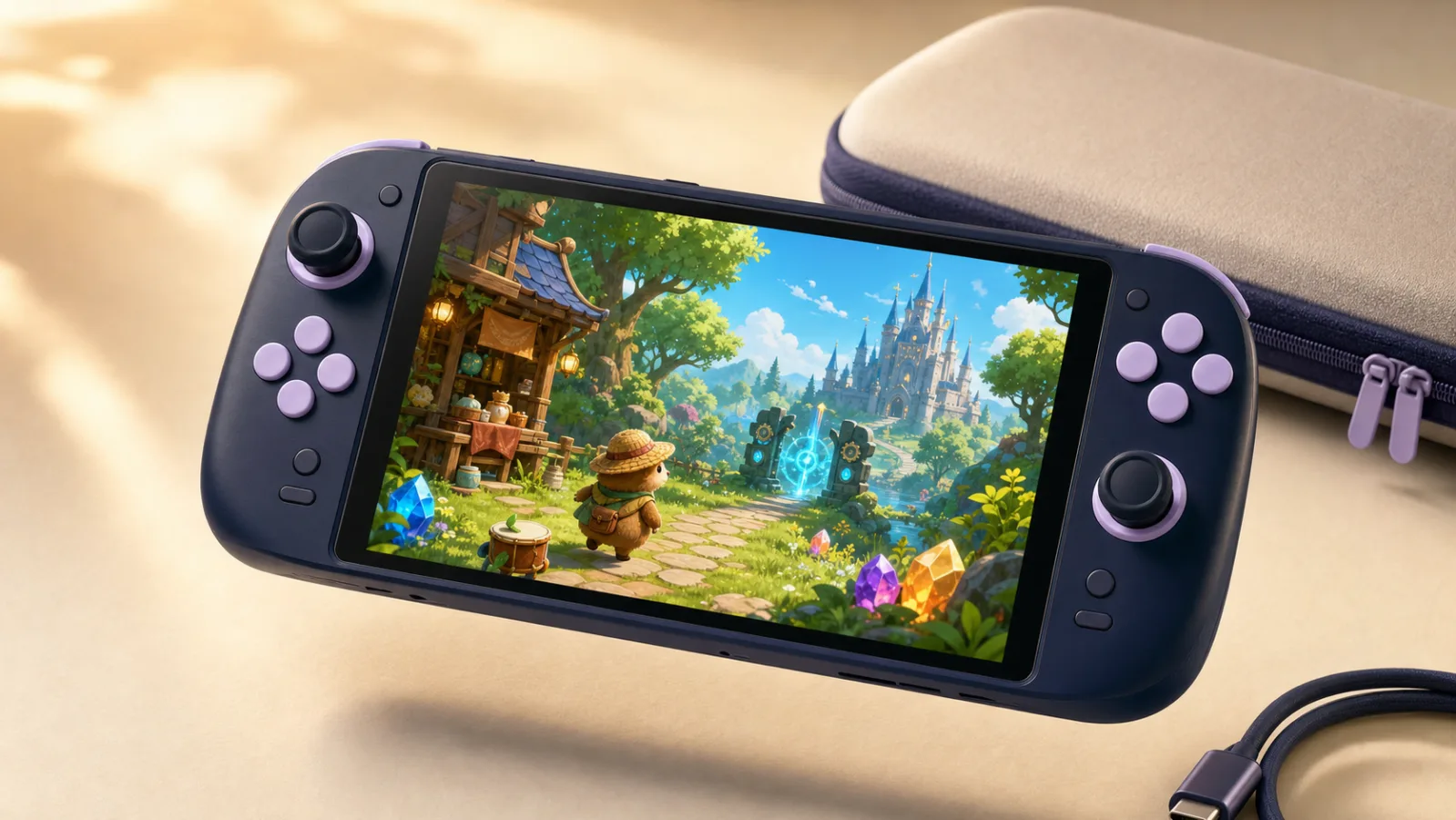
Handheld gaming is not one single experience. It can mean playing a quick arcade challenge on an older electronic handheld, settling into a long action adventure on a portable console, revisiting an NES maze game, or taking a modern indie game from television-sized play to a smaller screen. The best way to begin is not to chase every system or every genre at once. Start by deciding how you want to play: in short bursts, during travel, at home in bed, alone with headphones, or alongside friends.
This guide uses a varied group of games to show what a new handheld player should look for. Some are clearly built around compact, repeatable action. Others are substantial adventures that happen to have portable versions. A few are retro titles connected to handheld electronic LCD systems, while several modern games are available on Nintendo Switch, PlayStation Vita, Android, iOS, or upcoming Switch hardware. That breadth is useful. A good handheld library should give you an immediate game for five spare minutes, a deeper game for a long evening, and at least one social or replayable option.
Start with the kind of portable play you actually want
Before choosing a game, separate handheld gaming into three practical lanes. The first is pick-up-and-play: games with simple objectives, fast restarts, and clear rules. Arcade, puzzle, sport, and score-chasing games fit naturally here. The second is portable progression: adventures, platformers, and exploration games that reward returning over many sessions. The third is shared handheld play: games where passing a device around, playing locally, or connecting with other players is part of the appeal.
None of these lanes is better than another. They simply ask different things of your attention. A player with a busy schedule may get more value from a tightly focused action puzzle than from an enormous map. Someone who loves slowly learning a world may find a brief arcade loop unsatisfying. Knowing this early prevents the common beginner mistake of buying a celebrated game whose pace does not match the way they will use a handheld.
- Choose short-session games if you want immediate rules, quick retries, and simple stopping points.
- Choose longer adventures if you enjoy learning movement systems, revisiting locations, and unlocking new paths.
- Choose multiplayer-focused games if the handheld will be part of family, couch, or online play.
- Choose retro games if you appreciate direct design, limited controls, and the character of older platforms.
Understand platform fit before you choose
Portable-friendly does not always mean that every version of a game is handheld. Platform lists matter. Nintendo Switch is represented strongly in this selection, with Gem Smashers, FX-Unit Yuki: The Henshin Engine, Freedom Planet, Forma.8, Tanuki: Pon's Summer, and Tom the Postgirl listed for the system. Forma.8 also appears on PlayStation Vita as well as Android and iOS, making it the clearest choice here for players interested in several genuinely portable device categories.
Meanwhile, Handheld Electronic LCD appears in the records for Gauntlet, Fun House, Frogger, and Football!. These are a different proposition from a Switch or Vita library. Their appeal is tied to classic, highly constrained hardware and straightforward game concepts. Treat them as retro curiosities or history-minded choices rather than direct substitutes for a modern portable release.
Some games in this guide are future-facing. Ratatan is scheduled for Nintendo Switch 2 alongside PC, PlayStation 5, and Xbox Series X|S. Becrowned is also listed for Switch 2, while Tanuki: Pon's Summer is listed for Switch. Their presence is useful for planning a wishlist, but a beginner should distinguish announced or scheduled games from games they can play now. Building a starter library around confirmed access on the hardware you own is always the sensible first move.
The best first question: what does a satisfying session look like?
For a fast, colorful action-puzzle loop: Gem Smashers
Gem Smashers is a strong starting point for players who want a game that communicates its goal quickly. You rescue trapped animals by smashing colored gems before time runs out. The central wrinkle is that one of three prehistoric critters must find the appropriate power-up to transform into the color needed to eliminate matching gems. Clearing gems reveals the exit that lets the animals escape.
That structure makes it an inviting portable candidate. The objective is visible, the time pressure gives each stage energy, and the color-matching hook offers more than simple button mashing. Story, Arcade, and Vs. Battle modes provide several ways to approach the same core activity, while additional variants unlock during play. For a newcomer, Arcade is the natural way to learn its rhythm: focus first on understanding the transformation and matching requirement, then improve speed once the basic flow feels comfortable.
Pick this if you want short stages and a game that rewards concentration without demanding a lengthy commitment. It is listed on Game Boy Advance, Nintendo 3DS, Nintendo Switch, PlayStation Vita, PlayStation 4, and Wii, making it particularly notable as a game spanning several portable generations.
For a character-driven platform adventure: Freedom Planet
Freedom Planet is for the player who wants more than a quick diversion but still values immediate, physical movement. Set in the celestial world of Avalice, it lets you play as Lilac, Carol, or Milla. Each approaches enemies and obstacles differently. Lilac attacks with her hair and uses the Dragon Boost for high-speed aerial travel. Carol uses punches and kicks and can summon a motorcycle that rides on walls and ceilings. Milla creates throwable blocks and uses a psychic shield to reflect attacks.
For a first portable platform adventure, that character variety is a major advantage. You are not locked into a single solution to the game's combat and traversal challenges. A player drawn to speed and aerial movement may naturally prefer Lilac, while someone who likes close-range fighting might gravitate toward Carol. Milla is the obvious option for players interested in defensive tools and environmental utility. Adventure mode includes fully voiced cutscenes as the heroes defend Avalice from Lord Brevon and robotic minions; Classic mode presents the stages in order.
On a handheld, use the first sessions to learn one character rather than constantly switching. Platform games become more satisfying when your movement stops feeling like a list of inputs and starts feeling instinctive. Freedom Planet is listed on Nintendo Switch and Wii U among other platforms, so the Switch version is the portable fit in this group.
For exploration and gradual discovery: Forma.8
Forma.8 offers a different kind of long-form handheld game. You control a small exploration probe stranded on an alien planet after becoming separated from its companions. The task is to locate and recover a powerful lost energy source before time runs out. Its world is large and open, filled with secrets, ancient mysteries, deadly enemies, bosses, and power-ups that unlock further progress.
This is the best fit for a player who enjoys returning to the same world and slowly understanding its structure. Metroidvania design is often especially rewarding in portable play because it gives you meaningful goals at several scales. One session can be about reaching a suspicious passage, another can be about testing a new power-up in a previously inaccessible area, and a longer session can be about pushing through a difficult enemy encounter. You do not need to complete a huge objective every time you pick it up.
New players should resist the urge to treat every unexplored route as an immediate failure if it cannot be crossed. In a game built around unlocking progress, an obstacle can be a note for later rather than a wall. The hand-drawn vector graphics are presented at 60 frames per second, and the game is listed for Nintendo Switch, PlayStation Vita, Android, and iOS. That makes it an excellent cross-section of what modern handheld play can be: a full exploration adventure adaptable to dedicated portable hardware and mobile devices.
For a brisk retro-styled platform-and-shooting challenge: FX-Unit Yuki: The Henshin Engine
FX-Unit Yuki: The Henshin Engine is a focused choice for players who want platforming mixed with shoot'em up action. Yuki Shirokawa becomes FX Unit Yuki after approaching the FX Engine, then enters the CJC video game to stop SG Corporation's malware and defeat Ultradrive Unit Geni. The game spans eight levels filled with traps, enemies, and bosses.
Its compact level count is an advantage for a newcomer deciding whether action platformers are their genre. You have a clear arc, recognizable hazards, and boss encounters without a vast open-world commitment. The most helpful beginner mindset is to treat traps as patterns to learn rather than unfair interruptions. On a small screen, reduce distractions: play with sound on when possible, take breaks after repeated attempts, and do not rush into an unfamiliar section simply because you cleared the previous one quickly.
It is listed on Nintendo Switch as well as Dreamcast, Sega Genesis/Mega Drive, and TurboGrafx-16/PC Engine CD. That blend of platforms makes its Switch listing especially attractive to players who want a modern portable route into a game with clear retro hardware connections.
Retro handheld choices: simple rules, demanding execution
Retro handheld gaming can be wonderful for beginners, but it requires the right expectation. Older games often explain less, ask for precise timing, and place their challenge directly in the play rather than in layered tutorials. Their strengths are clarity, immediacy, and replay value. If you enjoy mastering a small set of rules, they can be ideal travel companions.
Gauntlet: best for dungeon pressure and cooperative play
Gauntlet is a labyrinthine action game in which players choose Thor the Warrior, Thyra the Valkyrie, Merlin the Wizard, or Questor the Elf. The goal is to navigate dungeons packed with enemies, find keys, open doors, collect treasure, and reach the exit. Each character has distinct abilities and attributes, and the game supports cooperative multiplayer for up to four players.
For a beginner, its important lesson is resource awareness. Do not merely fire projectiles at every threat; keep moving, learn enemy behavior, watch for keys and routes, and coordinate with other players if playing cooperatively. It is a good pick for people who enjoy being under constant pressure and who like the idea that different character choices can change the team's approach. Its Handheld Electronic LCD listing places it within the retro handheld conversation, while the NES version gives it a well-known home-console identity as well.
Frogger: best for pure timing
Frogger is built around one instantly understandable goal: guide Frogger home across a dangerous highway of cars and trucks, then across a swirling river populated by frog-eating creatures. That directness makes it one of the easiest games in this selection to begin, though not necessarily one of the easiest to master.
Its core portable appeal is repetition with purpose. Every failed attempt teaches the timing of a crossing or exposes a risky decision. Beginners should start by planning one safe move at a time rather than staring at the final destination. A successful route is made from individual choices: wait, hop, stop, and reassess. The game is listed for Atari ST and Handheld Electronic LCD, which firmly positions it as a retro-style, high-focus option rather than a modern long-form adventure.
Football!: best for two-player retro competition
Football! is a two-player American football game where players captain teams of electronic football stars and choose offensive and defensive plays including passing, running, field-goal attempts, and interception opportunities. On-screen sensors automate parts of the action, defensive linemen follow the ball, and a digital display tracks score and time. Crowd sounds, whistles, and a touchdown bugle give the match a distinct electronic presentation.
This is not the choice for someone seeking a detailed modern sports simulation. It is for players who want approachable head-to-head competition rooted in recognizable football decisions. The best way to learn is to play several short matches with the same opponent, deliberately trying passing, running, and defensive responses rather than chasing wins immediately. It is listed for Handheld Electronic LCD alongside Atari 2600, Magnavox Odyssey 2, and Texas Instruments TI 99-4A.
What about unusual genres and future portable picks?
A starter library becomes more personal when it includes one game outside your usual comfort zone. The supplied games offer several distinct possibilities. Tanuki: Pon's Summer, listed for Nintendo Switch, follows Pon, a tanuki working part-time at the Post Office. With the Tanuki Festival one month away and the shrine in disrepair, Pon spends the summer delivering packages, befriending people, and helping prepare for the celebration. This is the natural choice for someone who wants a slower simulation-focused experience rather than reflex-driven action.
Tom the Postgirl, listed for Nintendo Switch, is an adventure visual novel about a postgirl traveling through her village and uncovering the residents' secrets through an intentionally dark and unusual premise. Visual novels can work well in portable sessions because reading and decision-focused play offer a very different pace from constant movement. Its subject matter will not suit every player, so treat its premise as the deciding factor.
Ratatan is a scheduled rhythm roguelike action game with side-scrolling battles that can feature more than 100 characters in a melee and online co-op for up to four players. It is worth watching if musical timing, repeatable roguelike structure, and cooperative action sound appealing. Becrowned, also scheduled for Switch 2, is a surreal survival horror adventure set in a dark realm where fire no longer burns. Choose it only if you are specifically looking for an unsettling, mystery-driven atmosphere; it is not a gentle starting point for someone who dislikes horror.
A sensible first handheld library
If you are beginning from zero, do not build a library based only on one mood. A more useful setup has contrast. Start with one immediate game, one deeper game, and one game that reflects the specific kind of hardware or social experience you want.
- Pick an instant-play game: Gem Smashers for action-puzzle stages, or Frogger for classic timing-based arcade play.
- Add a game with progression: choose Freedom Planet for character-led platform action or Forma.8 for exploration, secrets, and ability-gated advancement.
- Add a distinct third experience: choose Gauntlet for cooperative dungeon pressure, Football! for retro two-player sport, or Tanuki: Pon's Summer for a quieter simulation direction when available on your platform.
There is no need to buy multiple games that all demand the same kind of concentration. Three similar action games can leave a newcomer feeling that handheld gaming is narrow or exhausting. One puzzle game, one adventure, and one social or relaxed game makes it easier to discover what you naturally return to.
Practical habits for better handheld sessions
Handheld gaming rewards small adjustments. Use headphones when a game's sound cues, music, or atmosphere matter, but keep volume at a comfortable level. In action games, a stable grip and a position where you can see the full screen are more valuable than playing in an awkward situation simply because the device is portable. For exploration games, stop at a place you can recognize when you return. For arcade games, decide in advance whether a session is for casual play or focused improvement.
Most importantly, let the device serve your routine rather than turning every spare minute into an obligation. A handheld is at its best when it lowers the barrier to playing. A single stage in Gem Smashers, a few crossings in Frogger, one new route in Forma.8, or a short stretch of Freedom Planet can all feel complete on their own terms.
The ideal first handheld game is therefore not necessarily the biggest, newest, or most difficult. It is the game whose structure fits the moments you have. Choose clear arcade rules if you want fast engagement, a platform adventure if movement and momentum appeal to you, a Metroidvania if exploration is your reward, or a retro electronic game if you want direct, concentrated play. Once you know which kind of session keeps calling you back, expanding your handheld library becomes much easier--and much more satisfying.
Community
Discussion
Start the conversation.
No comments have been posted yet.