

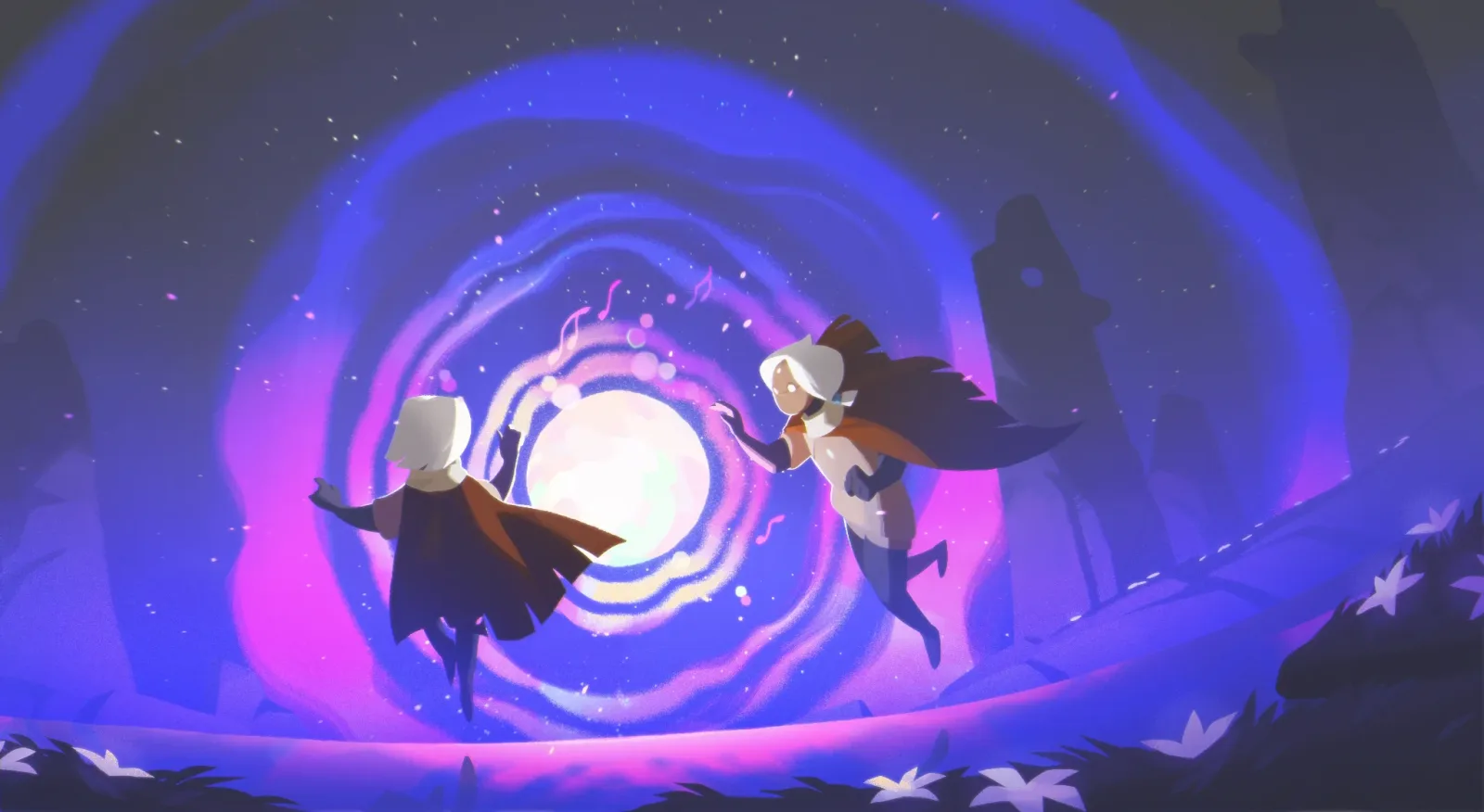
thatgamecompany has announced thatgamejam #02, a global independent game jam that will run from October 24 through November 7, 2026. Rather than beginning with a conventional written theme, this edition will open with a short audio track. Developers will be asked to use their personal response to that sound as the starting point for a new game, world, mechanic, mood, or other interactive idea.
The audio prompt will not be revealed until the jam begins, making the opening day an important moment for everyone taking part. It is intended to inspire interpretation instead of prescribing a single answer. Participants are explicitly not required to make rhythm games, music games, or projects that use the track as a soundtrack. The goal is broader: to see what happens when a shared sound is translated into many different forms of play.
Submissions open at 00:00 PT on October 24 and close at 23:59 PT on November 7. That gives entrants two weeks to plan, build, test, package, and submit their work. The event is open to students, hobbyists, and professional developers, whether they are working alone or with a team of up to five people.
An audio prompt built for interpretation
Game jams often give creators a short phrase, a visual reference, or a tight design constraint. thatgamejam #02 is taking a more sensory route. A brief piece of audio can suggest movement, emotion, place, tension, rhythm, story, or even a particular interface concept without saying any of those things outright. Two teams may hear the same prompt and reach entirely different conclusions.
For useful background on this topic, read Pixel Washer Scrubs Into Steam Early Access With Pigxel on the Hose.
One developer could hear a sense of isolation and make a quiet exploration game. Another might focus on an abrupt change in tone and build a puzzle around transformation. A team could treat the track's textures as an invitation to create an abstract visual space, while someone else may use its pacing to inform action-game encounters. None of these approaches needs to become a literal musical game to be connected to the theme.
That flexibility should make the jam approachable for a range of disciplines. Programmers can experiment with systems and controls; artists can build striking environments around a feeling; writers can develop a narrative response; and audio-focused creators can use sound as a design foundation without being restricted to a score-driven format. The theme asks for a creative reaction, not a narrowly defined genre.
It also creates a useful shared starting line. Everyone will receive the same track at launch, but the projects that emerge may vary dramatically in style and scope. That contrast is often one of the most rewarding parts of a jam: seeing how a common limitation or prompt becomes a platform for unexpected ideas.
For another perspective on this story, read thatgamejam #02 Will Ask Developers to Turn an Unrevealed Audio Track Into a Game This October.
Who can enter and what games must support
thatgamejam #02 welcomes creators at different stages of their development journey. Students looking to finish a small project, hobbyists seeking a deadline and community feedback, and experienced professionals wanting to prototype an unusual concept can all participate. Solo development is permitted, and teams can include up to five members.
For a short event, team size can have a major impact on planning. Smaller groups may be able to make decisions quickly and keep their projects focused. Larger teams can divide work across programming, art, design, sound, production, and testing, though coordination becomes more important. Since the jam lasts only two weeks, a clear early plan and a realistic feature list are likely to matter more than attempting to build a large game.
Submitted games must run on Windows or Mac, and English must be the default language. Those requirements provide a consistent baseline for judging while still allowing entrants to use the tools and engines that best suit their project. Developers should factor in packaging, installation, and basic testing on their intended desktop platform before the final hours of the submission window.
English as the default language does not prevent a project from having other language options, but entrants will need to ensure that the standard experience meets the event's stated requirement. As with any competitive jam, creators will also want to review the full rules and guidelines before committing to a concept, especially if they are working with a team or using third-party tools and assets.
Five awards are planned
The jam will recognize work across five award categories, offering incentives for both broad excellence and particular creative strengths. The announced awards are:
- Best Overall -- USD 3,000
- Best Gameplay -- USD 2,000
- Best Visual Design -- USD 2,000
- Community's Voice -- USD 2,000
- Taptap's Choice -- listed as USD 1,00
The category structure makes clear that a successful entry does not necessarily need to dominate every area. A game with especially polished mechanics may stand out in Best Gameplay, while a smaller or more atmospheric project could draw attention through visual direction. Community's Voice adds a separate route for an entry that connects strongly with players and fellow participants.
Taptap's Choice is also notable because the event includes a dedicated participation route for developers in China. While the award amount was announced in the event details as USD 1,00, entrants should consult the official rules for any further clarification on prizes and eligibility.
Judging, finalists, and the December results
thatgamecompany team members will review all submitted projects. Finalists will then be evaluated by Jenova Chen. The process combines an initial review across the full field with a final stage led by the studio co-founder and creative director.
Winners are scheduled to be announced on December 22, 2026. The later announcement date gives the organizers time to assess entries after the November submission deadline, identify finalists, and determine recipients across the five categories.
For participants, judging is only one part of the opportunity. A completed jam game can function as a portfolio piece, a prototype for a larger project, or a lesson in scoping and collaboration. Even projects that do not receive awards may benefit from the hard deadline, player reactions, and feedback that come with sharing work in a concentrated event.
The audio-led theme may be especially useful for portfolio projects because it gives creators an immediate explanation for their design process. Developers can show not only the finished game, but how they moved from a short sound-based prompt to a playable concept. That can reveal creative reasoning as well as technical execution.
Two submission routes, one combined pool
Rules, guidelines, and the primary submission process are available through the official itch.io jam page. A parallel TapTap portal will be available for developers in China. Importantly, projects submitted through both routes will be judged together, rather than being separated into independent competitions.
That combined approach means entrants can expect their work to be part of one international field. It also supports the jam's global focus while offering an additional access point for developers using TapTap. Teams should choose the portal that fits their circumstances and make sure they understand the applicable submission steps well before the deadline.
As the event approaches, it may be wise to prepare the practical pieces that can consume time once the theme arrives: development tools, version-control habits, communication channels, build pipelines, and a basic plan for testing. The actual prompt should shape the game, but having the production side ready can help teams spend more of the two-week window on iteration.
Discord will support team-building and feedback
The thatgamejam Discord server will remain open during the event for team formation, questions, and feedback. For solo creators who decide they would rather collaborate, it provides a place to meet artists, programmers, designers, writers, and audio specialists. For established teams, it can be a useful resource for clarifying rules or sharing progress with other participants.
Feedback is particularly valuable in a short jam. A fresh player may quickly identify an unclear objective, a difficult control scheme, or an important technical problem that the development team has stopped noticing after repeated testing. Even a brief round of outside playtesting can help a project communicate its central idea more effectively.
thatgamejam #02 ultimately presents a deliberately open challenge. The same opening-day audio track will reach every entrant, but it will not dictate what the games should look like or how they should play. With Windows and Mac projects due by November 7, developers have a compact window to turn a sound into something interactive--and potentially discover an idea they would not have found through a more traditional theme.
Community
Discussion
Start the conversation.
No comments have been posted yet.