
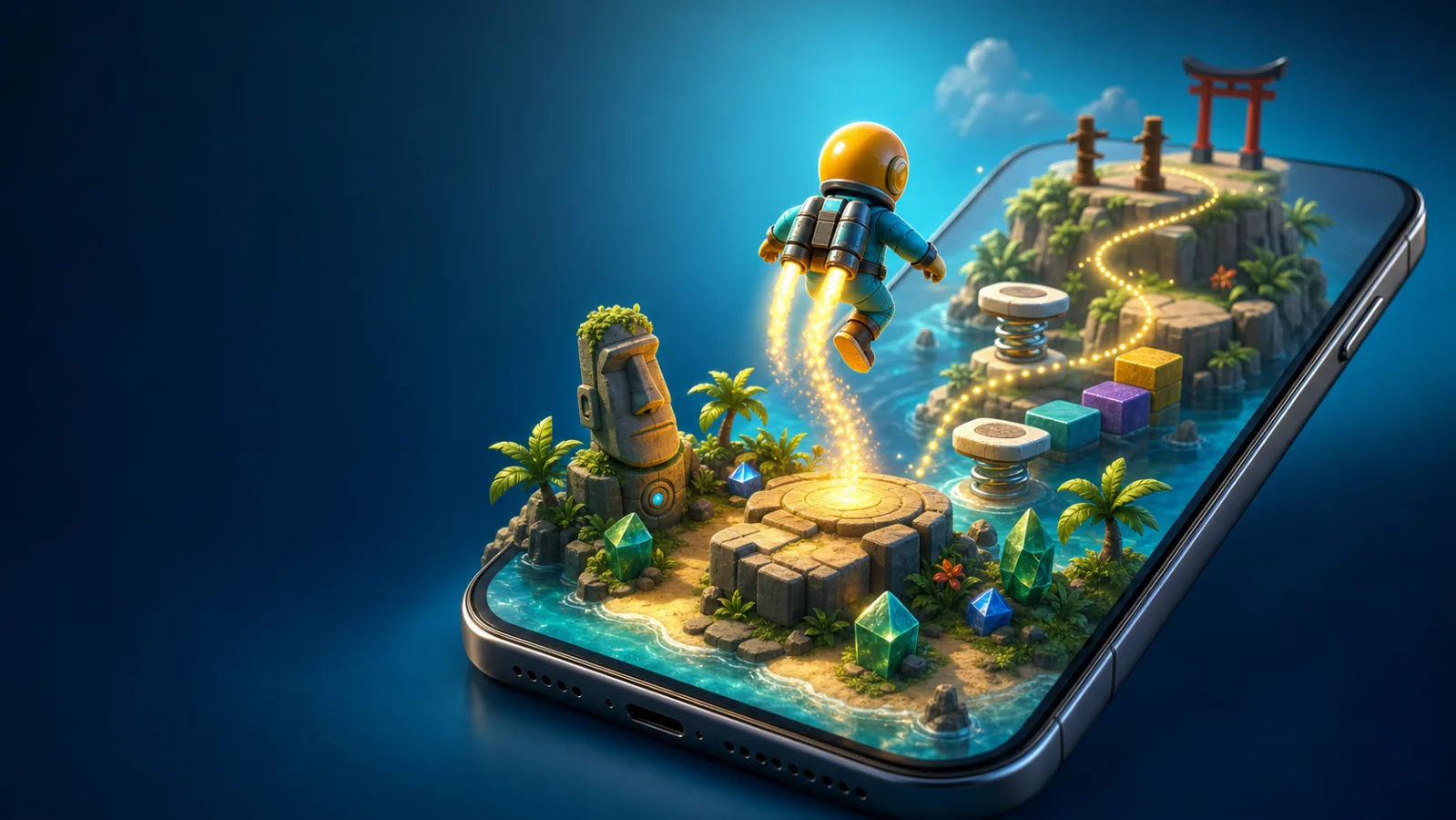
Mobile gaming is at its best when it meets you where you are. Sometimes that means a fast arcade run during a short break. Sometimes it means a puzzle that can be considered one move at a time. And sometimes it means using a phone or tablet as a way into a much older game whose ideas remain interesting long after its original hardware has faded from everyday use.
This starter guide is built around a simple truth: "mobile game" is not a genre. It is a way of playing. The games associated with Android, iOS, and earlier mobile devices can be quick, demanding, relaxing, experimental, story-led, or surprisingly deep. A good first choice depends less on what is most famous and more on how you want to spend your time.
The games below cover several useful starting points: endless arcade action, match-three puzzles, brainteasers, exploration-focused adventures, unusual platformers, racing, fighting, and open-ended action. Many also have histories on consoles, handhelds, PCs, or legacy mobile devices. That variety matters. It gives a new mobile player room to discover whether they value immediate control, carefully planned challenges, replayable score chasing, or a proper sense of journey.
Availability, versions, and controls can differ between devices and storefronts over time. Treat platform listings as a guide to a game's history rather than a guarantee that every version is currently obtainable on every device. When choosing, pay attention to which version you are considering and whether its control style fits the device you intend to use.
Start by choosing the kind of session you want
A useful first question is not "What is the best mobile game?" It is "What do I want this game to do for me?" The answer will narrow the field quickly.
- For five-minute bursts: choose arcade games, score challenges, or a puzzle with clear stopping points.
- For a daily mental workout: choose a grid puzzle, match-three game, or a puzzle adventure with discrete problems.
- For movement and mastery: choose a platformer, racer, or fighter, ideally with controls you are willing to practice.
- For a longer solo adventure: choose exploration games and action adventures built around secrets, tools, upgrades, or stages.
- For a nostalgic challenge: try an older console or arcade design, but expect a steeper learning curve and less hand-holding.
There is no need to force one game to satisfy every mood. In fact, a small personal rotation is often ideal: one immediate-action game, one thoughtful puzzle game, and one deeper adventure. That combination makes a mobile library feel flexible instead of repetitive.
The easiest entry point: Jetpack Joyride
Jetpack Joyride is the clearest recommendation for players who want to understand why arcade design works so well on mobile. It stars Barry Steakfries, a gramophone-company salesman who discovers an experimental machinegun jetpack in a secret laboratory operated by Legitimate Research. Barry takes the jetpack and launches into a high-flying escape.
The premise is playful, but its real strength is clarity. It is an arcade platform game, which means its appeal comes from movement, reactions, risk, and the urge to improve a run. You do not need to absorb a complicated ruleset before the game can become enjoyable. Start moving, watch what happens, and learn through play.
This is a good first mobile choice for players who want a game that fits naturally into small gaps in the day. Arcade structure gives each attempt a clean beginning and end, so you can play briefly without losing your place in a sprawling campaign. It is also good for people who enjoy repetition when that repetition is purposeful: runs become opportunities to recognize patterns, react a little better, and go a little farther.
Who should start here
- Players who want immediate action with little setup.
- People looking for a game suited to short sessions.
- Anyone who enjoys improving through repeated attempts rather than solving one fixed challenge.
- Newcomers who prefer responsive, readable arcade goals over complicated stories.
Approach it with an arcade mindset. Do not judge an early run solely by distance. Notice which obstacles disrupt your rhythm, which moments invite caution, and when a bolder move pays off. The pleasure is in gradually turning chaos into a routine you understand.
For a familiar puzzle format: Jewel Keepers: Easter Island
Jewel Keepers: Easter Island is a match-three arcade action game built around travel across Easter Island and the effort to uncover its mysteries. Match-three games are often excellent starting points because the basic interaction is easy to recognize: examine a board, identify possible matches, make a move, and watch the layout change.
That accessibility should not be mistaken for shallowness. A good match-three game asks you to read the whole board rather than only chase the first obvious move. It rewards patience, pattern recognition, and the ability to see how one match may create another opportunity. Its themed journey also gives the puzzle action a sense of forward momentum, useful for players who prefer a little context around their challenges.
This is the right first stop if you want something calmer than a reaction-heavy arcade game but still want constant interaction. It can suit players who are new to games altogether, because the central concept is visually legible, while also leaving room to improve at planning ahead.
A better way to play match-three puzzles
- Before making the first available match, scan the entire board for moves that may cause a larger chain reaction.
- Prioritize moves that change the most crowded or constrained areas of the board.
- Do not rush simply because the game is colorful and approachable; deliberate play is usually more satisfying.
- Use a difficult board as a pattern-reading exercise, not a test of speed unless the mode specifically creates time pressure.
Jewel Keepers: Easter Island is for the player who wants a reliable puzzle loop, a bright arcade tone, and a game that can be enjoyed in either a quick sitting or a longer stretch.
For pure puzzle structure: It's Mr. Pants
It's Mr. Pants offers a more unusual puzzle lesson. Instead of matching gems, players rotate pieces in 90-degree increments and arrange colored shapes to create rectangles larger than 3x2, making those rectangles disappear. Same-colored pieces cannot be placed on top of one another, while other colors can be layered over existing shapes to remove them.
This is a traditional grid-based puzzle game, and it rewards learning its particular language. The goal is not merely to make something disappear as quickly as possible. You need to think about color restrictions, the shapes coming next, and the changing geometry of the board.
Its three modes make it particularly useful for a new player trying to learn what kind of puzzle pressure they enjoy. Puzzle asks you to clear all shapes with a limited number of pieces. Wipeout asks you to clear the field within two minutes with unlimited pieces. Marathon tests endurance as the playfield closes in from the outside. The modes turn one core system into three distinct moods: planned efficiency, speed, and survival.
Choose this game if you enjoy puzzles that initially feel strange but become more satisfying as their systems click into place. It is less about spectacle and more about developing a private, steadily improving understanding of the board.
For a puzzle adventure with freedom: Ittle Dew
Ittle Dew is the strongest fit for players who want more than disconnected stages. Adventurers Ittle Dew and Tippsie crash onto a strange island filled with loot and mysterious inhabitants. From there, the game combines exploration, devious puzzles, classic adventure structure, secrets, shortcuts, and tools that can be combined in inventive ways.
The important word here is flexibility. The island can be explored at your own pace, and the game's approach to progression welcomes speedrunners as well as players who prefer to investigate every corner. That makes it a particularly appealing bridge between mobile-friendly play sessions and a more substantial adventure-game feeling.
For beginners, Ittle Dew is a reminder that being stuck is not always a failure. In an exploration-focused puzzle adventure, an unanswered problem may be an invitation to look elsewhere, find a shortcut, discover a secret, or reconsider the tools already in hand. Players who like thinking laterally will get the most from its design.
How to get the most from an exploration puzzle game
- Take note of doors, routes, and obstacles you cannot currently solve.
- Experiment with tools rather than assuming each has only one intended use.
- Allow yourself to leave a puzzle and return later with a fresh perspective.
- Explore for its own sake; shortcuts and secrets can make future progress smoother.
This is for the player who wants a mobile-capable game with a sense of place, discovery, and personal route-finding rather than a strict sequence of isolated tests.
For fast-thinking mystery puzzles: James Noir's Hollywood Crimes
James Noir's Hollywood Crimes takes a different puzzle route. Set in an interactive 3D world, it casts the player as the central character in a Hollywood mystery and presents 150 puzzles and mind games across the adventure.
That volume makes it a good option for someone who values variety. A single genre label does not always tell you whether a puzzle game will keep changing its demands, but a mystery framing can help give individual challenges a larger purpose. Rather than playing only for a score, you are working through a mind-twisting scenario.
For a newcomer, the best approach is to resist the urge to blaze through every puzzle. When there are many distinct mind games, it is better to learn what each one is actually asking. Is it about visual observation? Logical order? Spatial thinking? Memory? Once you identify the type of task, the puzzle becomes more manageable.
Choose James Noir's Hollywood Crimes if you enjoy puzzle collections, mystery atmosphere, and the satisfaction of working through many different forms of mental challenge.
For platforming with an unusual control idea: Ivy the Kiwi?
Ivy the Kiwi? is a platform game with a fresh central mechanic. Rather than directly moving its protagonist in the usual way, players guide Ivy by creating stretchy, flexible vines. These vines can move her through obstacles, protect her, and propel her forward. Crows, rats, raindrops, and other hazards demand increasingly careful and quick vine manipulation.
This makes Ivy the Kiwi? especially useful for players who are curious about touch-led game design. The vines create an indirect relationship with movement: you are not simply pressing left or right, but shaping a route and responding to hazards with drawn, flexible supports. The concept is easy to explain, yet it leaves plenty of space for precision.
Start slowly. Early on, focus on making one clean vine placement at a time and observing exactly how Ivy responds. As hazards increase, the game asks for faster decisions, but speed is more manageable once the motion rules feel natural. It is a fine choice for players who want a platformer without the usual control template.
For old-school platforming depth: Kid Chameleon
Kid Chameleon represents a tougher, more traditional platform-game path. Casey enters a virtual reality arcade game after its rogue boss, Heady Metal, begins kidnapping players who cannot complete it. Calling himself Kid Chameleon, Casey must clear every level, defeat every boss, and confront Heady Metal to rescue the missing kids.
Its premise captures the era's directness: get into the game world, survive its levels, and beat the final threat. For modern beginners, the major appeal is the sense of commitment. This is not necessarily a game to sample in scattered seconds. It is a platforming challenge for players who want to learn levels, persist through setbacks, and make progress through practice.
Because Kid Chameleon comes from an older platforming tradition, it is best approached with realistic expectations. Older games can ask more of the player and explain less. That is part of their character. Do not assume difficulty means unfairness; first give yourself time to understand the pace, hazards, and demands of each stage.
Pick Kid Chameleon if you want retro platforming with a clear rescue mission and are happy to trade convenience for a more demanding, level-by-level challenge.
For 3D platforming and spectacle: Jumping Flash!
Jumping Flash! changes the perspective completely. This first-person 3D action platformer puts you in control of Commander Robbit, a robotic super-bunny trying to save the world after Baron Aloha and the Muu-Muus steal Earth's greatest locations for a private retreat. Robbit's distinctive triple-jump and special weapons are the foundation of the experience.
First-person platforming requires a different kind of confidence from side-scrolling platform games. You must judge space, direction, and landing distance while seeing the world from inside the character's viewpoint. The triple-jump is therefore not just a flashy ability. It is a tool for navigation, recovery, and learning the game's sense of scale.
Choose Jumping Flash! if you want an older 3D game with a playful identity and if the idea of mastering movement in three dimensions sounds exciting. Give yourself permission to learn cautiously. Early jumps should be about understanding distance, not proving bravery.
For racing that does not behave like ordinary racing: Jet Moto
Jet Moto is an arcade racing game centered on hoverbikes that skim close to the ground and can travel across land and water. Its courses use that capability to create a style of racing that is not confined to normal roads. Along with circuit-style tracks, it includes suicide courses, where checkpoints sit at opposite ends and racers travel back and forth, potentially meeting oncoming traffic.
For new players, Jet Moto is a good reminder that racing games are not all about simulation. Its appeal is in the unusual properties of the vehicles and the unpredictable demands of the courses. Learn how the hoverbike behaves across different surfaces before worrying about perfect racing lines. On suicide courses especially, awareness matters as much as raw speed.
This is for players who want racing with an arcade edge, memorable track concepts, and a vehicle that changes the relationship between terrain and momentum.
For combat-focused retro play: Karateka and Karate Champ
Karateka follows a returning martial artist whose village has been destroyed and whose bride-to-be, Princess Mariko, has been taken by the warlord Akuma. Armed only with karate, the hero battles increasingly powerful warriors on the way to Akuma's mountain fortress. It is a focused, forward-moving martial-arts journey built around one-on-one confrontations.
Karate Champ is a different kind of fighting experience. It supports single-player competition against computer opponents as well as multiplayer matches. Its notable control concept uses two joysticks to simulate different limb movements: one controls the upper body and the other the lower body. That design gives kicks, punches, and defensive maneuvers a deliberate, coordinated feel.
Neither game should be chosen because you expect the control conventions of a modern fighter. Choose them because you want to encounter earlier combat-game ideas. Karateka is the better fit for a solo rescue quest and escalating opposition. Karate Champ is the better fit for a competitive match mentality and an interest in its distinctive two-joystick design. For either, begin by learning a small number of reliable actions rather than attempting every possible move at once.
For mischievous open-ended action: Jaws Unleashed
Jaws Unleashed offers perhaps the most immediately unconventional fantasy in this guide: playing as Jaws, the Great White shark from the film series. Set around Amity Island during the Fourth of July holiday season, it gives players an open-ended environment where the shark can eat, attack, and destroy across beaches, aquatic theme parks, chemical plants, and other locations.
Progression unlocks upgrades for ramming, biting, and survival, while up to 32 side quests provide further items and bonus-feature unlockables. That means the game is a better fit for players who enjoy having several possible objectives rather than a single narrow route.
Its subject matter is destructive, but its useful gaming lesson is about player-directed action. Explore the environment, test what activities lead to progress, and decide whether you prefer pushing the main path or pursuing side content. Choose Jaws Unleashed if you want a more expansive action game with upgrades, side quests, and an intentionally wild central premise.
Build a starter library instead of chasing one perfect game
The best mobile starting point is often a three-game mix. Pair Jetpack Joyride with Jewel Keepers: Easter Island or It's Mr. Pants if you want action and puzzles in equal measure. Add Ittle Dew if you want something to return to over longer sessions. Choose Ivy the Kiwi? or Jumping Flash! when you want platforming that feels unlike the standard template. Keep Jet Moto, Karateka, or Karate Champ in mind when you want a concentrated dose of retro competition and skill-building.
The point is not to play everything at once. Begin with the game that best matches your current mood, learn what it asks of you, and use that experience to guide the next choice. Mobile gaming can be immediate, but it does not have to be disposable. The right game can give you a quick burst of energy, a satisfying puzzle ritual, or a surprisingly substantial adventure--all from the same device you already carry.
Community
Discussion
Start the conversation.
No comments have been posted yet.