

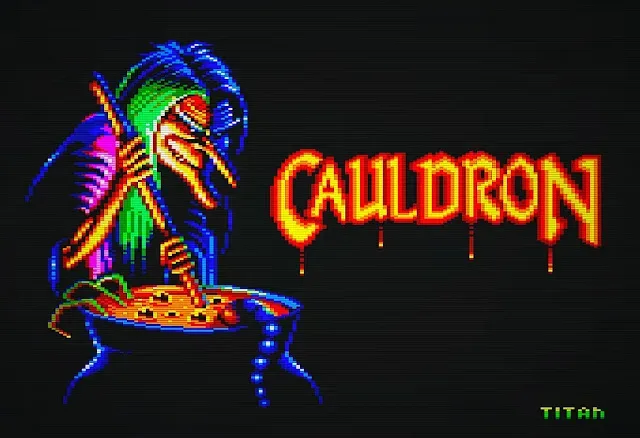
Cauldron: Halloween Edition has brought Palace Software's famously demanding 1985 adventure back to the Amstrad CPC, with a broad set of gameplay, presentation and quality-of-life improvements from Devil-System. The new release revisits the original game's distinctive mix of platforming and horizontally scrolling shoot 'em up action, while directly addressing the extreme difficulty that has long defined its reputation among retro players.
At its core, Cauldron remains the story of a young witch attempting a dangerous journey to defeat the Pumpking and earn the title of Witch Queen. That simple premise conceals a challenging multi-discipline adventure. Players must explore hazardous environments, navigate a witch on her broomstick through aerial threats, and survive the tricky platforming sections that made the original both memorable and intimidating.
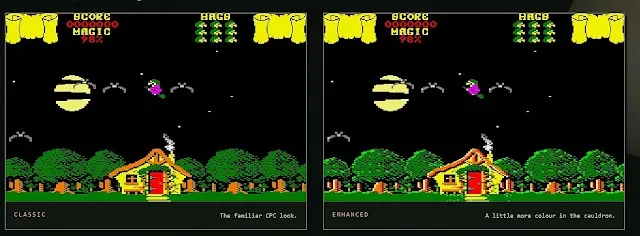
The Halloween Edition does not discard that identity. Instead, it gives players more control over how they approach it. Three separate difficulty levels, a dedicated training mode, an in-game map, pause functionality, score tracking and save support are all included. Classic and Enhanced versions are also available on every disk, offering an option for players who want the familiar look and feel as well as those interested in a refreshed visual presentation.
A cult classic with a fearsome reputation
Originally created by Steve Brown and Richard Leinfellner, Cauldron stood out in the mid-1980s because it did not fit neatly into a single genre. Its platforming sections asked players to make precise movement decisions in hostile spaces, while its side-scrolling broomstick sequences shifted the focus to shooting, navigation and survival. The result was ambitious for its era: a fantasy quest that demanded versatility rather than mastery of only one style of play.
For useful background on this topic, read Van Helsing Stalks the Commodore 64 in a New Gothic Side-Scroller.
The original's visuals and two-mode structure attracted considerable attention, but its difficulty became just as significant a part of its legacy. Cauldron could be punishing in ways that many players remember vividly, with little room for error and a journey capable of sending even experienced players back to repeat hard-won progress. For some, that uncompromising design is exactly why the game endures. For others, it made the adventure more fascinating than accessible.
Cauldron: Halloween Edition appears designed to serve both groups. It preserves a Classic mode for those who want an experience rooted in the game's old-school character, but its additional tools mean that players no longer have to treat the entire quest as an all-or-nothing endurance test. That is particularly important for a game whose original ideas remain appealing even when its severity can be daunting.
Three difficulty levels and a place to learn
The most immediately meaningful change is the introduction of three difficulty settings. Rather than presenting every player with the same unforgiving barrier, the new edition allows users to select a challenge level that better suits their familiarity with the game. This should be useful for veterans returning after decades away, as well as newcomers who know Cauldron more by reputation than personal experience.
A separate training mode goes further by providing a more relaxed way to explore. In a game built around dangerous routes and unfamiliar environmental hazards, the ability to learn the layout and practice movement without the full pressure of a standard run can substantially change how approachable the experience feels. Training does not have to remove the challenge; it can make the challenge understandable.
The built-in map is another major addition. Mapping was often an expected part of playing difficult computer games in the 1980s, whether players drew their own notes on paper or relied on memory and repeated failures. That process can be rewarding for dedicated enthusiasts, but it can also be a barrier for anyone who simply wants to engage with the game's progression. A map offers guidance without changing the world itself, helping players spend more time making decisions and less time retracing paths blindly.
Save functionality likewise modernizes the structure without changing Cauldron's fundamental objective. Being able to preserve progress matters greatly in an adventure known for its harsh obstacles. It makes the game easier to fit into shorter sessions and reduces the risk that a single mistake or an interrupted play period will erase an evening's effort. A pause feature contributes to that more flexible approach, while the high-score table retains an arcade-minded reason to chase stronger runs.
Classic and Enhanced modes on each disk
Devil-System has included both Classic and Enhanced modes on every disk. The choice recognizes that preservation and revision do not have to be competing goals. Some players will want the established visual identity they remember from the original Amstrad CPC release. Others may prefer the Enhanced presentation, which introduces refreshed details, including changes to environmental elements such as trees.
Offering both versions is especially fitting for a game with a long retro legacy. A new edition can easily risk becoming too distant from the software people remember, while a strictly archival reissue may leave potential improvements unexplored. Here, the two-mode setup gives players a direct choice between nostalgia and revision rather than insisting that one approach is inherently better.
The addition of four supported languages also broadens the release's usability. For a classic game returning to an active international retro-computing audience, language support is a welcome practical feature. Alongside difficulty options and saving, it helps position Halloween Edition as more than a minimal rerelease.
Reworked flying, controls and game feel
Perhaps the most consequential revisions sit beneath the visual layer. The Halloween Edition overhauls controls and physics, introducing gradual acceleration, softer braking and more fluid animation. Those changes are particularly relevant to the broomstick sections, where movement is not merely cosmetic. Handling directly affects a player's ability to react to threats, navigate the scrolling landscape and maintain control under pressure.
In older action games, difficulty can come from intentional level design, but it can also arise from rigid movement and limited feedback. Adjusting acceleration and braking can make a vehicle or character feel more readable without making every obstacle trivial. The stated aim here is smoother navigation through Cauldron's treacherous world, not a wholesale conversion into an easygoing game.
Optimized rendering and a retuned gameplay pace accompany the control changes. Together, these revisions suggest an effort to make the game's action flow more naturally on the Amstrad CPC. That matters because Cauldron's appeal has always rested on the tension between its two gameplay styles. If switching from exploration and platforming to aerial shooting feels smoother, the whole quest can become more cohesive.
Cauldron: Halloween Edition retains the original game's dangerous fantasy journey while supplying the tools needed to learn, practice and preserve progress through it.
Why this edition matters for Amstrad fans
New releases for vintage hardware are often at their strongest when they understand the difference between making a classic easier and making it more welcoming. Cauldron: Halloween Edition seems to take that distinction seriously. The game still offers a route for purists through Classic mode and the higher challenge options, but it no longer assumes every player must accept the same severe conditions before seeing what made the original special.
That approach is well suited to Cauldron's status as a technically and creatively ambitious game from its period. The original's blend of genres remains interesting, and its witch-versus-Pumpking premise gives the release a natural Halloween flavor. Yet the game's demanding nature has always been inseparable from discussion of it. An edition that supplies maps, saves, training and selectable difficulty has the potential to introduce its design to players who might otherwise abandon it early.
For returning fans, the appeal may be different. The refreshed controls, revised physics and optimized performance promise a new way to revisit a familiar world. Rather than merely replaying a preserved copy, experienced players can compare the Classic and Enhanced modes, test the altered handling, and decide how much the new pacing changes their relationship with the adventure.
A Halloween return built around player choice
Cauldron: Halloween Edition arrives as a thoughtful restoration of a game that was celebrated for its ambition and feared for its cruelty. Devil-System's additions are comprehensive: three difficulty levels, a training mode, map support, saving, pausing, a high-score table, four language options, dual visual modes and reworked movement systems all contribute to a substantially more accommodating package.
None of that means the Pumpking's world has become harmless. Cauldron is still built on perilous traversal, platforming precision and broomstick combat. What has changed is the number of ways players can meet that challenge. Whether someone wants the familiar nostalgic presentation, a refined Enhanced mode, or simply a chance to practice before facing the full quest, the Halloween Edition gives this 1985 Amstrad CPC classic more room to be rediscovered.
Community
Discussion
Start the conversation.
No comments have been posted yet.