

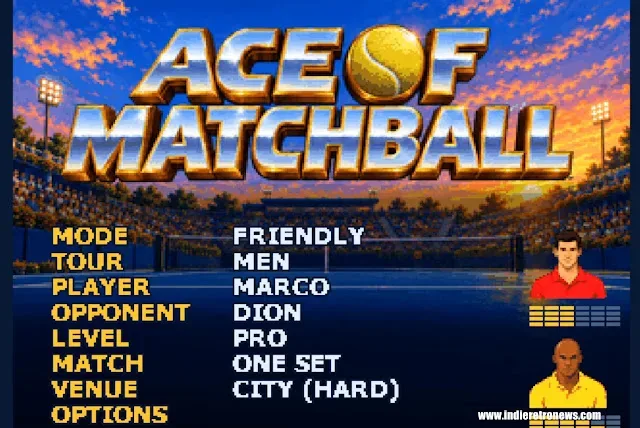
Ace of Matchball AGA is a newly released tennis simulator for the Amiga 1200, developed by Fliegeralarm Games. Designed around AGA-era hardware rather than modern retro-inspired PCs or consoles, the game aims to give Amiga players a comparatively feature-rich tennis experience: quick exchanges from the baseline, serves, lobs, four tournament settings, persistent player rankings, and a career structure built around a world tour.
The project is also notable for leaning into details that are unusual for an Amiga sports game. Alongside the expected ball striking and court movement, Ace of Matchball includes stamina that affects performance over time, animated officials and ball kids, player outbursts after bad points, and a system allowing players to challenge disputed line calls through replay footage. An update described as the Celebration Update adds 288 animations while also addressing ball boy and bottle-related bugs.
Fliegeralarm Games credits its code and design work alongside AI assistance, with the game built using the ACE engine. Its use of AI-assisted development may prove divisive among retro enthusiasts, but the game has already drawn favorable early reactions from players who have highlighted its controls and ambition. One community comparison has framed it as an "Amiga Top Spin 2K27," a description that points less to a direct imitation than to the developer's effort to create a deeper, more contemporary-style tennis package on classic hardware.
A tennis game built around momentum
Ace of Matchball puts players behind the baseline for fast exchanges in which timing, placement and sustained pressure appear to be central. Tennis games can easily become either overly technical simulations or simple button-mashing arcade contests. The stated goal here is an intuitive, momentum-based control approach, giving players a way to engage with the changing rhythm of a rally without losing the immediacy needed for a responsive sports game.
For useful background on this topic, read Control Resonant, Stick It to the Stickman and More Indie Games to Watch This Week.
Serves, standard groundstrokes and defensive lobs form the basis of the on-court action. The lobbing option is particularly important to the sense of tennis tactics: when an opponent has pushed forward, a well-timed high ball can turn a defensive position into an attacking opportunity. Equally, the promise of rapid-fire rallies suggests players will need to make decisions under pressure rather than simply wait for a single powerful winning shot.
That momentum is not only about player input. Ace of Matchball uses a stamina mechanic intended to make longer exchanges matter. As competitors tire during punishing rallies, their shot accuracy visibly suffers. This creates a useful layer of risk management, since grinding through a point may wear down an opponent but can also undermine a player's own ability to place the next shot precisely. It is a system that reflects one of tennis's defining ideas: the point is not always won by the hardest hitter, but by the competitor who can force one more uncomfortable return.
Career mode and a world tour that persists
Beyond individual matches, Ace of Matchball includes a career mode supported by an integrated world tour tracking system. Rankings are saved between sessions, meaning a player's results are intended to carry forward rather than disappear when the machine is switched off. For a single-player sports game, that persistence can be the difference between a collection of exhibition matches and a longer-term campaign with a meaningful sense of progression.
The ranking element gives victories and defeats broader consequences. A result should feed into a continuing tour position, turning each event into part of a larger attempt to rise through the standings. The supplied details do not outline the full tournament structure or the number of competitors represented in the rankings, so players should not assume particulars beyond the persistent world-tour framework. Still, the presence of a saveable ranking system is an ambitious feature for a game built for an Amiga 1200 configuration.
Ace of Matchball also emphasizes adherence to real-world tennis rules. That focus, together with career tracking and fatigue, indicates that Fliegeralarm Games is pursuing a simulation-leaning presentation even as it retains accessible controls. The balance may appeal to players who want tennis to feel recognizably authentic without requiring the kind of dense control scheme associated with some later 3D sports titles.
Four venues and a more animated match atmosphere
Matches take place across four distinct venues, including a Riviera clay court and indoor arenas. Surface and venue variety are important for a tennis title's identity, even where the available information does not specify every court or describe mechanical differences between them. Riviera clay immediately evokes slower, more patient exchanges, while an indoor arena can suggest a different visual character and competitive atmosphere.
Fliegeralarm Games has attempted to make the stadiums feel populated rather than treating the court as an empty playfield. Crowds react to the action, ball kids stay busy around the court, and players are animated as emotional competitors instead of silent avatars. When a point or decision goes badly, athletes can react with tantrums, thrown rackets and voiced swearing. These touches are not essential to scoring a point, but they can add personality to matches and reinforce the tension of close games.
The Celebration Update significantly expands this animation work with 288 new animations. Such an addition is especially relevant to a sports game, where small repeated gestures can influence how natural a match looks: movement between points, acknowledgements of a winner, frustration after an error, and the routines happening at the edges of play all contribute to the illusion of a live event. The same update includes fixes for issues involving the ball boy and a bottle.
Challenging a questionable call
Perhaps Ace of Matchball's most modern-sounding feature is its Challenge the Call system. If a player disagrees with a line judge's decision, they can contest it and watch a slowed, zoomed-in replay. The feature echoes the review technology associated with professional tennis, translating a familiar broadcast-era ritual into an Amiga game.
It is a clever fit for the sport. Line calls are naturally dramatic, particularly at decisive moments, and a replay challenge can turn an ordinary out call into a brief suspense sequence. The game's supplied feature list does not detail limits on challenges, rules governing when they may be used, or how a call is resolved beyond the slow-motion close-up. Even so, its inclusion helps distinguish Ace of Matchball from older tennis games that simply announce a result and move immediately to the next point.
More broadly, the system shows that the game is not solely focused on reproducing the basic act of hitting a ball. It is also interested in tennis as an event with officials, spectators, momentum swings and emotional reactions. That broader framing helps explain why ball kids, crowd responses and player temperament are all treated as visible parts of the match.
Amiga 1200 requirements and emulator support
Ace of Matchball is tailored specifically for a stock Amiga 1200 with AGA graphics, provided the system has a hard drive and the necessary memory expansion. The listed requirements are an Amiga 1200 or compatible machine, a 68020 processor or better, 2 MB of Chip RAM, and 2 MB of Fast RAM. Installation is hard-drive based: users unpack the archive and launch AceOfMatchball from its drawer.
For those playing through emulation, the game is listed as running in WinUAE and FS-UAE when configured as an A1200 with 2 MB of Fast RAM. That makes it accessible to players maintaining an Amiga environment on a modern computer, while the original hardware target remains clear. There is no stated support here for contemporary consoles, handheld systems, or native modern PC versions.
- Target hardware: Amiga 1200 AGA or compatible system
- Processor: 68020 or better
- Memory: 2 MB Chip RAM plus 2 MB Fast RAM
- Storage: Hard-drive installation required
- Emulation: WinUAE and FS-UAE with an A1200 configuration and 2 MB Fast RAM
From a casual suggestion to a finished court
The game's origin is tied to a casual exchange involving Fliegeralarm Games and Amiga streamer Amiga Bill. The developer asked whether making a tennis game for a friend was a worthwhile idea, and the positive response appears to have encouraged the project's completion. That backstory suits a game aimed squarely at a long-running enthusiast community: an idea sparked in conversation has become a fully featured release for the platform.
Ace of Matchball arrives with a mix of classic Amiga constraints and distinctly modern sporting ambitions. Its four courts, career progression, saved rankings, stamina, replay challenges and animated presentation give it a larger scope than a straightforward pick-up-and-play tennis game. Whether every player embraces its AI-assisted production is likely to remain a matter of personal preference, but the game's early reception indicates that many are responding to what happens on the court.
For Amiga tennis fans, the most compelling question is simple: can the momentum-driven controls, fatigue system and persistent tour turn individual rallies into a satisfying season-long climb? Ace of Matchball is built around that promise, pairing the immediacy of serves and passing shots with the longer-term appeal of rankings, venues and career results.

Community
Discussion
Start the conversation.
No comments have been posted yet.