

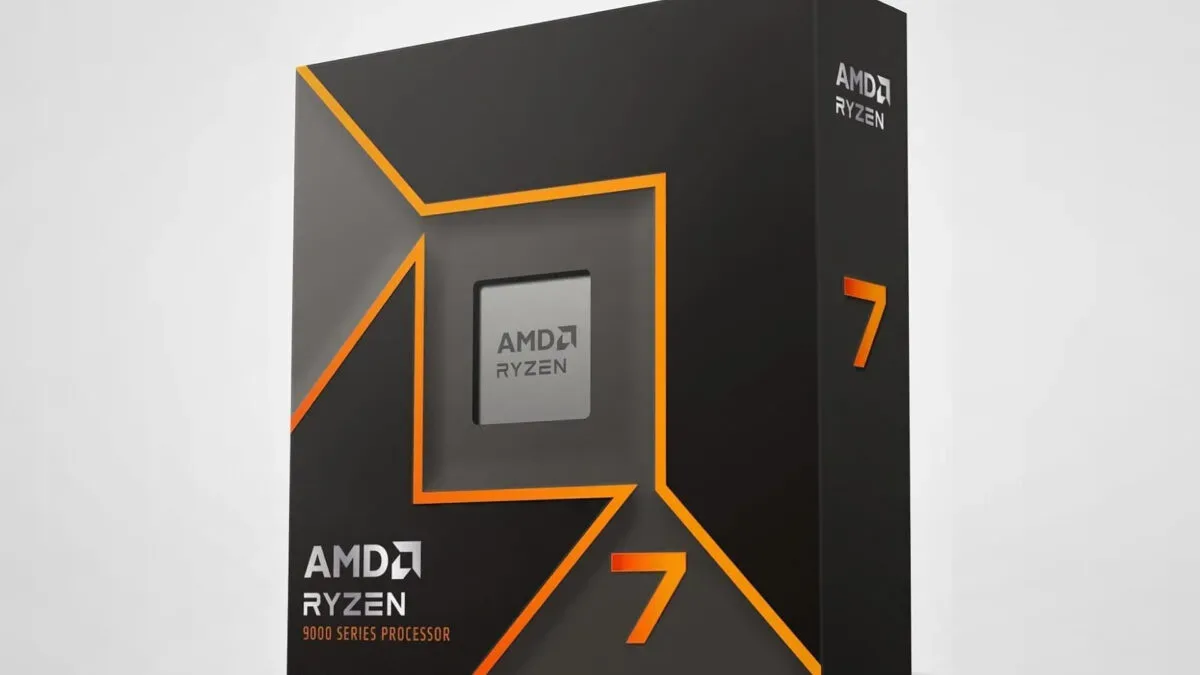
PC players considering a long-overdue processor upgrade have a notable deal to weigh during Black Friday week. AMD's Ryzen 7 9800X3D, one of the company's flagship gaming-focused desktop CPUs, is listed at $411 on Amazon and falls to $399 after applying a coupon on the product page. That is a $80 reduction from its $479 list price and the lowest reported price for the chip so far.
For builders whose systems are showing their age in CPU-heavy games, the reduction matters more than a typical sale on a component that is already positioned near the top of AMD's consumer desktop lineup. A graphics card upgrade can improve visual settings and GPU-bound performance, but it cannot always solve the sharp frame-time dips that appear in crowded multiplayer matches, simulation-heavy strategy games, or sprawling late-game cities. The Ryzen 7 9800X3D is built specifically to address many of those situations.
The processor arrived in late 2024 and quickly became a frequent recommendation for premium gaming PCs. AMD has marketed it as the world's fastest gaming processor, a broad claim that naturally depends on the games, resolutions, graphics cards, and test configurations involved. Still, the core design behind that reputation is clear: it combines modern Zen 5 CPU cores with a very large pool of L3 cache designed to keep more game data close to the processor.
Why the 9800X3D is aimed squarely at gaming
The Ryzen 7 9800X3D has eight cores and 16 threads, using AMD's Zen 5 architecture. Its standout specification is its 96MB of L3 cache, enabled by second-generation 3D V-Cache technology. Cache is extremely fast memory integrated near the CPU cores. When a game can access frequently needed data through that cache rather than making slower trips elsewhere in the system memory hierarchy, performance can improve substantially.
For useful background on this topic, read Alienware 16 Aurora Falls to $1,399.99 With $900 Black Friday Discount.
That does not mean every game receives the same benefit. At a high resolution with graphics settings pushed to the limit, the graphics card is often doing most of the restricting. In those circumstances, replacing a processor may produce a smaller average-frame-rate gain than buying a faster GPU. The X3D approach is more valuable when the processor is the limiting factor: esports titles chasing extremely high refresh rates, big multiplayer encounters, open-world games with dense simulation work, and strategy or city-building games that place increasing demands on the CPU as a session continues.
Just as importantly, the gains are often felt in frame consistency rather than only in a large number displayed by an average FPS counter. Players may notice a smoother experience through improved 1% lows, the measurement commonly used to describe the lower end of performance during demanding moments. A system that averages a high frame rate can still feel inconsistent when it intermittently stutters. Reducing those sudden dips is especially important on a 144Hz, 240Hz, or faster display.
AMD says Zen 5 brings an instructions-per-clock improvement of roughly 16% over the preceding generation. Pairing that architectural uplift with 3D V-Cache gives the 9800X3D a more flexible profile than older cache-focused designs. It is not merely intended for a narrow set of benchmark-friendly games; it has the general CPU performance to handle the everyday tasks expected of a modern high-end desktop.
A revised V-Cache design allows higher clocks
Earlier X3D processors made a trade-off for their extra cache. The stacked cache arrangement could impose thermal restrictions, which in turn meant lower operating clocks than comparable non-X3D models. AMD changed the physical arrangement for the Ryzen 7 9800X3D by placing the additional cache beneath the processor cores rather than on top of them.
That placement helps the cores dissipate heat more effectively and lets this model boost as high as 5.2GHz. The change is significant because it narrows the usual compromise between cache-heavy gaming performance and clock speed. Buyers get the large 96MB L3 cache that can transform results in certain games while retaining higher boost behavior for workloads that respond well to frequency.
The rated TDP is 120W. That is not insignificant, but it remains manageable for a performance desktop build. A capable dual-tower air cooler or a 240mm all-in-one liquid cooler should be sufficient for most users, assuming the case has reasonable airflow. AMD does not include a cooler with the processor, so prospective buyers should include that expense in a new-build budget if they do not already own a compatible unit.
There is a potentially useful bit of continuity for AMD upgraders: AM4 cooler mounting hardware generally carries over to AM5 because the mounting-hole arrangement has remained the same. It is still wise to check a specific cooler maker's compatibility guidance, particularly for older mounting kits, but many existing AMD cooler owners may not need to replace their cooling solution.
AM5 owners have the easiest upgrade route
The Ryzen 7 9800X3D uses AMD's AM5 socket. Anyone already using a compatible AM5 motherboard may be able to make this a relatively straightforward CPU replacement. Supported board families include B650, X670, B850, and X870 models. A BIOS update may be required before installing the processor, so builders should confirm their board's supported BIOS version and update procedure before beginning the swap.
For players coming from an older AM4 platform, the calculation is more complicated. Moving to AM5 means purchasing a new motherboard and DDR5 memory in addition to the CPU. That can turn a $399 processor deal into a much larger platform investment. With memory prices remaining elevated, the discount on the processor helps, but it does not eliminate the need to budget for the full transition.
That said, AM5 provides a more current foundation for a fresh gaming system. It is a more sensible direction for someone replacing a much older quad-core PC, especially if their present setup struggles with modern games while other components remain capable. Before committing, builders should also verify power-supply capacity, cooler clearance, BIOS support, and whether their desired DDR5 kit appears on the motherboard's memory compatibility list.
Who should consider this deal?
The 9800X3D is best suited to players building around a powerful graphics card and a high-refresh monitor. It makes the most sense in a 1440p setup where a fast GPU can otherwise expose a CPU bottleneck. Pairings in the range of an Nvidia GeForce RTX 5070 Ti or AMD Radeon RX 9070 XT and above are particularly appropriate for a system designed to pursue high frame rates at that resolution.
It also makes sense for players who regularly play CPU-intensive genres. Competitive shooters can benefit when a system is attempting to maintain exceptionally high FPS. Massive multiplayer raids can stress a processor with many player characters, effects, and networked events occurring simultaneously. Simulation, strategy, and city-building games can become dramatically more demanding after dozens of in-game hours, when population counts, pathfinding, and background calculations ramp up.
The 16-thread configuration provides useful breathing room beyond pure gameplay, too. Users who stream, keep Discord open, record footage, browse, or run other background applications should have more headroom than they would on aging four-core processors. Hardware video encoders on modern graphics cards remain valuable for streaming, but additional CPU capacity can still help prevent the entire system from becoming less responsive during demanding sessions.
Conversely, this is not automatically the right purchase for every PC gamer. Someone running a modest graphics card at 4K may gain little compared with putting the same money toward a GPU upgrade. Players happy with 60Hz gaming and stable performance in their usual library may not need this level of processor at all. And AM4 owners on a tighter budget should compare the complete cost of an AM5 migration with alternatives that allow them to extend their existing platform.
The coupon is worth checking before checkout
The key detail for anyone interested is that the lowest $399 price requires selecting the coupon shown on the Amazon product listing. Without that extra step, the processor is already discounted to $411, but the coupon lowers it by another $12. Promotional pricing and coupons can change quickly, particularly during Black Friday promotions, so shoppers should verify the final price in their cart before placing an order.
At $399, the Ryzen 7 9800X3D becomes a particularly compelling option for builders who were already targeting a premium AM5 gaming CPU. Its combination of eight Zen 5 cores, 16 threads, 96MB of L3 cache, a 5.2GHz maximum boost clock, and improved cache placement gives it strong credentials for eliminating CPU limitations in the games where smooth frame delivery matters most. For the right high-end PC, this is the kind of component upgrade that can make an existing graphics card feel newly unleashed.
Community
Discussion
Start the conversation.
No comments have been posted yet.