

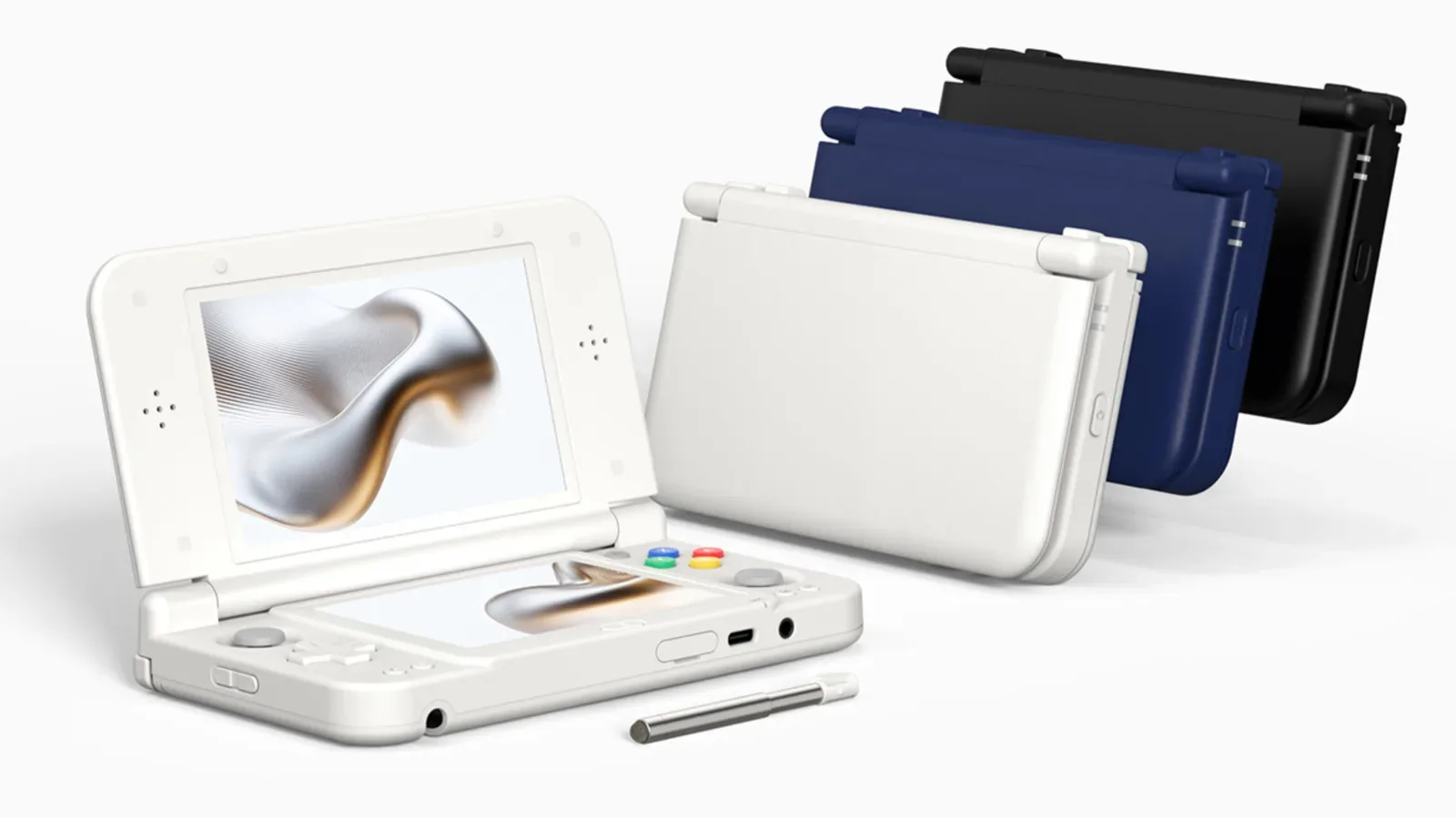
Anbernic's next clamshell handheld, the RG DDS, is moving firmly into premium territory. The company has set the device's standard price at $299.99, while a limited preorder offer lowers that figure to $284.99. It is a notable shift for a manufacturer often associated with more affordable retro-focused hardware, especially since the RG DDS takes visible inspiration from the dual-screen form factor made famous by Nintendo's 3DS family.
That comparison is unavoidable, but the RG DDS is not simply trying to recreate an older handheld feature for feature. Anbernic is positioning it as a substantially more powerful Android device with two screens, modern connectivity and the flexibility to run a broad selection of emulator applications. The company says units will begin shipping gradually on December 10, 2026, giving buyers a clearer idea of both the expected launch window and what they will receive for the higher asking price.
A premium price for a higher-powered clamshell
At $299.99, the RG DDS costs considerably more than the low-cost devices that have helped establish Anbernic's presence in the handheld market. It also puts the hardware in a different conversation from a straightforward nostalgia purchase. Buyers evaluating the RG DDS will be looking not just at its hinged dual-screen design, but also at its processor, display output, storage options and Android software support.
The central component is Qualcomm's Snapdragon G2 Gen 2. Anbernic had previously identified the chip when it initially teased the clamshell, and the fuller specification announcement now helps explain the company's pricing approach. The processor is intended to give the device enough performance for emulation beyond titles designed around the original 3DS-era concept, rather than restricting it to older, less demanding systems.
For useful background on this topic, read Ghost Sweeper Clears Its Kickstarter Goal for a Game Boy Advance Release.
Performance expectations still depend on the particular application, software version and game being used. Emulation can vary widely even on capable hardware, and compatibility is never guaranteed merely because a device carries a powerful processor. Still, the choice of the Snapdragon G2 Gen 2 signals that Anbernic is targeting a more demanding class of Android handheld than its entry-level machines.
The RG DDS will arrive in two memory and storage configurations. The base model includes 8GB of memory and 128GB of internal storage. An upgraded version raises those figures to 12GB of memory and 256GB of storage. Anbernic has not provided separate prices for the two configurations in the announced details, so prospective buyers will need to wait for any additional breakdown of which version the $299.99 figure represents and how the higher-capacity model may be positioned.
MicroSD expansion remains part of the package
Internal storage is only one part of the equation for an emulation-oriented handheld. The RG DDS includes a microSD card slot that supports cards up to 2TB. That is significant for players who prefer to keep larger libraries, media files or multiple Android applications available without depending solely on the internal drive.
Large-capacity expansion can be particularly useful for systems with bigger game files, although users should consider storage speed, card quality and the amount of content they genuinely expect to carry. The 2TB support gives the hardware a generous upper limit, but it does not require purchasers to immediately invest in the largest possible card. It does, however, make the device more adaptable over time than a handheld locked to its factory storage.
As with other emulation-capable devices, users are responsible for ensuring that the software and game files they use are obtained and handled lawfully. The RG DDS hardware is being presented as an Android handheld capable of using emulator apps; Anbernic's announced specification list does not change the legal considerations around game content.
Android 16 broadens the software possibilities
Anbernic says the RG DDS will run Android 16. That matters because Android gives users access to a large ecosystem of apps, including the emulator software that is central to the device's appeal. Rather than relying on a narrowly defined proprietary interface, the RG DDS is designed around a familiar mobile operating system with room for customization.
Android also means the machine is more than a single-purpose retro console. Depending on app compatibility and a user's preferences, it may be used for game streaming, media playback, cloud-connected services and other standard Android functions. The two-screen layout is the standout physical characteristic, but the operating system is what gives the hardware much of its potential range.
That flexibility can also require more setup than a traditional dedicated console. Android handheld users often choose their own applications, organize libraries, configure controls and adjust performance settings. For enthusiasts, that degree of control is a benefit. For players who simply want an appliance-like experience where every game is installed and optimized by a platform holder, the RG DDS represents a different kind of proposition.
Dual screens without the 3D effect
The RG DDS is clearly a callback to Nintendo's dual-screen clamshell history, but it will not reproduce one of the original Nintendo 3DS's most distinctive features. Anbernic has confirmed that its handheld does not include glasses-free stereoscopic 3D graphics.
Instead, the company is emphasizing higher-resolution displays. Exact display resolution and screen-size figures were not included in the currently announced specification details, so it remains too early to make precise comparisons with other handhelds. Even so, higher-resolution panels could make modern Android interfaces, video output and supported games look sharper than they would on older portable hardware.
The absence of a 3D display also avoids one of the unusual design compromises associated with the 3DS era. Nintendo's effect was memorable, but it was optional in many games and was not universally used by every player. Anbernic appears to be focusing its own design on the practical advantage of two separate screens rather than attempting to duplicate every feature of Nintendo's older device.
Wireless, video and sensor features
Beyond its processing hardware and storage, the RG DDS includes a strong list of current connectivity features. It supports Wi-Fi 6 and Bluetooth 5.4, standards that should help with wireless accessories and online uses supported by Android apps. Bluetooth support is especially relevant for users planning to connect wireless headphones or controllers, while Wi-Fi can support downloads, updates, streaming services and other connected functions.
Anbernic has also confirmed 1080p display output. This gives the handheld an option for playing on an external display, though the company has not detailed every aspect of the output setup, including the exact connection method or how individual apps will handle the dual-screen arrangement. Those details could matter greatly for players who see TV or monitor use as a major reason to choose the RG DDS.
Other confirmed hardware includes a six-axis gyroscope sensor and a 3.5mm audio jack. The gyro adds motion-sensing capability for compatible software, while the headphone jack remains useful for wired audio without requiring a wireless accessory or adapter. Neither feature alone defines the device, but together they reinforce the sense that Anbernic is trying to make a fully featured portable rather than a stripped-down specialty machine.
What the AI button is intended to do
Anbernic had already shown an unusual AI button in the RG DDS design. The company has now outlined several intended uses for it: game guides and strategy assistance, real-time translation during gameplay, and additional AI-based features that have not yet been specified.
The description leaves important questions unanswered. It is not yet clear which services or applications will power these functions, whether they will require an internet connection, how broad their language support will be, or exactly how the button will work across different games and emulators. "More fun AI features" is also a deliberately broad promise rather than a final feature list.
Still, the proposed uses point toward practical assistance rather than just a novelty control. Translation could be helpful in games without a player's preferred language, while guide and strategy tools may appeal to those exploring older titles without wanting to search separately on another device. The final value will depend on execution, reliability and how much user control Anbernic provides.
Three confirmed color options and a December start
The RG DDS will be offered in three colors: Glacier White, Basalt Black and Phantom Blue. These are the same color options previously teased for the clamshell. They give the device a mix of conventional light and dark finishes alongside a more colorful blue option, though Anbernic has not indicated whether all configurations will be available in every color.
The company's shipping wording is also worth noting. Rather than promising that every order will arrive on one specific day, Anbernic says the RG DDS will ship gradually starting December 10, 2026. That suggests fulfillment may occur in stages. Anyone considering a preorder should keep that phased schedule in mind, particularly if they expect the handheld to arrive immediately at the start of the shipping period.
Anbernic's RG DDS is shaping up to be one of the company's more ambitious handhelds: a dual-screen Android 16 device with a Snapdragon G2 Gen 2 processor, up to 12GB of memory, up to 256GB of built-in storage, microSD expansion up to 2TB and a $299.99 regular price. Whether that price feels justified will depend on how well the hardware performs in real-world use, how its dual-screen software experience comes together and whether its AI features prove useful. For now, it is clear that Anbernic is aiming beyond the budget category with a device designed to merge retro-handheld inspiration with modern Android hardware.
Community
Discussion
Start the conversation.
No comments have been posted yet.