

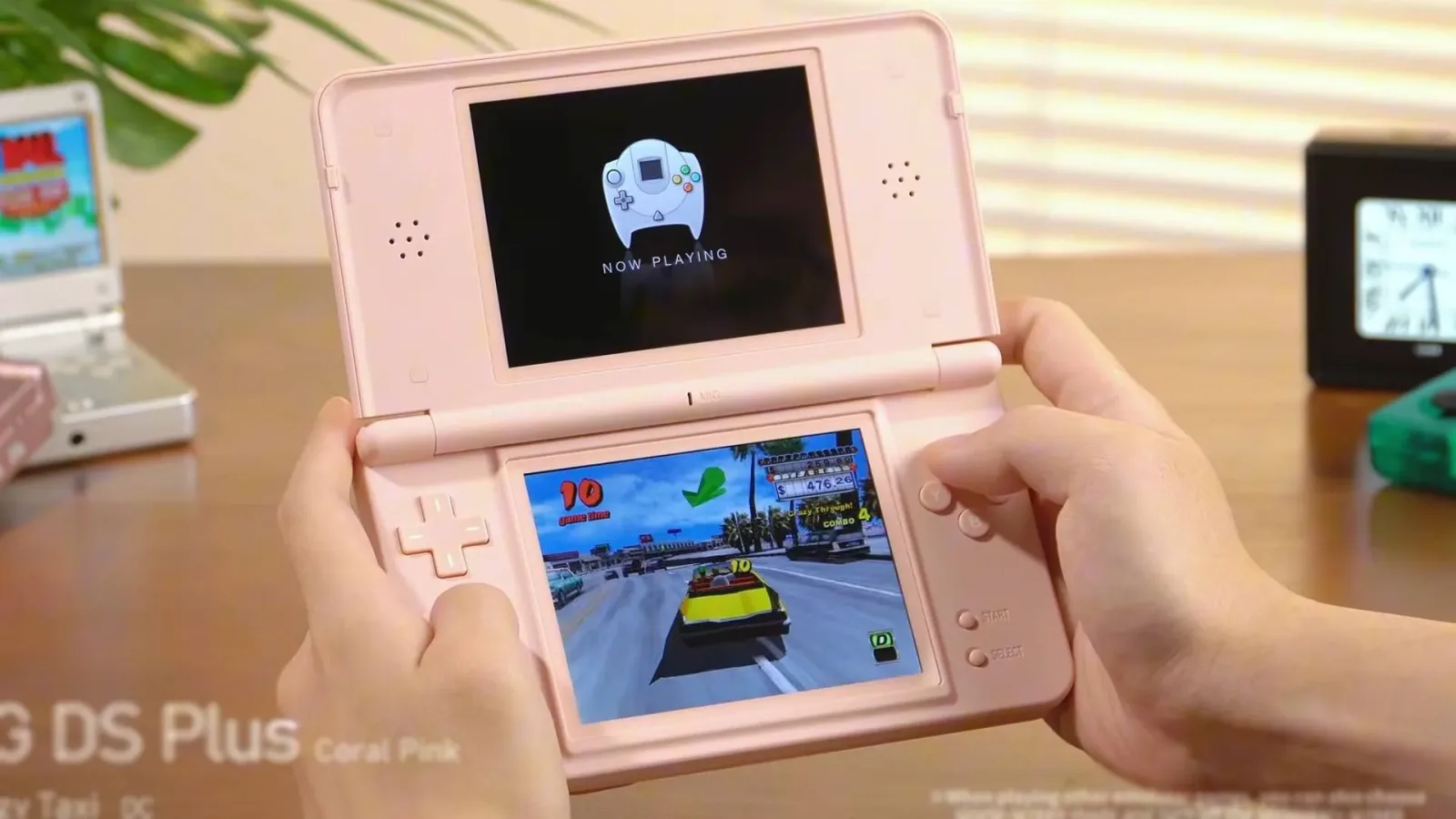
Anbernic's newly refreshed dual-screen handheld is making a stronger case for itself as more than a machine built solely around Nintendo DS nostalgia. A newly shown gameplay demonstration for the ANBERNIC RG DS Plus spends much of its time in the obvious territory--games designed for two displays and stylus input--but it also gives the clamshell a chance to tackle software from the PSP, Nintendo 64, Dreamcast, Sega Saturn, and original PlayStation.
That broader selection matters because the RG DS Plus is expected to arrive below $100. In a retro-handheld market full of increasingly expensive devices promising high-end emulation, a low-cost portable that can credibly cover several classic systems alongside a dual-screen focus could occupy a useful middle ground. The footage is encouraging, although it should not be treated as a guarantee that every game on every emulated platform will perform perfectly.
At the same time, one conspicuous omission clarifies where Anbernic's priorities and likely limitations sit: there is no Nintendo 3DS gameplay in the presentation. The absence does not conclusively prove that 3DS software cannot run at all, but it does suggest buyers should not expect the RG DS Plus to serve as a dependable, full-library 3DS emulation device.
A DS-shaped handheld with wider retro goals
The RG DS Plus resembles Nintendo's classic DS family closely in its overall approach. It is a folding handheld with two screens, designed around the convenience and visual identity that made the original DS hardware so distinctive. For many older games, that layout is not simply a cosmetic bonus. Titles that use maps, inventories, touch puzzles, menus, or separate gameplay views on the lower screen are more comfortable when played on hardware that preserves the intended two-panel format.
For useful background on this topic, read Castlevania: Dawn of Sorrow Still Stands Out for Its Brilliant Tactical Soul System.
Anbernic had revealed the revamped DS-style model only days before the new demo appeared. Its core proposition seemed clear from the start: offer a contemporary, relatively inexpensive portable for people who want to revisit DS games without forcing two-screen software onto a single display. The latest footage reinforces that role, including use of the unit's integrated stylus in games where touch control is part of the experience rather than an afterthought.
However, the video also shifts away from DS software in its latter half. That is where the RG DS Plus starts to look like a more flexible retro device rather than a narrowly specialized novelty. The showcased lineup includes Grand Theft Auto: Vice City Stories from PSP, Super Mario 64 from Nintendo 64, Crazy Taxi from Dreamcast, Shining Force III from Sega Saturn, and Castlevania: Symphony of the Night from the original PlayStation.
Those systems represent a meaningful spread of emulation demands. PlayStation and Nintendo 64 games have long been common targets for budget handhelds, though individual titles can still expose weaknesses in software settings or chipset performance. PSP brings a different set of challenges, particularly for games built around higher rendering demands and wide-screen presentation. Dreamcast and Saturn support can be especially noteworthy at this price range because both platforms have historically required more care, more powerful hardware, or more selective expectations depending on the game and emulator in use.
The Rockchip RK3568 sets realistic expectations
The RG DS Plus uses a Rockchip RK3568 chipset. That hardware helps explain why the machine can plausibly extend beyond simpler retro platforms while still falling short of the kind of performance buyers may associate with more premium Android handhelds. The demo indicates that the device has enough power for a range of PS1, N64, PSP, Dreamcast, and Saturn play, but a short curated reel is very different from exhaustive testing across each platform's entire catalogue.
Emulation performance is rarely a simple yes-or-no question. A handheld may run one Dreamcast game smoothly while another needs adjusted settings, produces audio issues, or drops frames. The same is true for PSP, Saturn, and Nintendo 64 libraries. Resolution choices, emulator versions, graphical enhancements, and the complexity of specific games can all affect results. As a result, the footage is best understood as proof that the RG DS Plus is capable of reaching these systems, not as confirmation of flawless compatibility.
That distinction becomes even more important when discussing Nintendo 3DS. While the handheld's dual-screen design may make it seem like a natural successor for DS and 3DS enthusiasts, the two Nintendo platforms have vastly different technical requirements. The 3DS adds 3D-era processing demands that go far beyond simply having two displays. A physical form factor that resembles the system does not automatically translate into the horsepower needed for consistent 3DS emulation.
It remains possible that lighter 3DS games could function to some degree on the RG DS Plus. Its apparent ability to run selected PSP and Dreamcast games makes that a reasonable possibility, rather than an impossibility. But anyone seeking stable speeds, broad compatibility, and dependable results across demanding 3DS releases should temper expectations. The decision not to feature 3DS material in the demonstration feels deliberate, keeping attention on the hardware's stronger and more realistic use cases.
Display and stylus could make the difference for DS fans
Raw emulation coverage is only part of the appeal for a device like this. The RG DS Plus is set to feature a 4.3-inch, 1024 x 768 display, and that specification could be important for the user experience. A sharper panel may help DS-era artwork and interface elements look clean, while the taller 4:3-oriented resolution is also a natural fit for older console material. How the screens are arranged, scaled, and configured in the final software will remain central to the experience, particularly for games that constantly rely on both displays.
The integrated stylus is another practical addition. Many DS games can technically be played through mapped controls or alternative touch solutions, but a built-in stylus reduces friction and keeps the hardware closer to the feel of its inspiration. Puzzle games, strategy titles, menu-heavy RPGs, and touch-focused releases all stand to benefit. It also means owners will not have to treat stylus input as a separate accessory problem whenever they switch from a button-driven game to one built around tapping and dragging.
For players who primarily want DS emulation, those design details may carry as much weight as whether a handful of Dreamcast or PSP games are playable. The DS library was built around specific hardware habits: opening a clamshell, looking between two screens, and reaching for a stylus when the software calls for it. A budget device that recreates those habits effectively could be more appealing than a more powerful single-screen handheld that handles the games less naturally.
Price is central to the RG DS Plus proposition
Anbernic's expected sub-$100 pricing is perhaps the most significant part of the equation. There are already inexpensive options for people who simply want a new portable for DS games. The existing Anbernic RG DS remains available at around $88, while the MagicX Zero 40 is another lower-cost alternative at $75.99. The Zero 40 takes a notably unusual route with a vertical display, demonstrating that the current handheld market is willing to experiment with form factors in pursuit of better support for older software.
The RG DS Plus appears intended to improve on that basic value proposition rather than compete directly with premium dual-screen emulation hardware. In particular, it occupies a very different tier from the Ayn Thor Lite, whose base model is priced at $259. A more expensive machine may be the appropriate option for users who want stronger 3DS capabilities and less compromise at higher emulation targets. But not every buyer needs that level of performance, especially if DS is the main priority and older home-console libraries are a welcome extra.
This is where the RG DS Plus could find its audience. It does not need to be the definitive answer for every platform. If it provides an enjoyable DS experience, handles a useful portion of PS1, N64, PSP, Dreamcast, and Saturn games, and stays below the $100 threshold, it could offer substantial value for players prepared to accept occasional tuning and uneven results in the most demanding libraries.
A promising demo, but not a final verdict
The gameplay showcase gives the RG DS Plus a more persuasive identity. Rather than being only a DS clone with a familiar clamshell silhouette, it looks positioned as a general retro handheld that happens to have a particularly suitable design for dual-screen games. Seeing it run titles from several generations and manufacturers makes that argument much easier to understand.
Still, real-world testing will determine whether the promise holds up. Battery life, control quality, hinge durability, software polish, screen behavior, emulator configuration, and performance consistency will all matter as much as a few well-chosen clips. It will also be important to see how comfortably it handles the games that have not been selected for a showcase.
For now, the strongest expectation is straightforward: the Anbernic RG DS Plus looks like it could be an affordable, appealing DS-first handheld with enough additional retro power to make it more versatile than its appearance initially suggests. Just do not mistake that versatility for a promise of full-speed 3DS emulation. The demonstrated systems are already a respectable target for a portable expected to cost under $100, and the omission of 3DS is a useful reminder to judge the device by the games it is actually built to handle well.
Community
Discussion
Start the conversation.
No comments have been posted yet.