

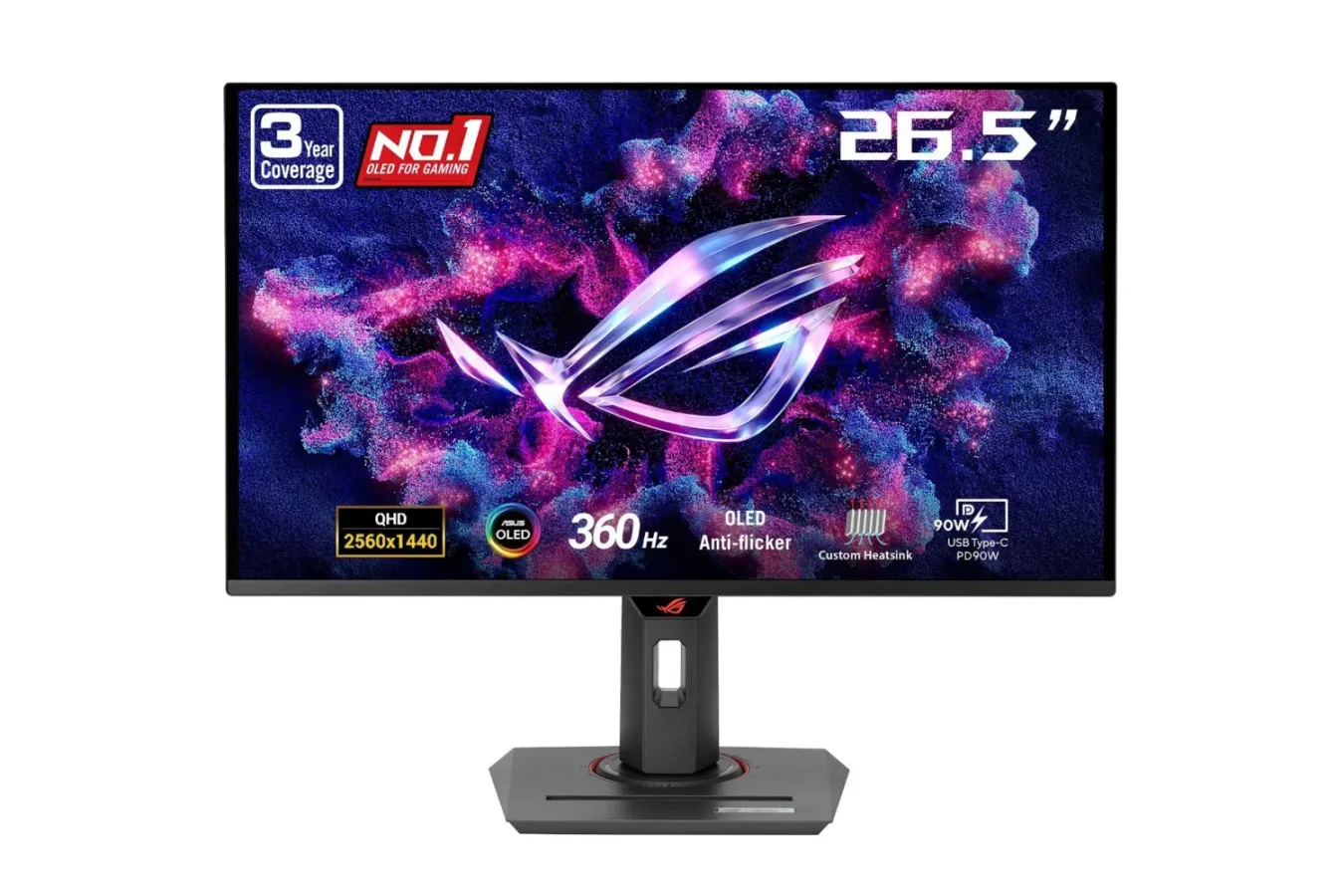
Players looking to upgrade to a high-refresh-rate OLED display have a substantial Black Friday option to consider. ASUS's 26.5-inch ROG Strix gaming monitor is currently listed at $549, down from $759. That is a $210 reduction, or roughly 28% off the listed price, for a compact QHD display aimed squarely at fast competitive games and premium desktop play.
The discount is notable not only because it takes more than $200 off the monitor itself, but because the purchase currently includes standard shipping, a three-year warranty, and a three-month Adobe Creative Cloud subscription. Those extras will not matter equally to every buyer, but the warranty is particularly relevant for shoppers weighing an OLED monitor purchase, where long-term care and display protection can be an important part of the decision.
This is not a massive ultrawide or a huge living-room panel. Its 26.5-inch size instead places it in the familiar sweet spot for desk gaming: large enough to provide a sharp, immersive QHD image while remaining manageable on a standard setup. For players who sit close to their screen, play shooters or action games, and do not want a display to dominate the entire desk, that balance may be exactly the point.
A 360Hz QHD display built for speed
The headline specifications are a 360Hz refresh rate and a 0.03 ms response time. On paper, that combination targets the sort of rapid motion where display behavior becomes very apparent: competitive shooters, fighting games, racing games, rhythm games, and other titles in which quick input feedback and clear movement matter.
For useful background on this topic, read HP OmniBook 3 Drops to $250 With 16-Inch Display and Claimed 20-Hour Battery Life.
A 360Hz panel can refresh the image up to 360 times per second, provided the connected hardware and game can produce sufficiently high frame rates. That does not mean every game will suddenly run at 360 frames per second. Demanding new releases, especially at QHD resolution and high graphics settings, can still require powerful PC hardware. But for esports-focused games or titles with scalable settings, the extra refresh-rate headroom can help make motion feel more immediate and fluid.
The very low quoted response time is meant to complement that refresh rate by limiting how long pixels take to transition between states. In practical terms, the goal is reduced smearing and a cleaner-looking image during rapid camera movement. A high refresh rate alone is only part of the equation; display response and frame pacing also affect whether fast motion looks crisp rather than blurred or uneven.
The monitor is also described as G-Sync compatible. Compatible variable-refresh-rate technology allows the display to better match its refresh behavior to the frame output of a graphics card. When it is working within its supported range, that synchronization can help reduce visible tearing and make fluctuations in frame rate less distracting. For PC players, it is a feature that can be useful well beyond competitive gaming, particularly in graphically intensive single-player games where performance is not always perfectly locked.
OLED anti-flicker tech is a key part of the pitch
ASUS is also highlighting its ROG-exclusive OLED Anti-flicker technology. Refresh-rate changes can sometimes introduce visible flicker on OLED displays under certain conditions, particularly when variable refresh behavior is involved. The anti-flicker feature is intended to reduce that effect and support a steadier, more comfortable image when refresh rates fluctuate.
That could be meaningful for anyone who spends long stretches at a monitor, whether the time is split between gaming, work, browsing, editing, and streaming video. Monitor comfort is difficult to judge from a specification sheet alone, and individual sensitivity varies, but minimizing distracting flicker is a sensible objective for a premium display designed for extended use.
Buyers should still approach any display purchase with their own priorities in mind. OLED's contrast and response characteristics are appealing, but the technology comes with its own care considerations. ASUS includes OLED Care functions, and the monitor's DisplayWidget Center software provides access to those controls and other adjustments. Anyone considering the display should take time to understand the available panel-care settings and how they fit their normal desktop habits.
The inclusion of a three-year warranty adds some reassurance here. Warranty terms can vary by region and retailer offer, so shoppers should review the specific coverage details shown at checkout rather than assuming every form of panel issue is treated the same way. Still, a three-year warranty is a more meaningful extra than a disposable bonus when the purchase is a high-end monitor.
Color coverage and HDR for more than esports
While the 360Hz figure will catch the attention of competitive players, this ROG Strix model is not being positioned as a speed-only panel. It carries DisplayHDR 400 certification and covers 99% of the DCI-P3 color gamut. Those specifications point toward vivid color performance and broad color coverage for games, video, and other visually focused tasks.
DCI-P3 is a wider color space than the older sRGB standard commonly associated with typical PC displays. High coverage can help a screen present richer colors where content and applications support them. That does not automatically make any monitor a professional-grade color-reference tool, and color-critical users should always look closely at their required workflows, calibration needs, and accuracy data. But for general gaming and entertainment, broad DCI-P3 coverage is a welcome feature alongside the panel's speed.
DisplayHDR 400 certification establishes a baseline HDR capability rather than promising the most extreme HDR experience available in the premium TV and monitor market. It is best viewed as one element in the overall picture rather than the sole reason to buy. OLED's ability to deliver deep blacks and strong contrast is likely to matter just as much to a player's day-to-day impression of a game, especially in dark scenes, atmospheric adventures, and cinematic titles.
The 26.5-inch QHD format also makes sense for players seeking a practical performance target. QHD offers more desktop space and image detail than Full HD while asking considerably less of a graphics card than 4K. Pairing that resolution with 360Hz gives buyers flexibility: esports games can be tuned for exceptionally high frame rates, while more demanding games can prioritize image quality without making the display's resolution excessively difficult to drive.
AI features and DisplayWidget Center add convenience
ASUS says the monitor includes AI capabilities designed to detect what is being played and optimize performance accordingly. Automated display features can be useful for players who do not want to manually adjust settings for every game, though they should not be treated as a replacement for personal calibration. Preferences around brightness, color temperature, HDR, and motion settings are subjective, and the best configuration can vary greatly from one title to another.
For manual control, DisplayWidget Center is designed to provide quick access to monitor settings and OLED Care functions. Software-based adjustment can be more convenient than navigating a display's on-screen menu with physical controls, especially for people who frequently switch between work and gaming profiles. It also makes the feature set more approachable for owners who want to check panel-care options without digging through multiple monitor menus.
Who should consider this Black Friday price?
At $549, the ROG Strix 26.5-inch monitor remains a premium purchase, not an entry-level upgrade. The deal makes the most sense for PC players who specifically want the combination of QHD resolution, OLED characteristics, and an exceptionally high 360Hz refresh rate. Someone mainly playing slower games at modest frame rates may get more value from a less expensive display, while a buyer who needs a larger screen for split-screen productivity may prefer a bigger panel or ultrawide model.
It is also worth being realistic about the PC required to take full advantage of 360Hz. Competitive games are generally the most likely candidates for very high frame rates, especially when settings are optimized for performance. Players focused on visually demanding games can still benefit from the monitor's response time, contrast, color coverage, and variable-refresh-rate support, but they should not buy solely on the expectation of seeing 360 frames per second in every release.
For shoppers already planning an OLED gaming monitor upgrade, however, the current price meaningfully changes the equation. The direct discount brings the display from $759 to $549, while the included shipping, warranty, and three-month Adobe Creative Cloud subscription add a little more value around the purchase. As with many Black Friday promotions, availability and included bonuses can change, so buyers interested in this configuration should confirm the displayed price and offer details before completing an order.
The core appeal remains straightforward: this is a relatively compact QHD ROG Strix screen with 360Hz gaming performance, a 0.03 ms response time, G-Sync compatibility, OLED anti-flicker technology, and broad DCI-P3 color coverage. For a player seeking that particular blend of speed and image quality, a $210 cut is a much more compelling entry point than the original $759 listing.
Community
Discussion
Start the conversation.
No comments have been posted yet.