

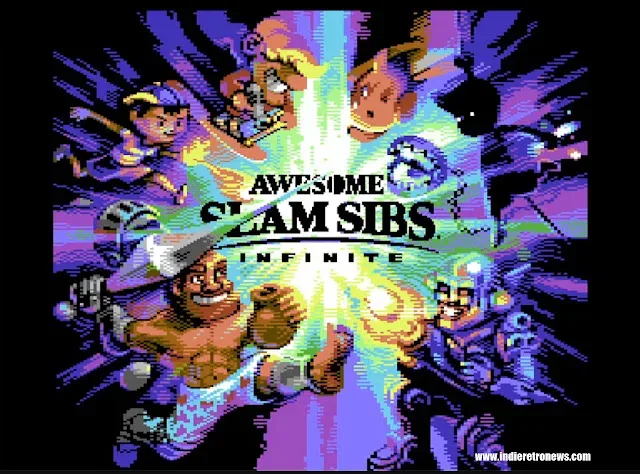
Awesome SlamSibs Infinite has arrived on the Commodore 64, bringing an unlikely but welcome dose of chaotic multiplayer fighting to one of gaming's most enduring home computers. Created by developer Søren Trautner Madsen with contributions from fellow enthusiasts, the new C64 title is described as a nostalgic tribute to Super Smash Bros. Ultimate, reimagining the broad appeal of a character-driven platform brawler within an extraordinarily constrained retro format.
The premise is appropriately direct: select a fighter, take hold of a joystick, and face either another player sitting beside you or a computer-controlled opponent. Yet the simplicity of that pitch belies the scale of the technical challenge. The Commodore 64 has only 64 kilobytes of memory to work with, making even a modest modern-style fighting game an ambitious undertaking. Awesome SlamSibs Infinite aims to deliver recognizable characters, animation, music, stages, effects, and competitive action while operating inside that tiny memory budget.
That tension between huge inspiration and limited hardware is at the heart of the project. Rather than trying to disguise the C64's restrictions, Awesome SlamSibs Infinite embraces them. It is a game built around the appeal of making a familiar kind of multiplayer spectacle work on a machine that predates the genre's modern standards by decades.
A platform-fighter idea on 8-bit hardware
Platform fighters are especially demanding games to translate to older systems. Their appeal depends on movement, readable character animation, responsive combat, multiple players or opponents, and stages that can influence the flow of a match. Even when the controls are approachable, the games need a great deal of information to remain legible in motion: where each fighter is positioned, what attack is being used, whether an environmental hazard or visual effect is active, and how the match state is changing.
For useful background on this topic, read Pokémon and Fender Reveal Red and Green Anniversary Guitars for 2027.
On contemporary platforms, developers can draw on vastly more memory, processing power, and storage than an 8-bit computer could ever provide. A Commodore 64 game cannot simply bring over that level of content or presentation unchanged. Instead, its creators need to decide what matters most, where assets can be compressed or reused, and how visual feedback can remain clear without overwhelming the system.
Awesome SlamSibs Infinite approaches that problem through a deliberately retro lens. It combines characters, classic-game references, and vintage-styled music in a brawler intended to feel lively and playful rather than like a technical demonstration. The result is rooted in the same communal, pick-up-and-play spirit that has kept local multiplayer games relevant across generations.
The title's stated inspiration also makes sense as a design starting point for a C64 release. The enduring attraction of Smash-style games is not solely tied to high-end visuals or massive rosters. At their core, they create immediate competition: players can quickly understand that they need to move, attack, avoid danger, and outlast their rival. That accessibility is well suited to the joystick-in-hand setup of a classic home computer.
Built by hand, limitation by limitation
Madsen says every line of code, sprite, and animation was produced by hand using a traditional development approach. Modern AI tools were avoided during production, apart from limited bug-hunting work toward the end of development. That choice was not presented as the fastest or most efficient route to completing a game. On the contrary, Madsen acknowledges that creating a project this way is an inefficient process by today's standards.
But efficiency is not the only goal in the C64 development scene. For many programmers, artists, musicians, and players still engaged with classic systems, the process is inseparable from the finished game. Building within fixed limits encourages techniques and solutions that would be unnecessary on modern hardware. Every sprite frame, effect, and piece of code must justify the memory it uses. Constraints become part of the creative identity rather than simply obstacles to eliminate.
In Awesome SlamSibs Infinite, those constraints were particularly significant because a full fighting game places pressure on several parts of the machine at once. Characters need sprites and animations. Attacks need clear feedback. Arenas need their own visual personality. Menus need to communicate options efficiently. Music must fit alongside everything else. Creating all of that in 64KB requires a careful balancing act, and Madsen has described the handling of sprites, animation, and stage effects as a major hurdle.
That makes the game notable not merely because it takes inspiration from a much newer multiplayer series, but because it attempts to compress the feeling of that experience into a computer whose hardware limitations demand continual compromise. It is a reminder that the most interesting retro projects are often not straightforward recreations. They are reinterpretations shaped by what an older machine can realistically do.
A team effort behind the brawling
While Madsen led the project, Awesome SlamSibs Infinite was not made in isolation. Jesper Rune Larsen assisted with the menu system and additional code, while Jarkko Salminen created the menu graphics. The wider community also contributed pixel art and music, supporting the game's mix of visual references and retro audio.
That collaborative side is important in a release such as this. The C64 remains active because of people who preserve skills, hardware knowledge, and design traditions that might otherwise disappear. New games for the platform often depend on a mixture of specialist roles: coding tuned to the machine, pixel art designed for its display capabilities, music composed with its sound hardware in mind, testing on original equipment or compatible setups, and community feedback throughout development.
Even the menu work matters in a project like this. A menu is where players first learn what a game offers, and on older hardware it must do so without consuming excessive space or slowing down the experience. Additional code support can be just as crucial, especially when a game is trying to coordinate the rules and presentation of a fast-moving competitive match.
The collaboration also reinforces the game's central theme: Awesome SlamSibs Infinite is meant to be shared. It may include computer opponents, but its ideal setting is clearly local play, with two people next to one another and ready to settle a rivalry through a few rounds of joystick-driven combat.
Designed for side-by-side competition
Local multiplayer has always been one of the strongest reasons to return to vintage systems. The technology may be old, but the social ritual remains immediate. One player can react to another's tactics in real time, celebrate a comeback, complain about a close loss, or demand an instant rematch without a lobby, voice chat, account system, or internet connection getting in the way.
Madsen has emphasized that sitting alongside a friend is the best way to enjoy Awesome SlamSibs Infinite. That recommendation aligns naturally with the game's brawler format and with its Commodore 64 home. It is intended to recreate the direct, face-to-face energy of classic competitive games, where the physical setup is part of the experience.
Computer opponents ensure that a player is not entirely dependent on having another person nearby, but the game's identity is built around competition with a friend. In that sense, Awesome SlamSibs Infinite is not trying to mimic every feature expected from a modern online fighter. Its ambition lies elsewhere: deliver a concentrated burst of multiplayer fun on authentic old-school hardware.
Why releases like this matter
The continued arrival of new Commodore 64 games demonstrates that retro platforms are not simply museum pieces. They remain creative targets. Developers still find fresh ideas in their limitations, whether they are making arcade action, puzzle games, adventure titles, or, in this case, a fighting game influenced by one of the best-known multiplayer franchises of the modern era.
Awesome SlamSibs Infinite stands out because it connects those eras so openly. It takes the recognizable energy of a contemporary platform fighter and filters it through the practical realities of 8-bit development. The game does not need to compete with modern releases on their own terms to be interesting. Its appeal comes from seeing how far a small team can push a beloved machine while retaining the excitement of quick, chaotic battles.
For Commodore 64 fans, it is another opportunity to put original hardware, a compatible setup, or an emulator to use with something newly made. For players more familiar with modern fighting games, it offers a glimpse into the craft required to create action-heavy software under restrictions that would be almost unimaginable today.
Above all, Awesome SlamSibs Infinite is a passion project built around persistence, technical ingenuity, and the pleasure of sharing a game with another person in the same room. With its handcrafted code and art, collaborative contributions, vintage music, and joystick-focused local battles, it carries forward the traditions that have allowed the Commodore 64 scene to remain active long after the computer's original commercial era.
Community
Discussion
Start the conversation.
No comments have been posted yet.