

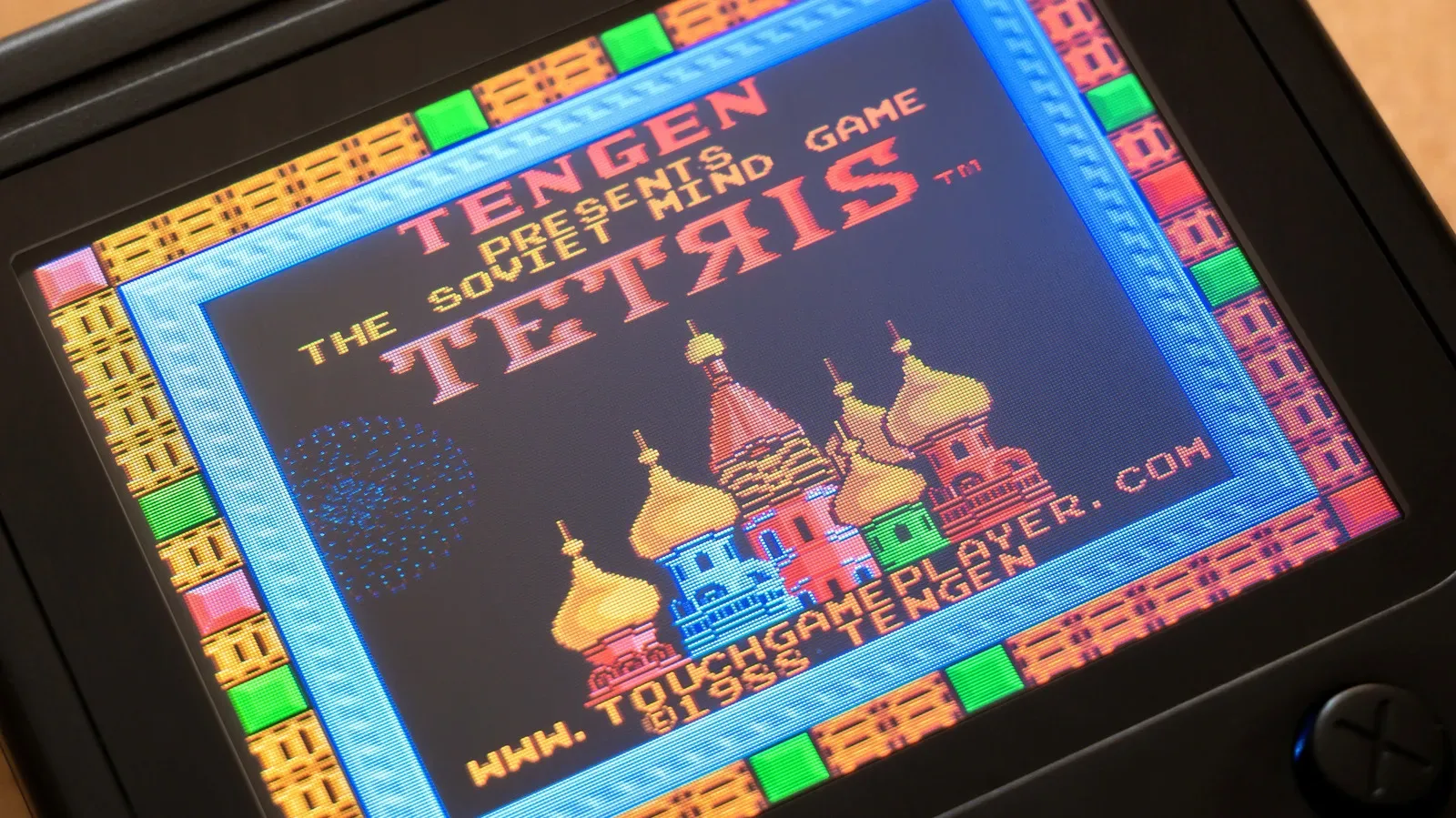
Few video games have been placed in as many hands, on as many screens, in as many different forms as Tetris. Plenty of famous games have earned a reputation for repeated reissues. The Elder Scrolls V: Skyrim is a frequent punchline whenever another edition appears, while Super Mario Bros. and Sonic the Hedgehog have spent decades returning through collections, remasters, virtual libraries, and retro devices. Yet Tetris sits in a category of its own.
The puzzle game has accumulated more than 200 official releases, in addition to a huge number of unofficial conversions, clones, and bootlegs. It has appeared on home computers, major consoles, handhelds, phones, calculators, web browsers, and devices that were never designed with games in mind. That reach is not just an accident of licensing history. Tetris is one of gaming's most portable ideas: easy to explain, difficult to truly master, visually legible, and playable with a remarkably small number of inputs.
Its long life also shows that a re-release does not always mean simply putting an old game back on sale. Across four decades, Tetris has been a bundled pack-in, a competitive challenge, a multiplayer party game, a meditative audiovisual experience, a battle royale, and even the subject of an interactive historical collection. Each era has found a different reason to bring it back.
From Soviet computer experiment to worldwide phenomenon
Tetris began in the Soviet Union in 1984 and 1985, when programmer Alexey Pajitnov was making games for enjoyment. His earliest version ran on the Elektronika 60, a Soviet computer without graphical output. The falling shapes were therefore represented with text characters rather than the colorful blocks most players associate with Tetris today.
For useful background on this topic, read Grand Theft Auto movie Remains Unlikely as Take-Two Sets a High Bar for Adaptations.
The essential design was already there. Players rotate and arrange tetrominoes, the geometric pieces built from four squares, to create complete horizontal lines. Completed lines disappear, opening room for more pieces until the growing stack finally reaches the top of the playfield.
Pajitnov and colleagues subsequently brought the game to the IBM PC, where copies spread through informal sharing. Interest soon expanded beyond the region. Versions followed for prominent computers of the period, including the Commodore 64, Amiga, and Macintosh. The trip from a text-display experiment to an international game was anything but straightforward, involving complicated rights negotiations and disputes. But the simplicity of the program helped it travel at a time when personal-computer software was often passed from person to person.
The decisive moment came in 1989 with the Game Boy version. Nintendo pursued the rights for its new handheld through a lengthy process that included a legal battle, ultimately securing the license. Tetris was bundled with the Game Boy in every market other than Japan, turning it into a defining part of the handheld's identity.
That edition introduced the version of the famous "Theme A" music that many players immediately recognize. Pajitnov has identified it as his favorite release. It is also the best-selling non-mobile version of Tetris, with more than 35 million copies sold. The pairing was extraordinarily effective: the Game Boy could go anywhere, while Tetris could be understood in seconds and replayed endlessly in brief sessions.
Why the game adapts so easily
At its heart, Tetris asks players to perform a handful of actions: move a piece left or right, rotate it, drop it, and make decisions before the next piece arrives. That limited control scheme made the game a natural fit for early computers and handhelds with few buttons. It remains equally comfortable on a modern controller, keyboard, touchscreen, or even unconventional hardware.
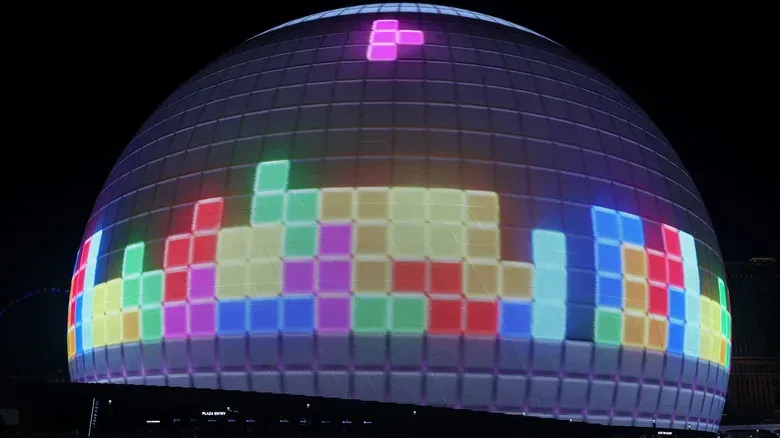
The visual requirements are similarly modest. A clear board and distinct shapes are enough to make the game function. This has enabled versions on hardware with radically different capabilities, from monochrome portable systems to high-definition consoles and virtual reality headsets. It also explains why unofficial adaptations have appeared in surprising places, including graphing calculators.
But technical portability alone does not explain Tetris's staying power. The rules are accessible almost immediately, yet the skill ceiling is immense. A new player can understand line clearing in one round; an expert can spend years improving speed, planning, recovery, and scoring. Every placed piece creates a fresh problem, and a seemingly harmless gap can become disastrous several moves later.
The Game Boy's enormous success created another powerful advantage: shared memory. For many players, Tetris was one of the first games they owned or played seriously. New editions can therefore appeal simultaneously to people revisiting a familiar rhythm and to newcomers encountering that rhythm for the first time.
Since 1996, Pajitnov and business partner Henk Rogers have managed branding and licensing through The Tetris Company. Official releases generally follow a set of rules known as the Tetris Guideline, covering aspects of presentation, controls, and game behavior. That framework helps maintain a recognizable identity even as developers build very different modes around the central puzzle.
The brand's familiarity has occasionally stretched beyond literal Tetris games. The Super NES title known internationally as Tetris Attack, for example, was originally Panel de Pon in Japan and does not use falling tetrominoes. The Tetris name was licensed for other markets because it was expected to signal a block-based puzzle game. Later related releases outside Japan used the Puzzle League name.
Classic editions that changed the formula
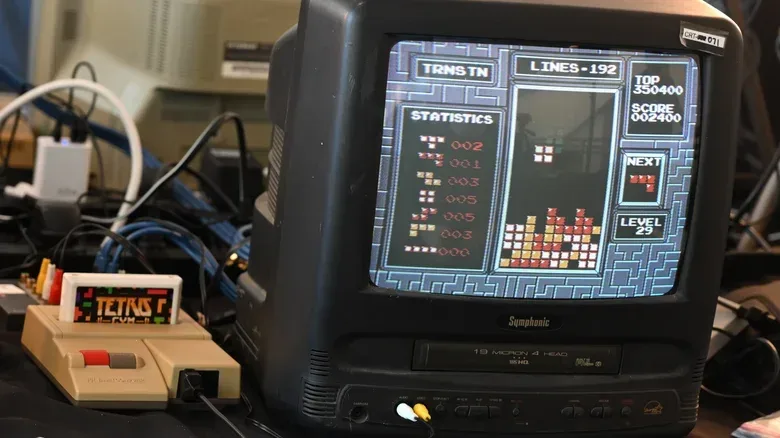
Not every historic version plays like the one most people picture. The NES release, also from 1989, became a major competitive favorite in part because of its severe design. Rather than encouraging endless play, its accelerating speed was effectively intended to bring a run to a natural conclusion. Competition initially focused on reaching the maximum score before the notorious "kill screen." In more recent years, highly skilled players have developed techniques that let them continue beyond barriers once believed impossible.
NES Tetris is demanding for other reasons. There is no hold function to save a piece for later. A tetromino locks into place immediately once it touches the stack, without the movement grace period found in many newer games. Its piece selection can also produce long stretches without a needed I-shaped piece. Modern systems often use a pseudo-random approach designed to ensure players receive each shape regularly; NES Tetris can leave them waiting.
Tetris DX arrived on Game Boy Color in 1998, refreshing the original handheld concept with color and introducing a feature that became a staple: Sprint play. In this format, the objective is to clear 40 lines as quickly as possible rather than survive indefinitely.
Released in 1999, Nintendo 64's The New Tetris brought four-player competition to a mainstream Tetris release and introduced the ability to hold a piece for later use. That option significantly changed decision-making, offering players a way to preserve an awkward shape or prepare for a better placement.
Tetris DS, released in 2006, remains one of the most celebrated entries. It presented several modes with Nintendo-inspired themes drawing from series such as The Legend of Zelda and Metroid. It was also the first official Tetris game to include online play, an important step for a series increasingly suited to global competition.
Modern Tetris is much more than one game
The continued stream of releases has not depended on nostalgia alone. Developers have repeatedly found ways to combine Tetris with contemporary ideas while protecting the core loop.
Puyo Puyo Tetris is one of the clearest examples. First released in Japan in 2014 and later launched in other regions in early 2017, it combines Tetris with Sega's Puyo Puyo puzzle series. Puyo Puyo had long been popular in Japan, though many of its earlier Western appearances came as franchise reskins, including Dr. Robotnik's Mean Bean Machine and Kirby's Avalanche. The crossover gives players multiple ways to compete, including modes that merge the two styles on the same battlefield.
Then there is Tetris Effect, released in 2018. Instead of treating the board as a purely abstract challenge, it turns play into a sensory journey through shifting landscapes, music, and reactive visual effects. The game originally focused on VR platforms, but Tetris Effect: Connected expanded it to modern systems in standard non-VR play. Its Zone mechanic allows players to stop time temporarily and clear more than the traditional four lines at once, offering a dramatic variation without abandoning the familiar pieces.
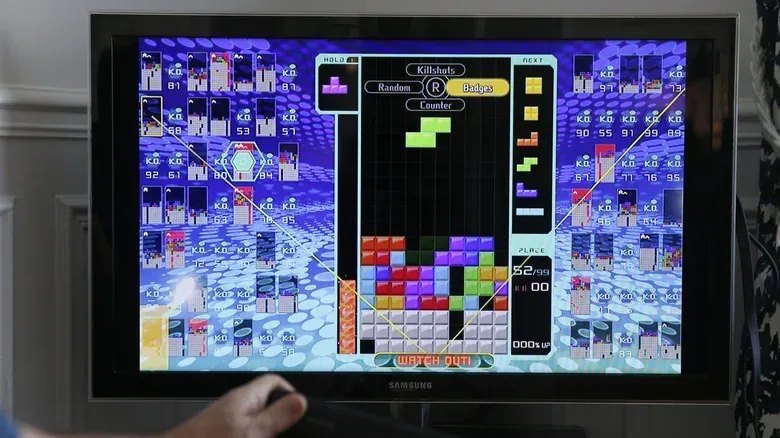
Tetris 99 took inspiration from the battle royale boom in 2019. Ninety-nine players compete at once, with line clears sending garbage blocks to opponents' boards. The last surviving player wins. It is an almost improbably natural pairing: the quiet concentration of Tetris becomes a frantic multiplayer elimination contest, and every efficient clear can become an attack.
For the series' 40th anniversary, 2024's Tetris Forever approached the legacy from a preservation angle. The release functions as an interactive museum, combining interviews with playable versions from the franchise's history. It acknowledges that Tetris is not just a single classic game but a sprawling family of interpretations shaped by hardware, business, culture, and player communities. Its story has also reached beyond games, including the 2023 Tetris film released on Apple TV.
A perfect loop for every generation
Calling any game perfect is subjective, but Tetris has an unusually strong claim to permanence. It does not need a large world, cinematic storytelling, expensive technology, or a complicated control layout. Its tension emerges from the board itself: one more piece, one more decision, one more chance to repair a mistake before the pace increases.
That makes each new version feel less like a replacement for the last and more like another lens on the same enduring idea. Players can pursue a high score on old hardware, compete at elite speed on NES Tetris, race 40-line Sprints, battle dozens of rivals, relax inside Tetris Effect's audiovisual environments, or explore decades of history through Tetris Forever.
More than 200 official releases is an extraordinary total, but it is also the logical result of a game that keeps fitting the moment. Tetris was suited to the earliest home computers, became inseparable from the Game Boy, and has remained relevant across phones, consoles, online play, VR, and competitive streaming. Whatever device comes next, the falling blocks will probably find room on it.
Community
Discussion
Start the conversation.
No comments have been posted yet.