

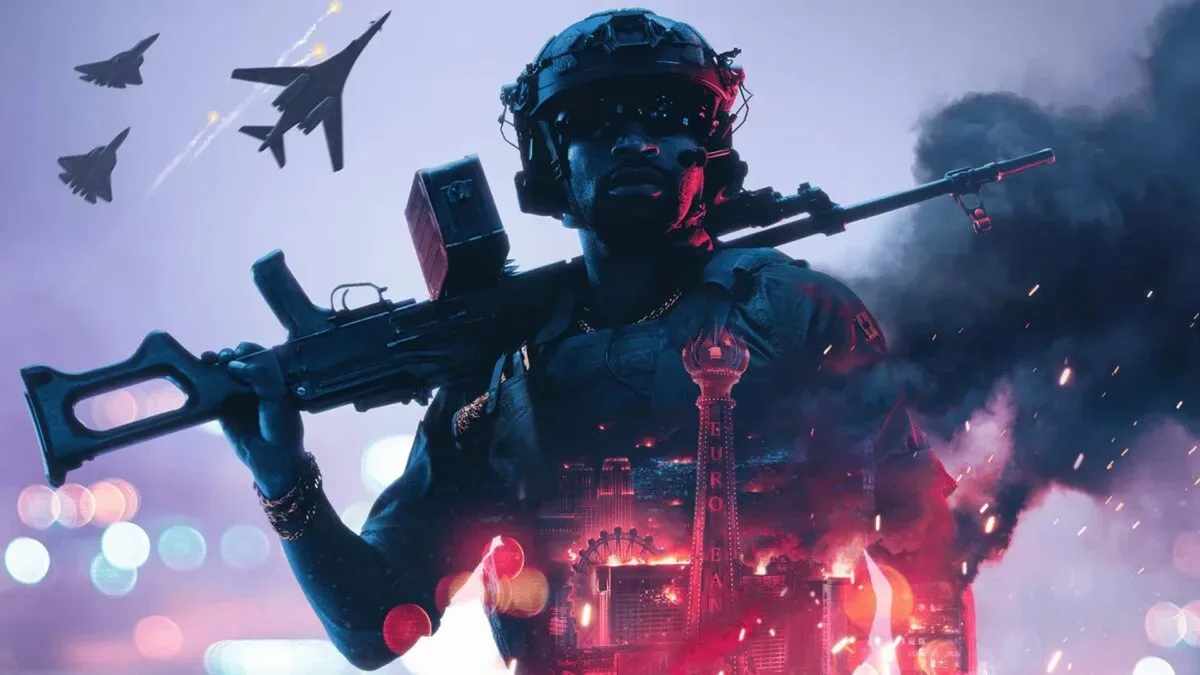
Battlefield 6 has reached its first anniversary with a story that feels remarkably fitting for a modern live-service shooter: an enormous opening, a swift comedown, several hard-earned recoveries, and persistent questions that have never entirely gone away. Launched in October 2025 for PlayStation 5, Xbox Series X/S and PC, EA's latest large-scale military shooter quickly became one of the year's defining releases. It also became 2025's best-selling game, finishing ahead of Call of Duty: Black Ops 7.
That commercial result does not mean Battlefield 6 has enjoyed a smooth first twelve months. Its players have spent much of the year arguing passionately about map sizes, mode design, cosmetic direction and the character of the series itself. The developers, including DICE and the other teams under Battlefield Studios, have adjusted course more than once. Some changes produced a clear improvement. Others supplied fresh material for the community's ongoing disputes.
With Season 5 now underway in October 2026, the game is in a considerably healthier place than it was during its rough first season. Its newest original locations have won meaningful praise, and several beloved returning maps helped restore confidence over the summer. Still, Battlefield 6's second year will need more than nostalgia and occasional high points if it is to retain the audience it attracted at launch.
A launch built on Battlefield's classic strengths
Before release, the open beta created the kind of excitement the franchise had struggled to generate after several uneven entries. More than 500,000 people played concurrently on Steam at one point during the beta. That enthusiasm climbed after launch, with Steam's concurrent-player total exceeding 700,000.
For useful background on this topic, read PS5 Sales Rise 22% as Marvel's Wolverine Bundle Drives Hardware Demand.
Much of the appeal came from how closely Battlefield 6 seemed to reconnect with the qualities players associate with Battlefield 4. The combat had a grounded presentation, weapons felt responsive, destruction made a visible contribution to battles, and performance was a major focus. For fans who had drifted away from the series, it appeared to be a confident return to a familiar formula: broad military conflict with vehicles, infantry engagements and chaotic objectives all happening at once.
The positive mood did not mean there were no warnings. Even in the beta, a common criticism was that too many maps felt constrained for a franchise historically associated with enormous combat spaces. That concern would outlast the beta and become one of the defining criticisms of Battlefield 6's first year.
Players also watched the game's cosmetics closely. Battlefield's community had seen other military shooters embrace increasingly outlandish crossover material, and many hoped this entry would avoid that route. The development team communicated an intention to keep the visual identity believable and grounded. That promise has remained central to later arguments whenever a skin, event or themed item has appeared to push against it.
For another perspective on this story, read Battlefield 6 at One: Strong Maps, Old Disputes and a Crucial Second Year.
The honeymoon ended quickly
In its initial weeks, Battlefield 6 largely benefited from goodwill. There were complaints about progression feeling overly demanding, alongside loud criticism of changes to the series' signature Conquest mode. Crucially, the Conquest alterations were reversed in less than 72 hours, providing early evidence that the team was willing to react quickly when a decision landed badly.
The more difficult stretch began with Season 1 on October 28, 2025. It introduced a new map and Redsec, a battle royale mode, but neither arrival generated much enthusiasm. Redsec drew criticism for requiring squad play and for carrying Battlefield 6's class system into a format where many players felt it did not fit naturally.
Its largest controversy was also tied to a map. Redsec featured a huge space, yet players frustrated by Battlefield 6's lack of large conventional maps could use it only within the battle royale mode. For a community asking for the sweeping sandbox battles traditionally associated with the franchise, seeing a major map committed to a separate mode felt like a missed opportunity.
Season 1's standard multiplayer addition, Blackwell Fields, did little to calm those concerns. Players widely regarded it as too open, too small and not especially memorable. The timing made matters worse: the first major post-launch battleground was expected to demonstrate the game's future, but it instead reinforced the belief that Battlefield 6 had not yet solved its scale problem.
Community creators made the contrast especially difficult to ignore. Using in-game tools, players transformed Redsec's environment into a large, classic-style Battlefield combat zone. The result became popular enough to underline what players were asking for. The developers subsequently acknowledged the desire for bigger maps and indicated that larger options were being developed.
Cosmetics and AI concerns added to the tension
Map design was not the only issue complicating the first season. A planned cosmetic nicknamed "Blue Bro," featuring a bright blue look and skull-faced mask, sparked complaints from players who believed it clashed with the grounded direction established before launch. The item's coloration was later toned down, satisfying some critics, though the larger disagreement about what belongs in Battlefield 6 never disappeared.
Late 2025 also brought scrutiny over an in-game emblem that players suspected had been made with AI tools. The emblem was changed shortly after it appeared. While that did not establish a complete picture of how assets were produced across the game, the incident left many players uneasy as the title entered 2026.
With the community mood deteriorating, Season 2 was delayed from January to February. The delay was intended to give the team time to address issues, improve the game and deliver a stronger content update. It was a setback for a live-service release that needed dependable momentum, but it also reflected the extent to which the opening seasonal plan required revision.
Better maps gave the game a path forward
Season 2 proved to be a more positive step. Contaminated, one of its key maps, found favor with players thanks to its larger sightlines, vertical variation and more satisfying overall scale. It was not an instant resolution to every complaint, but it demonstrated a stronger understanding of what much of the audience wanted from Battlefield 6.
The game's most convincing recovery came in the summer through Seasons 3 and 4. These updates restored three established fan favorites: Golumn Railway, Grand Bazaar and Wake Island. Returning maps can invite criticism that a live-service game is leaning too heavily on the past, but in this case they gave Battlefield 6 reliable, proven spaces that many players were eager to revisit.
Wake Island in particular has a special place in the series. It has appeared in many Battlefield installments and remains one of those maps whose return immediately signals a renewed embrace of the franchise's history. Its arrival was a practical way to rekindle excitement after the disappointments of the earlier months.
Season 4 also delivered Tsuru Reef, a new large-scale battleground built around islands and naval warfare. The map helped bring back players who had been discouraged by the smaller and less satisfying early selections. It also produced a slightly ironic reaction: after so many demands for greater scale, some players felt Tsuru Reef was too large. That divide illustrates the challenge facing the team. "Bigger maps" is a clear demand in broad terms, but individual preferences over pacing, traversal and action density remain far less unified.
Season 5 shows original work can stand beside the classics
The current Season 5 has supplied another reason for cautious optimism. Two new maps, set in Las Vegas and Area 51, have been warmly received by much of the player base. They are large, distinctively themed and offer experiences that do not simply duplicate the returning favorites.
That matters for the game's long-term outlook. Reintroducing classic maps can help stabilize a troubled season, but Battlefield 6 cannot build its identity exclusively from remembered successes. The reception to Las Vegas and Area 51 suggests the present team can create new spaces that players consider worthy companions to Battlefield's legacy locations.
At the same time, the old cosmetic debate has intensified again. A Dead Space-themed limited-time Halloween event has divided the community. Some see it as harmless seasonal material that does not fundamentally alter the game's military identity. Others consider it evidence that the original commitment to a realistic tone is being weakened.
There have also been renewed allegations involving AI-generated-looking content. Players have highlighted skins with apparent typos, unusual design choices and excessive numbers of pistols as examples that have raised concerns. These claims continue to fuel distrust among those who already felt uneasy after the emblem controversy late last year.
A crucial second year begins
Battlefield 6's current atmosphere is neither the jubilant rush of launch nor the gloom surrounding Season 1. It is a more measured and fragile confidence. Players have seen the game improve, particularly through Contaminated, Tsuru Reef, the returning classics, Las Vegas and Area 51. They have also seen the same disputes resurface often enough to doubt that every lesson has been fully absorbed.
The broader business context adds further uncertainty. In April, EA announced layoffs across the teams making up Battlefield Studios, even as the game had become 2025's best-selling release. EA chief executive Andrew Wilson received a $38 million bonus during the same period. The layoffs and EA's emphasis on cost-cutting have naturally raised questions about the resources and stability available for Battlefield 6's continued support.
Its second year therefore has a straightforward, if demanding, assignment. Battlefield 6 needs to maintain the stronger standard set by its best recent maps, listen carefully to the audience on features and balance, and avoid allowing cosmetic choices to overwhelm the grounded identity that helped win people over in the first place. If it can do that, its difficult first year may ultimately look like the foundation of a long-lived comeback. If support falters or cost-cutting wins out over sustained investment, even a strong recovery may not be enough to prevent a slow decline.
Community
Discussion
Start the conversation.
No comments have been posted yet.