

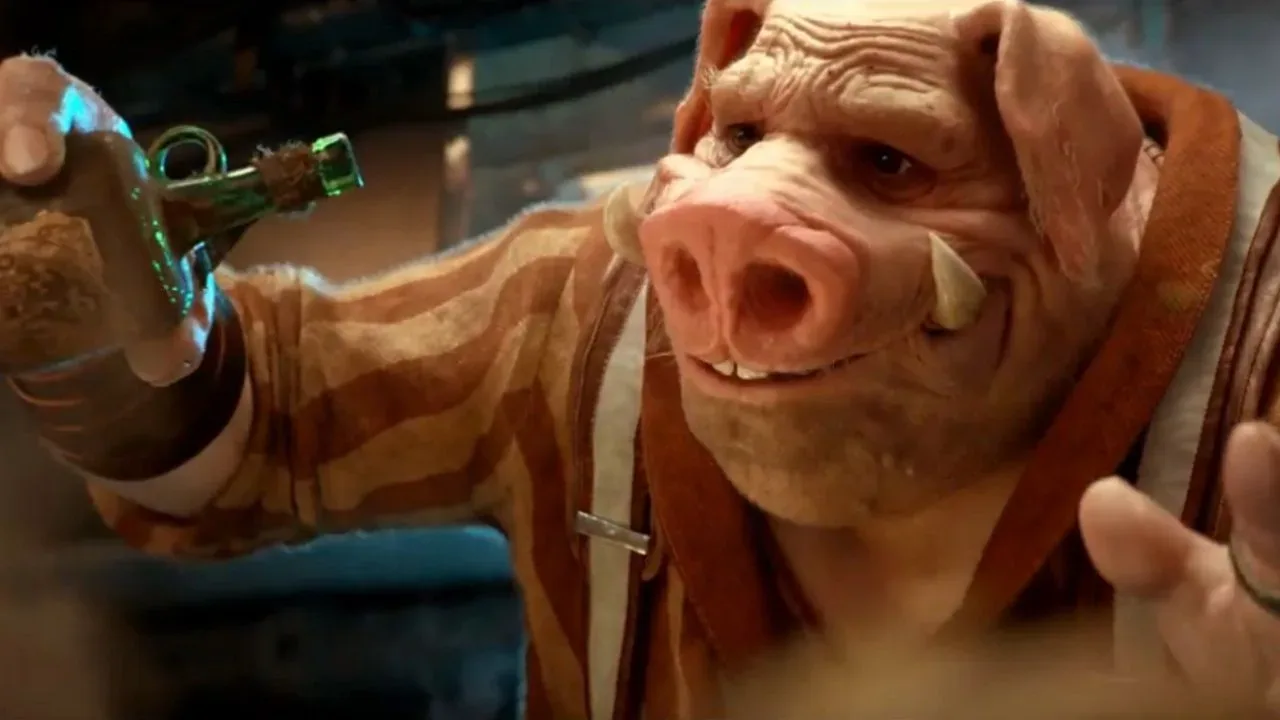
Beyond Good & Evil 2 may have undergone another major reinvention. A report from French outlet Origami claims Ubisoft's famously long-gestating sequel has moved away from a heavily connected, live-service-oriented multiplayer concept and is now being shaped as a single-player-first experience with optional co-op.
It is an especially striking claim because the game has been public for more than 18 years, yet its eventual form remains difficult to pin down. Ubisoft has continued to maintain that the project is in development, but there has been little official visibility around it in recent years. If the new reporting is accurate, the lack of progress toward a release may be tied less to one troubled production plan than to repeated changes in what the game is supposed to be.
The report describes a project that has traveled through several fundamentally different design directions since 2019: from a broadly multiplayer, connected game influenced by the continuing-service models of Fortnite and Destiny, through team-oriented concepts for four players and then two-player co-op, before arriving at its current reported solo-first structure.
That does not mean the game is confirmed to be close to launch. Quite the opposite: one of the report's most notable assertions is that Beyond Good & Evil 2 is still in pre-production. Ubisoft has not publicly confirmed the details of this account, including the game's present design, development stage, platforms, or release window.
For useful background on this topic, read Full Circle Developers Report Layoffs as EA Restructures Skate Team.
A connected-game vision reportedly dominated 2019 to 2022
Origami's report says that from 2019 through 2022, Beyond Good & Evil 2 was being developed as a highly multiplayer and connected title. The concept reportedly took direct cues from the kind of ongoing social games that emphasize persistent engagement, recurring activities, and groups of players coming together online.
Under that approach, players were said to create their own characters rather than simply step into the role of a fixed protagonist. Activities would reportedly be generated dynamically, while larger sessions could organically bring players together through matchmaking. In broad terms, it sounds like Ubisoft was exploring a game built around shared systems and repeatable social play rather than a conventional authored single-player campaign.
That direction would have represented a dramatic interpretation of the Beyond Good & Evil name. The original game is remembered for its character-driven adventure, its distinctive setting, and the journey of protagonist Jade. While the sequel has long appeared intended to be much larger in scale than the 2003 release, a player-created-character, connected-game format would have placed the series in a very different space.
It also reflects a period when many major publishers were pursuing games designed to retain players for months or years. The success of titles such as Fortnite helped make the prospect of a massive, regularly updated multiplayer hit enormously appealing across the industry. But those ambitions also introduce difficult production demands: network infrastructure, matchmaking, live operations, a steady pipeline of content, player progression, social systems, and a gameplay loop compelling enough to sustain a population over time.
A project already challenged by the expectations attached to a beloved cult classic could have found those additional demands particularly hard to reconcile with its creative identity.
Four players, two players, then optional co-op
The report suggests the multiplayer model did not remain static. The concept reportedly evolved toward a more open-ended approach, then toward four-player team-based action. From there, it is said to have narrowed again into a two-player co-op format.
Those shifts matter because they point to more than routine iteration. It is common for individual missions, combat systems, progression mechanics, and story elements to change during a long game production. Moving between a large-scale connected experience, squad action, smaller co-op, and a solo-led adventure is a much more substantial series of pivots. Each approach requires different assumptions about level design, narrative pacing, character progression, technical priorities, and the role players are expected to have in the world.
A four-player game, for example, needs encounters that remain readable and enjoyable amid several simultaneous combatants. A two-player co-op title must decide whether both participants have identical abilities, complementary roles, or different story positions. A single-player game has more freedom to control pacing and challenge, but it must also make sure its core systems are satisfying when one player carries the entire experience.
According to the account of the project's current state, Ubisoft is now pursuing the latter model first. Optional co-op would still preserve a way for players to explore together, but the game would reportedly not require online connectivity and would be designed primarily around solo play.
Combat reportedly takes cues from Marvel's Spider-Man
Beyond its overall structure, the report offers one indication of the game's current gameplay ambitions. Its combat is reportedly being positioned in the vein of Marvel's Spider-Man, suggesting an accessible, fluid action system focused on movement, responsiveness, and cinematic momentum.
That comparison should be treated carefully. It does not establish that Beyond Good & Evil 2 will play like Insomniac Games' superhero series in any exact sense, nor does it reveal which characters, weapons, traversal tools, or combat mechanics are actually planned. Design comparisons made internally can refer to anything from player responsiveness to camera work, enemy encounters, animation priorities, or the general feel the team wants to achieve.
Still, it offers a clearer picture than the live-service description. A solo-led action adventure with optional co-op and fast, polished combat would be easier to understand as a successor to a series known for exploration, personality, and action-adventure storytelling. Whether that concept will remain in place long enough to become a finished product is the larger question.
The reported pre-production status is the biggest warning sign
Perhaps the most concerning point is the claim that the game remains in pre-production after so many years. Pre-production is typically where teams define a project's central pillars, test ideas, establish technology, create prototypes, and determine the scope of full production. It can involve substantial work, but it is generally not the stage players expect a game to occupy nearly two decades after its announcement.
The report characterizes the project's history as one where internal creative milestones have repeatedly changed. In that telling, missed targets were not simply the result of a team failing to deliver a settled plan on time. Instead, the plan itself was repeatedly altered, changing the definition of what the team was meant to deliver.
That distinction is crucial. A difficult game can recover when a studio identifies a problem, makes a decision, and executes a focused solution. Repeatedly redefining the game's foundation can be much harder to overcome. Every new direction risks invalidating prototypes, systems, assets, narrative work, and technical investment built for the last one. It can also make it difficult for a team to establish consistent priorities.
For a sequel with an unusually long and public history, the challenge is even greater. Beyond Good & Evil 2 has accumulated years of expectations, speculation, and skepticism. Any eventual release will need to stand on its own as a game, while also answering the inevitable question of why it took so long to arrive.
Ubisoft still needs to provide official clarity
There is a potential upside to the reported change. A focused single-player game with optional co-op may give the project a more coherent starting point than an attempt to chase the scale and service requirements of the industry's largest online hits. It may also allow Ubisoft to build around a clearer player journey rather than designing every major system around persistent multiplayer engagement.
But a new direction only helps if it remains stable. The report does not provide a release target, confirmed platforms, or evidence that the game has entered full production. Ubisoft has likewise not announced any new timeline or detailed public update that would settle those questions.
For now, the most important takeaway is not that Beyond Good & Evil 2 has been definitively transformed into one specific game. It is that the project reportedly continues to search for the version of itself that can finally move forward. A solo-first action adventure with optional co-op may be the clearest identity the sequel has had in some time, but after 18 years, only an official reveal and sustained development progress will show whether that identity lasts.
Community
Discussion
Start the conversation.
No comments have been posted yet.