

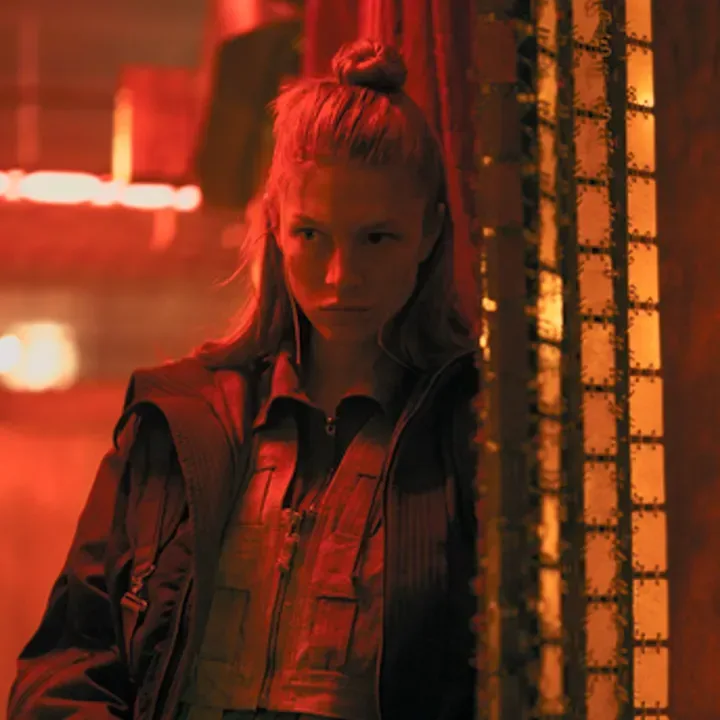
Blade Runner 2099 has offered its clearest look yet at the case driving its return to the celebrated science-fiction universe. A newly revealed trailer puts the limited series' central mystery into sharper focus: Replicants are disappearing, someone may hold the key to saving them, and the answer could destabilize the rebuilt city of Los Angeles.
The series stars Hunter Schafer as Cora and Michelle Yeoh as Olwen, two figures whose alliance appears necessary but far from comfortable. Their investigation unfolds 50 years after Blade Runner 2049 and 80 years after the original Blade Runner, carrying the franchise's familiar questions about identity, mortality, exploitation, and the line between human life and manufactured life into a much later era.
Set to debut on November 25, 2026, Blade Runner 2099 will arrive as an eight-episode limited series. All eight episodes are planned to be available on the same day, allowing viewers to either approach its mystery gradually or follow its clues through a full binge-watch immediately.
Embedded X/Twitter post
A Los Angeles Rebuilt Beyond Humanity
The new footage presents a future Los Angeles that has been remade in the decades since the previous film. Yet the setting's renewal is not framed as a triumph for ordinary people. The series description establishes a pointed premise: the city has been reborn, but not through humanity. That idea is an apt continuation of a world where corporations, technological power, artificial beings, and urban decay have long existed in uneasy balance.
For useful background on this topic, read LEGO Hope Assembles Invites Fans to Design Star Wars and Marvel Crossover Sets.
Rather than simply revisiting the visual shorthand associated with the franchise, the show's setup suggests a city facing a new stage of its dependence on Replicants. The missing-person numbers mentioned in the trailer make that tension tangible. Olwen says that 10 female and 18 male Replicants have vanished during the past year. Whether those disappearances represent abductions, escapes, organized resistance, or something even more complicated is not yet clear, but the scale points to a crisis that cannot be dismissed as a handful of isolated cases.
That uncertainty is central to the appeal of the premise. The Blade Runner setting has always treated information as something incomplete, compromised, or weaponized. Characters frequently operate with only fragments of the truth, while memories, official records, and even physical evidence can be unreliable. A rash of missing Replicants gives the series a strong investigative engine while leaving ample room for the philosophical unease that defines the property.
Cora Takes on One More Identity
Schafer's Cora begins the story as a fugitive who is trying to end a life spent running. Her proposed solution is a risky one: she takes on the identity of a Blade Runner. In this universe, that role carries considerable weight. Blade Runners are tasked with tracking down Replicants who have gone missing or gone into hiding, a job that has never been morally simple in the franchise's previous stories.
For Cora, adopting that identity appears to be both cover and commitment. It gives her a route into the mystery, but it also places her within an institution built to police the very people at the center of the case. The trailer's tense exchanges indicate that she is not merely an observer caught near a major event. She has agency, secrets, and an agenda that may be difficult to reconcile with the mission she is asked to undertake.
The official story outline says Cora is forced to work with Olwen while pursuing a runaway who is concealing a truth powerful enough to bring down a fragile city. That language raises obvious questions. Is the runaway connected to all 28 disappearances? Is the threat political, biological, technological, or personal? And what exactly is fragile about the current order of Los Angeles? The trailer does not resolve those questions, but it makes clear that the stakes extend well beyond a conventional hunt.
There is also an inherent dramatic contradiction in Cora's situation. A fugitive seeking a final escape from pursuit becomes a hunter herself. The role reversal fits the franchise's longstanding interest in who gets to define legality, personhood, and danger. It could also force Cora to confront similarities between her own need for a new identity and the Replicants she is meant to locate.
Michelle Yeoh's Olwen Faces Her Own Deadline
Yeoh's Olwen is described as a Replicant who is only days from dying, giving the investigation an urgent personal dimension. Her role is more than that of a partner supplying knowledge of the missing. The trailer's mention of a possible cure for all Replicants makes Olwen's limited time especially significant, turning the broader mystery into an immediate matter of survival.
A mysterious "he" is said to be out there, and this person supposedly knows the cure for every Replicant. That claim could transform the existing order of the Blade Runner universe. Replicants have repeatedly been defined, controlled, and threatened by restrictions tied to their lifespan and reproduction. A cure could mean liberation for some, but it could also create new forms of leverage for whoever controls it.
Olwen's dialogue at the end of the trailer reinforces the series' atmosphere of suspicion. "I don't know what you're doing," she tells Cora. "Do you?" The line does not explain their conflict, but it makes their partnership feel provisional. Neither character seems positioned as a straightforward guide for the other. Both may be pursuing the same target for radically different reasons, and both may be withholding information.
Yeoh's presence also brings a compelling contrast to Cora's apparent instability. Olwen is facing a fixed deadline, yet she appears focused enough to recognize the danger around her. Cora, meanwhile, may be attempting to build a future through an assumed role while the past closes in. Their relationship has the potential to become the emotional center of a case that otherwise spans the fate of a whole city.
Continuing a Legacy of Noir Science Fiction
Blade Runner 2099 enters a franchise with a remarkably durable legacy. Ridley Scott's 1982 film established the rain-soaked, neon-lit noir vision that has influenced games, film, television, animation, and science-fiction storytelling for decades. Denis Villeneuve's Blade Runner 2049 expanded that world while preserving its patient mood and fascination with artificial memory, created beings, and institutional cruelty.
The new series has the difficult task of honoring those foundations without relying solely on familiar iconography. Its 2099 setting offers a practical way to do that. With five decades separating the show from Blade Runner 2049, the series can explore a society changed by previous events rather than merely retracing them. The premise of widespread Replicant disappearances and a potential cure immediately establishes problems that belong specifically to this era.
Its place 80 years after the original film is equally important. The first story's questions remain unresolved at a cultural level because the technology it imagined feels less distant than it once did. Artificial intelligence, synthetic media, automation, surveillance, and corporate control continue to provoke real-world debate. Blade Runner has never offered easy answers to such anxieties, and the trailer indicates that Blade Runner 2099 is not likely to start now.
For viewers who also follow games, the series' mystery-driven structure may feel particularly familiar. The best cyberpunk games often put players in environments packed with competing interests, incomplete records, morally compromised employers, and choices shaped by systems larger than any one character. While Blade Runner 2099 is a television production rather than an interactive release, its hunt for a missing truth in a decaying future city speaks directly to the same enduring appeal.
What to Watch for Before the Full Season Arrives
The trailer and story description leave several points worth following as the premiere approaches:
- The missing Replicants: The disappearance of 28 people in a year suggests a pattern, but the nature of that pattern remains hidden.
- The alleged cure: If it is real, it could alter the lives of every Replicant and threaten the structures that keep them under control.
- Cora's assumed identity: Her decision to become a Blade Runner may protect her in the short term, but it also risks exposing who she was before the case began.
- Olwen's remaining time: Her approaching death gives every lead and every disagreement an added sense of urgency.
- The runaway's secret: The person at the center of the search is said to hold knowledge capable of collapsing Los Angeles' already unstable foundation.
The limited-series format may be especially well suited to this material. Eight episodes provide enough space to explore the investigation's twists, establish the condition of Los Angeles in 2099, and spend time with the competing motives of Cora and Olwen. Releasing the full season at once will also invite close scrutiny from longtime fans eager to connect its details to the films.
For now, the key promise is a familiar one delivered through a new pair of leads: a detective story where the most important clues may not be physical, the people being hunted may be the most human figures in the room, and the supposed solution could prove more dangerous than the problem. Blade Runner 2099 premieres November 25, 2026, with all eight episodes set to arrive together.
Community
Discussion
Start the conversation.
No comments have been posted yet.