

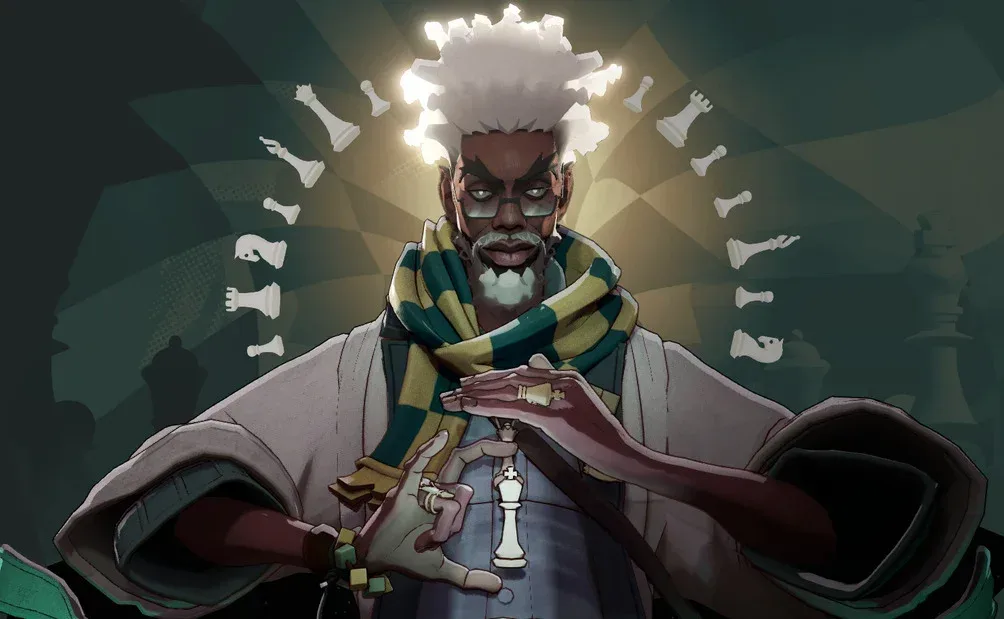
Deadlock's newest hero is already earning attention not simply for bringing chess pieces into a hero shooter, but for the unusually careful way Valve appears to have built that concept into every part of his presentation. Solomon, a levitating chess grandmaster who fights with a board in hand, has reload animations that recreate positions from some of the best-known games in chess history. Players have identified nods to the 1851 Immortal Game between Adolf Anderssen and Lionel Kieseritzky, as well as the 1996 match in which IBM's Deep Blue defeated Garry Kasparov.
It is an especially fitting detail for a character whose central battlefield identity is built around the game. Solomon does not merely use a chessboard as visual decoration or toss generic magical projectiles around the arena. He can bring oversized versions of chess pieces into play and command them in ways that reflect the movement of their tabletop counterparts. The historical arrangements visible during reloads add another layer to that idea: his board is not just equipment, but a miniature record of the game's famous tactical moments.
A chess player built around the board
Solomon arrived in Deadlock's recent City Never Sleeps update, which introduced him alongside five other heroes. Deadlock remains in a closed beta, but its developing roster has prompted substantial interest thanks to its unusual mixture of supernatural concepts, period-flavored urban imagery, and mechanically distinctive combatants. Solomon has quickly emerged as one of the update's most closely watched additions.
Embedded X/Twitter post
The character's silhouette helps explain why. He floats in a lotus-like pose, calmly suspended above the ground while carrying the visual language of an old-school chess master into Deadlock's magical conflict. Rather than treating strategy as a vague character trait, the design connects it directly to what the player sees and does. Small pieces rest on his board, then larger manifestations can be called onto the battlefield. That lets Solomon's gameplay fantasy land immediately: he is a strategist attempting to control space and shape an encounter several moves ahead.
For useful background on this topic, read Arc Raiders Frozen Trail update Sends Steam Player Count to Seven-Month High.
That theme makes the reload work more than a clever Easter egg. Reload animations are normally a brief necessity between attacks, often invisible to anyone except the person playing the character. For Solomon, the moment becomes an opportunity to reset a tactical puzzle. Each new formation on the board communicates that this is a player who has studied openings, sacrifices, traps, and famous turning points. It is a small touch, but one that can give a hero a stronger sense of identity than a larger but less considered visual effect.
The Immortal Game reference
One of the identified configurations draws from the Immortal Game, played in London in 1851 between Adolf Anderssen and Lionel Kieseritzky. The game remains a celebrated piece of chess history because of its aggressive, sacrificial style. Anderssen gave up major material on the way to a dramatic checkmate, creating a sequence that has long been taught, replayed, and admired for its imaginative attacking play.
Referencing that contest fits Solomon particularly well. The Immortal Game is not remembered because it was a cautious exercise in preserving every advantage. It is remembered because of audacity: the willingness to trade pieces away in pursuit of a decisive attack. A character who can summon giant chess pieces as combat tools naturally benefits from an allusion to a game where each piece can be viewed as part of a greater tactical plan.
For players who recognize the layout, the animation creates a direct bridge between chess culture and Deadlock's action. For everyone else, it still reads as an evocative board position being arranged by a composed grandmaster. This is the kind of reference that works at multiple levels. It rewards expertise without requiring it, which is often the ideal approach for games borrowing from a specialized subject.
Deep Blue and Kasparov bring a different kind of history
Another reload position points to Deep Blue's 1996 victory over Garry Kasparov. That result carries a very different cultural weight from the Immortal Game. Where Anderssen and Kieseritzky represent the romance of nineteenth-century over-the-board brilliance, Deep Blue versus Kasparov is inseparable from public anxieties and fascination surrounding computers, calculation, and the changing relationship between human skill and machines.
Kasparov won the overall 1996 match, but Deep Blue's individual win was historically significant as a major milestone for computer chess. Their rematch the following year would become even more famous, with Deep Blue winning the match. The reload nod specifically highlights the 1996 game in which the computer defeated Kasparov, preserving the importance of that earlier breakthrough rather than collapsing the two events into one.
It is a notably interesting selection for a game like Deadlock. Its setting blends an alternative mid-century New York with fantasy creatures and powerful occult forces, yet the Deep Blue reference introduces another form of strangeness: the rise of machine intelligence and the possibility of calculation exceeding an individual human mind. Solomon's precise, controlled persona can accommodate both sides of chess history. He evokes the old master at a park table, but his strategic power can also suggest something colder and more exacting.
Deadlock's city gives the character room to stand out
Deadlock takes place in an alternate version of mid-century New York, where two deities struggle for control of the city. A catastrophic event known as the Maelstrom has brought fantastical beings onto its streets, and heroes have aligned themselves with the rival divine forces in hopes of having wishes granted. It is a setting with enough supernatural upheaval to support almost any strange idea, but the strongest character concepts still need a recognizable human hook.
Solomon's is easy to understand. He resembles the mysterious, intensely focused chess player one might see at a public table, except he has been elevated into a mystical figure capable of making the pieces physically real. The contrast between familiar city imagery and supernatural escalation is central to why the concept works. Chess itself is ordinary, social, competitive, and deeply tied to public spaces. Deadlock turns that familiar activity into an uncanny weapon without losing sight of what made it recognizable in the first place.
The rest of the City Never Sleeps additions underline the breadth of the game's character ambitions. Solomon arrived beside a folklore-associated witch and a sewer-dwelling antagonist connected to The Nutcracker, among others. Those are disparate inspirations, but they all fit a world willing to pull from urban legends, theatrical tradition, magical archetypes, and odd historical texture instead of relying on a single narrow aesthetic.
Why minute animation details matter in a live-service shooter
Hero shooters are crowded with characters designed to make an instant impression. A distinctive weapon, a bold costume, and a short backstory can establish an archetype, but those elements do not always sustain interest once players spend dozens of matches with a hero. Small repeatable details can matter more. A reload is seen constantly. Giving it variations that reference genuine chess history means Solomon has a bit of personality and discovery built into a routine action.
That approach can also foster a community around observation. One player notices a familiar arrangement, another identifies the specific game, and a larger group begins comparing the animation to historical records. The result is discussion that goes beyond raw balance numbers or ability cooldowns. In a competitive game, players will always debate strength and counterplay, but a well-made character also invites appreciation for artistry, research, and thematic coherence.
Deadlock's closed-beta status makes that attention notable. The game is still being shaped, and individual heroes can change before a broader launch. Nevertheless, the enthusiasm around Solomon reflects the appeal of a roster that is not afraid to be peculiar. A board-wielding, floating chess grandmaster could have stopped at a surface-level gag. Instead, the historical positions suggest a design team interested in extending the premise into places many players may never have expected to inspect.
A promising move for Solomon
There is no need for every Deadlock player to know the Immortal Game move by move or to be familiar with the history of Deep Blue and Kasparov for the hero to succeed. The essential fantasy is already clear: Solomon controls a board, thinks strategically, and turns chess pieces into threats that loom over the fight. The references enrich that fantasy for people willing to look closer.
In a genre where many characters are introduced through instantly legible powers and broad personality hooks, Solomon's reloads demonstrate the value of specificity. His chess theme is present in his animations, his posture, his weapon, and his apparent combat kit. With famous games represented on the board, it also reaches beyond Deadlock itself into a long, varied history of human competition and tactical imagination.
That may be why players have been so eager to celebrate him so early in the game's life. Solomon is not just dressed like a chess master. He appears designed as one, down to the positions he restores between shots.
Community
Discussion
Start the conversation.
No comments have been posted yet.