

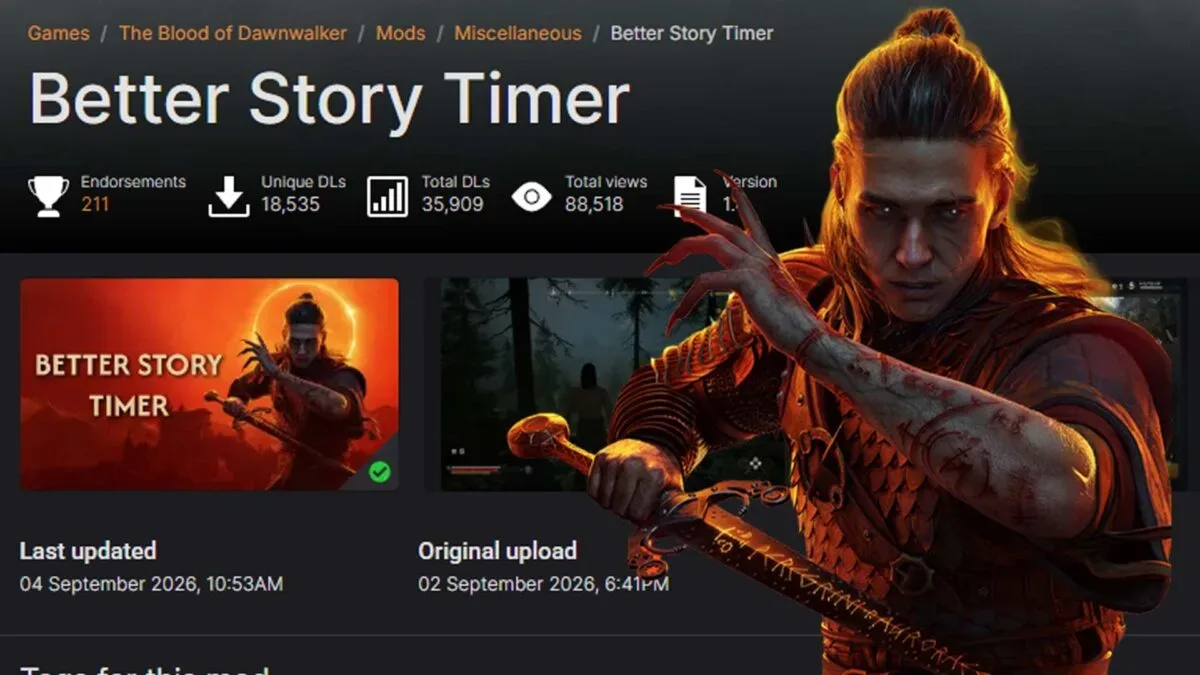
The Blood of Dawnwalker is built around pressure. Rebel Wolves' open-world RPG asks players to manage a vampire warrior's life across a shifting day-and-night cycle, with time advancing the world's calendar and affecting how players approach quests, combat, exploration, and character development. That structure is central to the game's identity, but it is also proving to be one of the first major points players want to alter on PC.
A mod called Better Story Timer has become the game's most popular download on Nexus Mods, offering players more room to complete activities and, in some configurations, removing certain time restrictions altogether. Since being uploaded on Wednesday, the mod has been downloaded more than 36,000 times, including an increase of over 5,000 downloads during the day the figures were reported.
That does not mean every Blood of Dawnwalker player is rejecting its timer system. SteamDB showed more than 50,000 people playing the RPG at the time those numbers were noted, and that represents only part of the overall audience across PC and consoles. Even so, the scale of the mod's early uptake is a clear indication that a substantial group of PC players would rather experience the game with less urgency hanging over their decisions.
A design built around the passing of time
Rebel Wolves, a studio formed by senior developers who previously worked on The Witcher 3, designed Blood of Dawnwalker around its unusual split between day and night. Players take the role of a vampire warrior, and the passage of time is not merely a visual effect or an atmospheric backdrop. It is an active part of the game's larger structure.
For useful background on this topic, read Five Acclaimed Steam Games to Grab for Less Than $25 This Weekend.
The cycle pushes the calendar forward, meaning that time management is woven into numerous parts of play. Exploration is no longer entirely separate from progression. Taking fights, pursuing quests, leveling up, and wandering the world can all carry an implied cost because players are aware that the clock is still moving.
For some players, that is exactly what gives the RPG its stakes. A time-sensitive structure can make route planning meaningful, encourage harder choices, and stop an open world from becoming a checklist that can be completed at leisure. It can also strengthen role-playing: if the protagonist is operating under serious narrative pressure, an endless amount of time to gather loot or clear side content may undermine the premise.
But game timers have long been divisive, particularly in large RPGs. Many players prefer to inspect every corner of a map, pause to experiment with character builds, read dialogue carefully, or take on optional activities without feeling that they are jeopardizing another objective. When a game's systems create tension between those habits and the most efficient route forward, some players see that as compelling friction. Others see it as an obstacle to the way they want to play.
Better Story Timer answers a specific player demand
Better Story Timer directly addresses that conflict. Its popularity suggests that the concern is not necessarily with Blood of Dawnwalker's world, characters, or core vampire premise, but with the amount of freedom players have within the game's schedule. More time means more opportunity to investigate the open world, spend longer on individual quests, and make decisions without feeling rushed by an underlying deadline.
The mod also offers an option to eliminate some restrictions entirely. That is a much more significant change than a simple quality-of-life adjustment, because it can alter the intended rhythm of the campaign. The original system is designed to make time a resource. Removing it changes the resource-management layer and potentially transforms how players prioritize nearly every activity.
Yet that is also the point of modding in a single-player game. A player who enjoys the fantasy, combat, story, or exploration but dislikes the scheduling pressure can customize the experience rather than abandon it. The choice does not alter anyone else's save file, competitive ranking, or multiplayer match. For users who want the default design, the existence of the mod changes nothing.
Blood of Dawnwalker's timer is part of its intended challenge, but PC players are showing that an intended system and a preferred system are not always the same thing.
Inventory and progression limits are also being adjusted
The story timer is far from the only source of friction receiving attention from the game's modding community. Other popular Blood of Dawnwalker mods focus on expanding how much players can carry, increasing loot rewards, accelerating leveling, and supplying additional talent points.
None of those tools have matched Better Story Timer's download total, but together they paint a broader picture. A segment of the game's PC audience is interested in smoothing out the limits surrounding progression and exploration. More inventory space reduces the need to decide what to keep and what to leave behind. Extra loot can lessen the time spent searching or grinding. Faster leveling and more talent points let players reach stronger or more specialized character setups sooner.
Each adjustment can be viewed as convenience, but each also touches a core part of RPG pacing. Carry limits force decisions about preparation and value. Slower progression makes each level or talent selection more deliberate. Scarcer rewards can give exploration and combat a more measured cadence. Altering those systems may make the game more immediately accommodating, while also reducing some of the pressure and trade-offs that the original balance seeks to create.
There is no universal answer to whether that produces a better version of the game. A player with limited time may value a quicker path through progression. Someone interested in carefully planned survival-style resource management may prefer the unmodified rules. Another player might use only the timer mod while retaining inventory and leveling constraints. Modding does not have to be an all-or-nothing rejection of the developer's design; it can be a set of very specific adjustments.
Why timers remain controversial in open-world RPGs
Open-world games often promise freedom, but timers put boundaries around that freedom. This can create a productive tension. If a world will change, opportunities can be missed, or a looming narrative objective cannot be ignored forever, then choosing what not to do becomes as important as choosing what to do.
At the same time, players often approach open worlds with completionist instincts that conflict with urgency. They may want to clear map markers, uncover hidden locations, collect equipment, and test systems before committing to a major quest. A persistent timer can turn those activities into sources of anxiety rather than discovery, especially when players do not fully understand what the game will penalize or when.
Blood of Dawnwalker is encountering that familiar divide early. Its day-and-night calendar is one of its defining ideas, and its broader limits appear to have been designed to reinforce a sense of consequence. But the rapid interest in Better Story Timer shows that many players are willing to put in the extra effort of installing a mod in order to create a less restrictive version for themselves.
PC flexibility, console limitations
The situation also highlights one of the most enduring differences between playing a single-player RPG on PC and playing it on console. PC players can often use community-made tools to tailor mechanics that are not exposed through the game's own settings. If an inventory cap, experience curve, visual effect, interface choice, or timing system does not suit them, there may be a mod that changes it.
Console players have fewer options unless a developer officially adds accessibility features, difficulty settings, gameplay toggles, or sanctioned mod support. Blood of Dawnwalker is available on consoles as well as PC, but the currently discussed modifications are part of the PC modding ecosystem. Players on console who share the same frustrations cannot simply install Better Story Timer or the other listed adjustments.
That does not inherently make one platform's experience definitive. The default game remains the same designed challenge, and some players will likely appreciate the fact that it asks them to live with its constraints. Still, the popularity of these mods demonstrates the appeal of optionality. The ability to adjust a game privately can allow more people to enjoy its world on their own terms.
A player-driven response to deliberate friction
Blood of Dawnwalker's early mod trends are less a verdict on the RPG than a reminder of how varied player preferences can be. The timer, inventory limits, and paced advancement are not accidental inconveniences. They are systems intended to shape decisions and reinforce the game's tension. For some, that structure will be a major strength.
For others, the priority is having more time to explore, more space to carry discoveries, and a faster route to the character build they want. Better Story Timer's 36,000-plus downloads make that preference impossible to ignore. In a single-player RPG, both approaches can coexist: one player can embrace every deadline, while another can remove the clock and enjoy the same dark open world at a different pace.
Community
Discussion
Start the conversation.
No comments have been posted yet.