

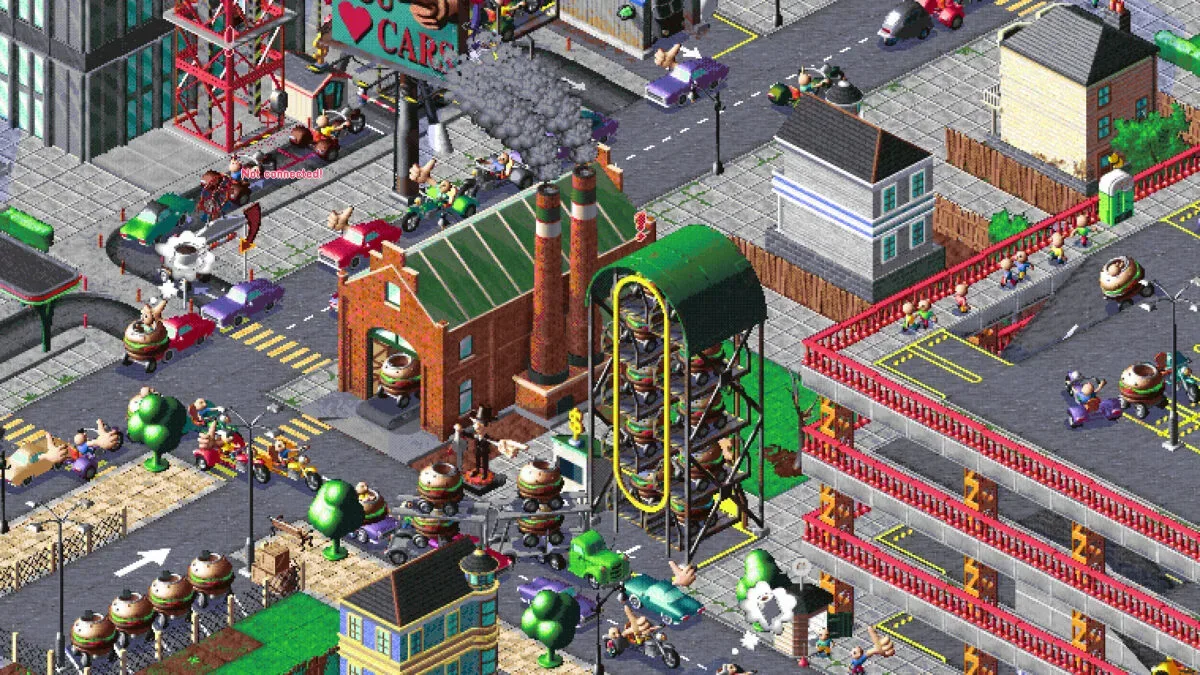
Car Park Capital takes one of the most mundane pieces of modern urban life--a place to leave a car--and turns it into the center of an increasingly sinister management simulation. At first glance, it has the approachable, grid-based appeal of a classic tycoon game. Players paint parking bays, set prices, place signs and watch vehicles roll in. But the game's joke, and its central argument, is that a successful parking business cannot remain merely a parking business for very long.
To make more money from spaces for cars, Car Park Capital pushes players toward reshaping the entire world around them. Housing is removed to make room for lots. Residents are relocated to suburban developments, increasing their dependence on driving. More drivers create demand for vehicles, fuel, roadside businesses and still more parking. What starts as a simple construction exercise becomes a deliberately exaggerated chain reaction of private development, car dependency and civic decay.
Developed by Dutch studio Hilkojj Interactive and published by MicroProse, the game is currently in early access. Its pitch is unusually sharp for a management game: it is not asking whether players can create a pleasant, efficiently planned city. It is asking how much of a functioning society they are prepared to sacrifice in pursuit of a bigger, more profitable car park.
A Tycoon Game About the Cost of Convenience
Simulation games have covered an enormous amount of ground. Players can run farms, transport networks, amusement parks, zoos and businesses of every conceivable kind. Yet Car Park Capital focuses on a form of infrastructure that is often treated as an unremarkable necessity. Parking spaces are everywhere, but their scale, cost and effect on communities are easy to overlook when they are spread across streets, shopping centers and enormous paved lots.
For useful background on this topic, read Debra Wilson Explains Why So Many Game Characters Resemble Her.
Car Park Capital makes those consequences impossible to ignore. Its opening tutorial reportedly begins near the entrance to a busy theme park, presenting a scene that might initially suggest a conventional amusement-park management game. The twist arrives quickly: the rides are not the player's concern. The important thing is the parking outside.
That premise establishes the game's tone. Players learn the fundamentals of operating a car park, including laying out spaces, marking lines, setting fees and adding suitable signage. The tutorial then moves from ordinary operations into the satirical core of the game: undermining public transit in order to drive more customers toward private cars and paid parking.
It is an intentionally blunt escalation, but that bluntness is the point. The game does not frame its systems as morally neutral tools. Every business decision carries an implied social consequence, and the route to expansion is designed to make that consequence uglier over time.
From Parking Spaces to a Car-Dependent Empire
Campaigns begin with what looks like a favorable position: a small piece of parking-lot paradise. The trouble is that urban environments are dense, expensive and full of inconvenient alternatives to car travel. Building naturally within those limits will only take a parking operator so far. To grow aggressively, players must acquire more land--and land is generally occupied by something or someone already.
That means apartment blocks and homes can become targets for eviction. But removing residents creates another problem. Those people need somewhere else to live, so players are encouraged to construct suburban housing farther from the city center. The resulting sprawl serves a business purpose. Residents placed at a greater distance from work, shopping and leisure are more likely to need cars.
From there, the game's logic continues to expand outward. A larger driving population needs vehicles. Vehicles need fuel. New commercial developments benefit from superstores and drive-through businesses. The player's parking empire becomes intertwined with car manufacturing, oil extraction, property development and retail infrastructure.
It is a vicious circle rendered as a management loop: create the conditions that force more people to drive, then profit from the new problems those conditions create. A bigger car culture creates demand for bigger lots, which encourages further demolition and development, which makes driving more essential than before.
Car Park Capital takes that premise to absurd and unsettling extremes. It reportedly includes attractions such as a Ferris wheel intended only for cars to enjoy, a joke that captures the game's broader vision of public life being remade around vehicles rather than people. Even leisure, in this version of urban planning, becomes another extension of the automobile.
Satire With Teeth
There is a long tradition of games using simple systems to expose the logic of institutions, economics and power. Car Park Capital fits comfortably into that tradition, though it does so through bright tycoon-game presentation and a steadily escalating list of awful options. Its targets are not subtle: car-first planning, speculative real-estate development, privatization and the ways commercial incentives can reshape shared civic spaces.
The game's progression appears designed to force players into wearing multiple corporate hats. The parking-lot manager does not stay a parking-lot manager. To maximize returns, they become a developer, industrialist, energy baron, retailer and enforcer. It is less a story about mastering a single business than about building a system where each business reinforces the others.
Public services and local infrastructure are not protected from this logic. The game allows players to take actions such as privatizing toilets, dismantling civic amenities and responding to protests through a personal security apparatus. It goes further still, offering private police and firefighters in a world where the boundary between public responsibility and private profit has been thoroughly eroded.
Those mechanics are intentionally grotesque, but they also prevent the satire from becoming purely decorative. Car Park Capital does not simply put cynical jokes in tooltips while asking players to optimize a harmless spreadsheet. Its systems make the player participate in the escalating damage. The comedy comes from the extremity of the options, while the discomfort comes from recognizing the recognizable real-world pressures beneath them.
The Shadow of Car-Centric Planning
The game's subject inevitably brings urban planner Robert Moses to mind. Moses remains a controversial and widely discussed figure because of his enormous influence on mid-century infrastructure and development in New York, as well as the human cost associated with projects that displaced communities and prioritized highways. Car Park Capital does not need to directly recreate that history to evoke it. Its fictionalized parking empire is built on similar questions about who gets displaced, what forms of travel are favored and who has the power to decide how a city should function.
That framing gives the game more bite than a standard "evil corporation" simulator. The player is not just increasing an abstract profit number by making arbitrary cruel choices. They are shaping land use, mobility and access to basic services. The game's central gag is that parking can become an all-consuming priority, but the underlying observation is that transport choices influence nearly every other part of a community.
When homes are pushed farther away, car ownership becomes less optional. When public transit is weakened, alternatives become less practical. When streets and commercial spaces are planned around driving, walking and cycling can become more difficult or dangerous. Car Park Capital turns that feedback loop into an exaggerated machine for generating revenue.
Early-Access Ambition and a Potential Limit
For all its sharp ideas, Car Park Capital may face a familiar challenge for simulations: sustaining interest after players understand the systems. The early game's escalation sounds entertaining precisely because it keeps revealing another dreadful industry or policy that can be folded into the parking empire. Eventually, however, the player can become extremely powerful.
That invincibility is thematically appropriate. An unchecked developer or monopoly should feel difficult to stop. Yet a game can make an effective point and still need enough resistance, variety and uncertainty to remain compelling over a long campaign. If the path to domination becomes too straightforward, players may reach the point where the satire has landed but the strategic tension has faded.
Early access gives Hilkojj Interactive room to develop that balance. The available material includes a default city scenario, while players can also move on to the Florida Keys to see how much damage their parking-centered ambitions can do in a different setting. Additional scenarios, harder constraints or more dynamic reactions from communities could potentially help the game maintain its momentum while strengthening its central critique.
A Management Game That Wants Players to Feel Uneasy
Car Park Capital's most interesting quality is that it makes the normal pleasure of a tycoon game feel increasingly compromised. There is satisfaction in expanding a business, improving flow, filling spaces and watching the numbers rise. The game understands that appeal. It uses familiar management-game rewards to lure players into choices that grow ever more destructive.
Rather than presenting players with a clean distinction between good and bad routes, it suggests that the system itself is the problem. The easiest way to make a parking empire thrive is to make everybody else's world more dependent on it. By the time players are developing suburbs, drilling for oil and suppressing opposition, the humble painted parking bay has become the foundation for an entire hostile economy.
That makes Car Park Capital an unusual early-access project: a simulator where optimization is not just the challenge, but the punchline. It may be dark, ridiculous and intentionally over-the-top, yet its broadest question is serious. What happens when every shared space is viewed chiefly as an opportunity for private extraction--and every person is expected to arrive by car?
Community
Discussion
Start the conversation.
No comments have been posted yet.