

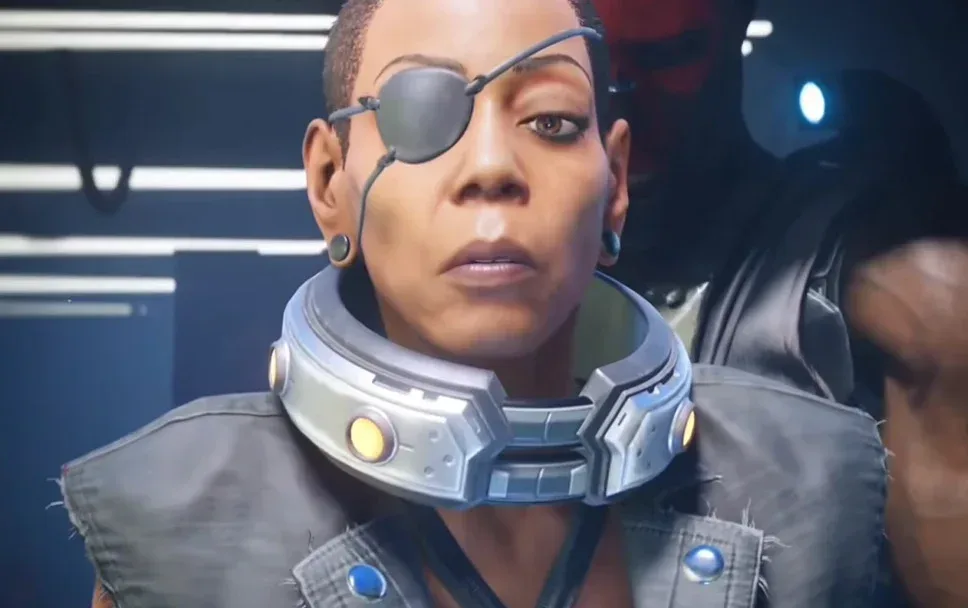
Debra Wilson has become one of the most recognizable performers working in video games, even for players who may not immediately know her name. Her voice, motion-capture work, and increasingly familiar facial likeness have appeared across major series including Wolfenstein, Marvel's Wolverine, Suicide Squad: Kill the Justice League, Star Wars Jedi, and Death Stranding. For years, fans have noticed an amusing pattern: a remarkable number of characters played by Wilson look strikingly like Wilson herself.
Wilson has now addressed that recurring observation, and her answer is more straightforward than any elaborate fan theory. She does not claim to have a special requirement that studios use her face, nor does she present the trend as a calculated personal branding strategy. Instead, she says the decision usually belongs to the game developers and their production teams.
More notably, Wilson says she personally enjoys roles where the character does not resemble her. For an actor who has spent decades creating personalities through voice, performance capture, and physical acting, the opportunity to vanish behind an entirely separate design remains especially appealing.
Embedded X/Twitter post
Wilson would rather transform than simply appear
In a conversation on the Hyperfixated podcast with Joseph Shepherd, Wilson said that she loves games in which her characters bear little or no resemblance to her real-world appearance. Her point was not that facial scanning or recognizable performers are inherently bad. Rather, she framed acting as an opportunity to escape into someone else, and a character modeled too closely on the actor can limit that sense of transformation.
For useful background on this topic, read Monkey Island 2 and Fate of Atlantis Receive 256-Colour Amiga AGA Enhancements.
That perspective makes sense in the context of Wilson's career. She is a prolific character actor whose work has spanned comedy, television, animation, games, and performance capture. A digital production can ask an actor to do much more than read lines: they may need to embody a creature, a military leader, a villain, a supernatural being, or a person with a radically different age, body type, history, and physical presence. A character design that moves away from the actor's own face can create another layer of imaginative distance.
Wilson compared the alternative to simply doing theater. If a performance ends up looking exactly like the performer, the work can feel less like inhabiting an unfamiliar identity. That does not mean audiences are wrong to enjoy spotting her in games. It does, however, underline that performers may have very different feelings about visibility than fans do.
Why the resemblance keeps happening
There is no single production rule behind the repeated appearances. Modern game development frequently combines voice acting, motion capture, facial capture, photogrammetry, scanning, and digital sculpting. Some studios build characters around the faces of their cast, while others use a performer's physical performance and voice but create a completely separate appearance. Still others fall somewhere between those approaches, borrowing certain features without pursuing a literal digital replica.
In Wilson's case, several high-profile productions have chosen a close match. She plays Callisto, the one-eyed Morlock leader in Insomniac Games' Marvel's Wolverine, a role that has again prompted discussion around her likeness. The podcast conversation was recorded before the game's release, but comments from the interview have circulated again amid renewed attention on the character.
Insomniac's approach fits a broader contemporary tendency in blockbuster games: major characters are often designed to resemble the actors who portray them. This is a recognizable creative and technical choice in cinematic action games, and it can help developers preserve the nuances of facial performance. When a project captures expressions in detail, using the actor's own likeness may simplify some elements of the pipeline while also making the connection between physical acting and final character easier to retain.
But Wilson's gameography shows that the resemblance is not applied with identical intensity every time. Her portrayal of Amanda Waller in Suicide Squad: Kill the Justice League is a particularly direct match, and Grace Walker in Wolfenstein also shares much of Wilson's appearance. Other performances are less immediately identifiable as the actor, whether because of different character design choices, stylization, age adjustments, costumes, makeup, animation, or the nature of the role itself.
A career built on range and experience
The online conversation can sometimes reduce the issue to a running joke: Wilson is everywhere, and the characters look like her. Yet that joke risks overlooking the reason she is regularly considered for major parts. Wilson has years of experience across performance disciplines that are invaluable to games, especially projects that demand actors who can deliver dialogue, physicality, and precise emotional work within technical production constraints.
Del Walker, a developer who worked on both the Star Wars Jedi and Suicide Squad franchises, previously defended Wilson's prominence by emphasizing the strength of her casting audition performances. His comparison was to watching Michael Jordan in 1996 arriving at a high school basketball game: an overwhelming level of talent and experience that immediately distinguishes itself from the field.
That image helps explain why familiar performers recur. Game casting is not simply about finding a recognizable face. Studios need actors who can work effectively with demanding direction, deliver believable reactions under performance-capture conditions, understand the practical limitations of a shoot, maintain character consistency across sessions, and bring energy to roles that may be separated into many small fragments during production. An actor with a record of doing all that well is likely to remain in demand.
Wilson's presence across several large franchises is therefore less mysterious than it may seem. Developers repeatedly returning to an accomplished performer is a normal result of a competitive industry. A great audition, a successful prior collaboration, and a demonstrated ability to handle the medium's unusual requirements can all matter more than novelty.
The larger shift toward recognizable digital actors
The discussion around Wilson also reflects a larger change in the games business. In earlier eras, voice actors were often invisible to players, even when they delivered beloved performances. Their voices became iconic, but their physical identities were not necessarily part of the character. Advances in visual fidelity, facial capture, and marketing have changed that equation.
Games now frequently feature performers whose faces are immediately recognizable. In some cases, that is central to the project's appeal. A high-profile actor can contribute not only a vocal performance but also a promotional image, a recognizable physical presence, and a cinematic style that developers want their characters to carry. Death Stranding is one prominent example of a game built around recognizable actors, while Cyberpunk 2077 made major use of Keanu Reeves' likeness and performance as Johnny Silverhand.
This approach can be creatively effective. Seeing subtle expressions transferred from a performer to a digital character can lend dramatic scenes a particular immediacy. It can also help audiences connect a game to the people who made its performances memorable. At the same time, it can create the expectation that an actor's body and face should accompany every role, even when the performer may prefer a more transformative assignment.
Wilson's comments are a useful reminder that acting is not only about recognition. Many performers value the ability to become unrecognizable, whether through costume, voice, animation, makeup, creature work, or a wholly original digital model. In games, the technology can support either direction: exact replication or near-total reinvention.
Fans can enjoy the pattern without turning it into a mystery
It is understandable that players notice Wilson's recurring appearance. Her features are distinctive, and several of her prominent game roles have put those features front and center. The observation has become a community meme precisely because she is so effective and so visible in major releases.
Still, Wilson's own remarks offer a grounded explanation. The repeated use of her likeness is generally a developer-led choice, not a hidden arrangement that requires every studio to scan her face. Her casting success is also not an accident of resemblance. It is tied to a long career, broad skill set, and a reputation for delivering exceptional work.
There is also room for both sides of the idea. Players can appreciate seeing Wilson represented in a game, particularly when her facial performance adds texture to a role such as Amanda Waller or Callisto. And developers can continue to call on her for characters that look nothing like her, allowing the actor to pursue the creative escape she says she enjoys.
As game performances become increasingly sophisticated, Wilson's career illustrates an important truth about the medium: a great performer is more than a scanned face. Whether a role resembles her closely or is transformed beyond recognition, the element that keeps studios returning is the performance itself.
Community
Discussion
Start the conversation.
No comments have been posted yet.