

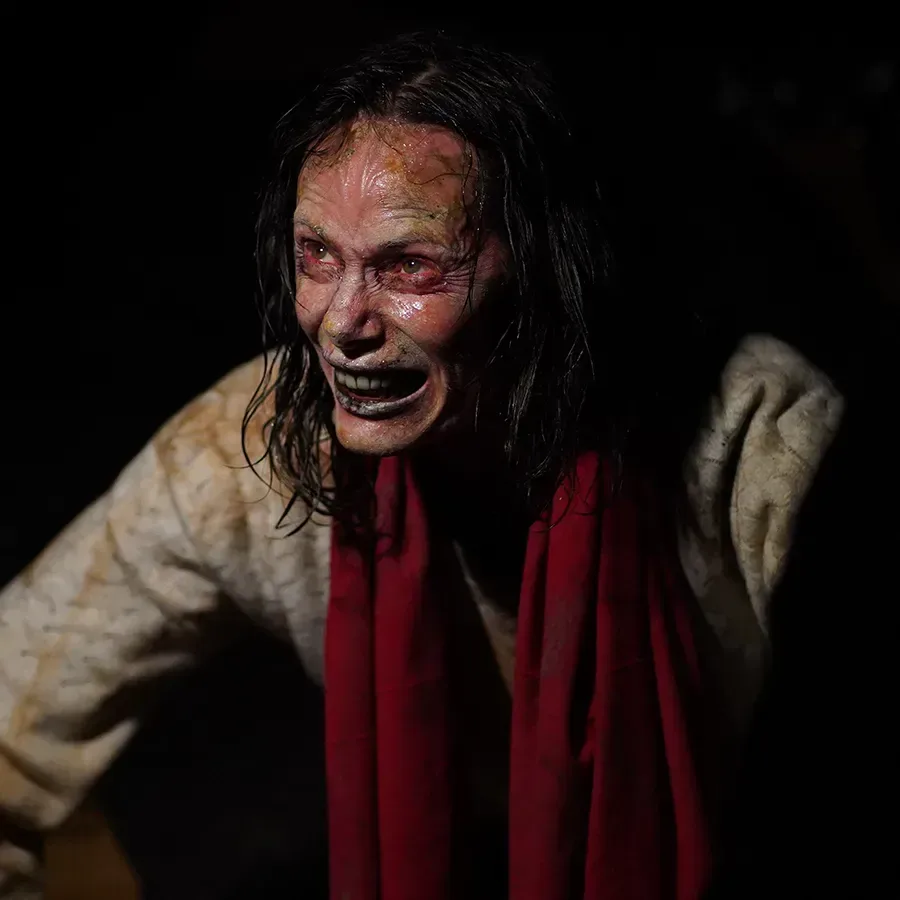
Chandler Riggs is taking a direct trip into the Baker estate. The actor, widely recognized for playing Carl Grimes in The Walking Dead, has created a new fan film inspired by Resident Evil 7: Biohazard, adapting one of the game's most memorable early encounters: Ethan Winters' brutal garage showdown with Jack Baker.
The short, titled Resident Evil: Biohazard, is a roughly 20-minute live-action project that puts Riggs in the role of Ethan. Jason Douglas, who voiced Jack Baker in the game, appears as the relentlessly dangerous Baker family patriarch. The cast also includes Mary Rachel Quinn, Eugenie Bonderant, Johnathan O'Niel, and Sam Coyles.
The film is set to arrive online on October 14. Its release comes shortly after Zach Cregger's theatrical Resident Evil movie, which debuted in September, earned major commercial success for the franchise, and drew strong critical notices. While Cregger's film has prompted debate among players hoping for a closely game-faithful adaptation, Riggs' project is built around his own affection for Capcom's horror series and a desire to recreate a particularly cinematic moment from Resident Evil 7.
A practical answer to wanting more time on set
Riggs' motivation for making the film is straightforward: he loves the process of filmmaking and wanted to create something connected to a game he cares deeply about. Rather than waiting for another acting opportunity to come along, he decided to build one himself with collaborators who shared that enthusiasm.
For useful background on this topic, read Street Fighter 6 movie costumes Revealed for Dhalsim, E. Honda and Zangief.
That approach is reflected in the selection of material. The garage battle is one of Resident Evil 7's defining sequences, combining the game's intimate first-person perspective with a sudden escalation into a loud, violent vehicle fight. Ethan's attempts to escape Jack's pursuit turn a confined garage into an improvised arena, and the scene captures the mix of dread, dark humor, and outrageous action that helped establish the Baker family as memorable antagonists.
A 20-minute format gives the team room to treat that confrontation as more than a brief reference. Rather than simply recreating an image or costume from the game, the fan film aims to translate the pace and pressure of the sequence into live action. That is a challenging proposition for any game adaptation, particularly one based on a title whose perspective and presentation are so tied to player control.
For Riggs, the appeal is not framed as an attempt to compete with a studio production. It is a chance to get on set, work with people he finds exciting, and make a piece of genre entertainment that he wanted to see. His comments make clear that the project emerged from fandom as much as professional ambition.
Playing a character known for hiding his face
The biggest creative obstacle was always likely to be Ethan Winters himself. In Resident Evil 7, Ethan is largely an audience stand-in, seen through the first-person camera for much of the game. For years, the character's face was deliberately obscured, making him unusual among the series' major protagonists. A live-action version cannot fully preserve that device without creating a very different viewing experience.
Riggs acknowledged that showing Ethan's face was intimidating because it represents a significant departure from the game's approach. The production considered whether it could shoot entirely in first person or otherwise avoid presenting Ethan's face. Ultimately, that was not considered the best way to make the story readable and engaging for viewers who may not already know the game.
It is a useful example of the compromise inherent in adaptation. A camera perspective that feels natural when a player is controlling a character can become restrictive in a conventional short film. Live action needs to communicate performance, reactions, geography, and emotion in different ways. Keeping the protagonist permanently outside the frame might be an inventive technical exercise, but it could also make the film less accessible to the broader audience Riggs hopes to reach.
The choice does not mean the project has abandoned faithfulness elsewhere. On the contrary, Riggs described the team as trying to remain highly true to the game in many areas, which makes the Ethan decision stand out even more. It is a calculated change intended to make the adaptation work as a film rather than a literal duplicate of gameplay.
Why Resident Evil adaptations inspire such strong reactions
Resident Evil has always occupied a complicated place in adaptation culture. The games have a huge collection of recognizable heroes, villains, monsters, locations, weapons, costumes, and set pieces. That instantly gives filmmakers a rich pool of material, but it also sets an extremely high bar for audiences who have spent years forming attachments to characters including Leon Kennedy and Jill Valentine.
Cregger's recent film took its own route through the franchise rather than pursuing a one-to-one retelling of an existing game. That decision has been divisive among some dedicated fans, even as the movie found a wider audience and became the series' most financially successful film. The disagreement reflects a familiar question for game adaptations: should a screen version reproduce the story players already know, or should it use the game universe as a foundation for an original narrative?
Riggs takes a relatively open view of that divide. He believes it is impossible to satisfy every part of a fandom, and he sees value in filmmakers telling a new story that can bring more people into the series. He also recognizes why adapting iconic game characters can be daunting. A character with decades of history and a well-established image carries expectations that cannot be ignored.
At the same time, Riggs' own short demonstrates that there is room for more direct adaptations of individual scenes. His work is not trying to replace the game or insist that there is just one correct model for a Resident Evil film. Instead, it explores what happens when a familiar gameplay sequence is treated as a focused live-action set piece.
An open invitation for a future collaboration
Riggs has said he would be interested in expanding the idea into a feature-length adaptation of Resident Evil 7 someday. He also expressed interest in working with Cregger on another film in the broader Resident Evil universe should the director choose to continue with the property.
"My phone is open. Hit my line!" Riggs said when discussing the prospect of collaborating on a future project.
That possibility remains uncertain. Cregger has indicated that the negative reaction from a vocal segment of the fanbase made him reluctant to tackle another franchise film. However, he has also discussed having sequel ideas, leaving the longer-term future of his connection to Resident Evil unclear.
For Riggs, the key point appears to be the collaborative process rather than ownership of a specific version of the franchise. His enthusiasm is aimed at making films, sharing a set with talented people, and finding ways to keep creating. The fan-film route has allowed him to do that on his own terms while drawing on a game series that clearly means a great deal to him.
A notable reunion for the Baker family
Jason Douglas' participation gives the project an especially fitting connection to Resident Evil 7. Jack Baker's voice performance was a major part of why the character landed so effectively in the game: threatening, unpredictable, grotesque, and frequently funny in a way that made the horror even more unsettling. Bringing Douglas into the live-action short creates a bridge between the original performance and this new interpretation.
That choice also underscores the care behind the production. Fan projects can range from quick tributes to elaborate independent films, but casting an actor directly associated with the game is a meaningful signal of the team's ambitions. It suggests that the film is approaching its recreation of the garage sequence with both reverence and an understanding of the tonal balance that makes Resident Evil 7 distinctive.
Whether the short eventually leads to a larger adaptation or simply stands as a focused love letter to one unforgettable fight, it arrives at an interesting time for the franchise on screen. Big-budget adaptations and independently driven fan productions are now examining different sides of the same horror universe. Riggs' Resident Evil: Biohazard will offer viewers its own answer to a simple question: what would it look like if Ethan Winters and Jack Baker's garage nightmare escaped the game and entered the real world?
Community
Discussion
Start the conversation.
No comments have been posted yet.