

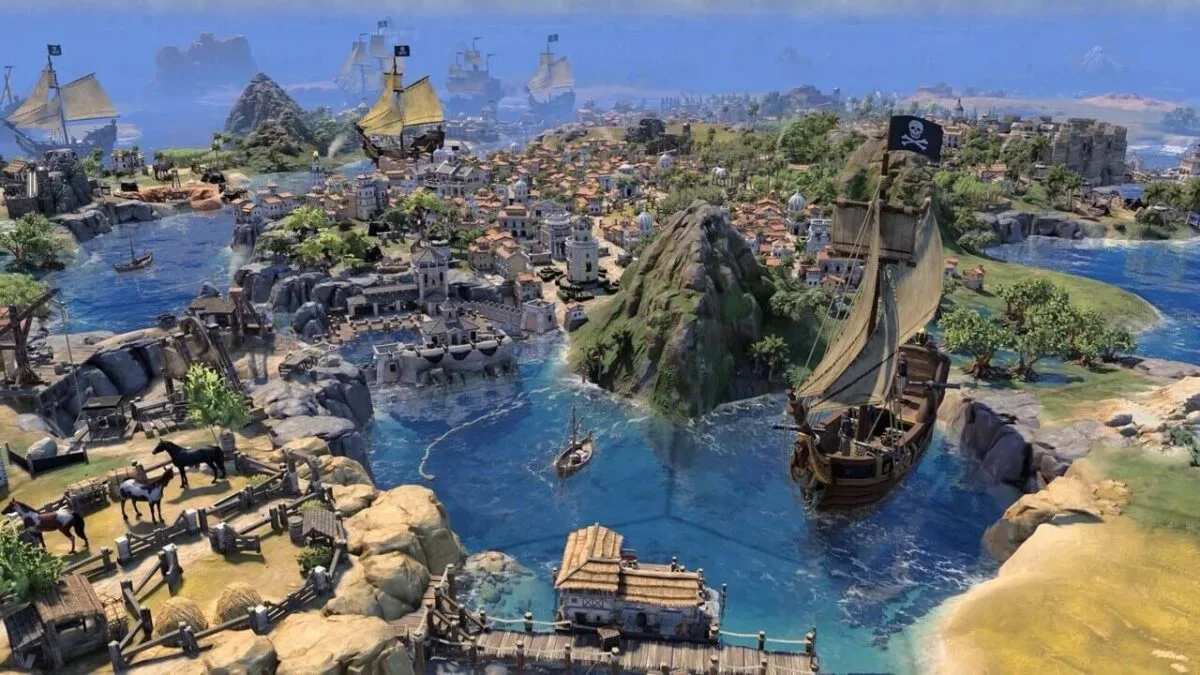
Civilization 7 is set to receive its biggest free update to date in 2027. Firaxis Games has announced Arc of Tomorrow, a major content and systems overhaul built around the long-requested Atomic Age. The new era will carry campaigns from the 1950s through the 2050s, adding a fourth Age to the game's historical timeline and introducing new gameplay mechanics shaped by Cold War tensions, nuclear deterrence, global diplomacy, industrial production, and space-age ambition.
The announcement followed a developer panel at PAX West 2026 and arrives at a significant point for the strategy game. Civilization 7 launched in February 2025, and its post-launch reception has remained divided despite a regular stream of updates. Firaxis has continued to address problems and add features, but many players have voiced frustration over the game's interface, its streamlined approach to certain long-standing Civilization systems, and the absence of a late-game historical period that felt essential to the series' progression.
Arc of Tomorrow is intended to address at least one of those major concerns directly. Rather than ending before the modern geopolitical landscape fully takes shape, Civilization 7 will ultimately let players guide their civilizations into an era marked by the threat of nuclear war, indirect superpower conflicts, rapid technological development, social movements, and humanity's push beyond Earth.
A Fourth Age for Civilization 7
The centerpiece of Arc of Tomorrow is the Atomic Age, which will become Civilization 7's fourth playable Age. Firaxis says the era spans roughly from the 1950s to the 2050s. Like the Ages already in the game, it will have its own period-specific gameplay, visuals, buildings, units, and other content designed around its place in history.
For useful background on this topic, read JBL Bar 300MK2 Soundbar Deal Cuts 38% Off Dolby Atmos Audio.
That timeline matters because it fills a gap many fans have identified since launch. Civilization games have traditionally invited players to shepherd a society from ancient foundations into increasingly modern and futuristic forms. Civilization 7's Age structure created a different rhythm for that journey, but the lack of an Atomic or contemporary period left the historical arc feeling incomplete for players who wanted to see their empires confront the political and technological challenges of the twentieth century and beyond.
Creative director Ed Beach described the recent past as a particularly complicated but compelling period for the franchise to explore. The Atomic Age is not simply a setting for more advanced military hardware. It is a time associated with fear, uncertainty, proxy war, the constant possibility of nuclear escalation, extraordinary scientific achievements, and movements for equality and justice. Arc of Tomorrow appears to be aiming for systems that reflect those contradictions rather than treating the period as a straightforward power upgrade over earlier Ages.
Nuclear Strategy Will Expand Beyond Simple Destruction
One of the update's largest additions will be expanded nuclear gameplay. Firaxis has confirmed that Arc of Tomorrow will include additional offensive and defensive nuclear options, along with new units and a new take on the logic of mutually assured destruction.
For another perspective on this story, read Civilization 7's Arc of Tomorrow Update Adds the Atomic Age.
In Civilization, nuclear weapons have often represented an enormous military escalation: a devastating tool that can transform a war instantly but may carry diplomatic penalties or severe repercussions. The Atomic Age's new mechanics suggest Firaxis wants nukes to become a more central strategic concern, with deterrence and prevention potentially as important as launching an attack. The reference to a twist on mutually assured destruction indicates that possession, defense, retaliation, and political perception may all play a meaningful role.
The update will also introduce Multilateral Agreements. These agreements will allow multiple leaders to respond collectively to unfolding global circumstances. Firaxis offered the example of a growing nuclear stockpile, where leaders could push for disarmament or instead choose escalation. That could give late-game diplomacy a greater sense of shared stakes, especially when a single empire's actions have consequences for every civilization on the map.
How these negotiations will work in practice remains to be seen. Arc of Tomorrow is still early in development, and Firaxis has stressed that its plans may change before release. Even so, the proposed system points toward a more international approach to diplomacy than merely managing a series of one-to-one relationships. A crisis involving nuclear arms is inherently global, and the design goal seems to be making that reality felt at the strategy layer.
City-States and Proxy Warfare Take on a Larger Role
Another major theme of the Atomic Age will be indirect conflict. Arc of Tomorrow will enhance interactions with City-States and add Proxy Warfare, allowing players to focus resources and attention on smaller conflicts instead of always committing to open empire-versus-empire war.
Proxy wars became a defining feature of twentieth-century geopolitics, with powerful nations supporting allied factions or competing interests without necessarily engaging one another directly. Translating that concept into Civilization could make City-States more important pieces on the board during the late game. Rather than existing mainly as targets for influence, alliances, or conquest, they may become focal points for larger struggles between rival powers.
Firaxis is also planning new empire-management options. Players will be able to turn their own Settlements into new City-States. The studio says this will offer more precise control over the Settlement Limit while ensuring players retain a way to access improved City-State abilities. It is a notable addition because it gives players a deliberate way to reshape their empire's political map instead of treating every settlement solely as territory to hold and develop directly.
That could create interesting decisions for wide empires. A player might choose to relinquish direct control over a less vital settlement in exchange for the advantages associated with a City-State, while also freeing room under the Settlement Limit for a different expansion plan. The final details will determine how flexible or costly that process is, but it suggests Arc of Tomorrow is looking to provide more agency over the game's broader administrative constraints.
Film Crews and Manufactured Goods Add New Economic Layers
Not every Atomic Age addition is centered on war or diplomacy. Firaxis is introducing Great Works of Film, a system that will send Film Crews in search of appropriate filming locations. The best destination will depend on the genre of film being pursued, while the benefits received will vary based on the quality of the finished production.
This feature could give culture-focused players a new activity tied to the visual and popular-media explosion of the modern era. It also sounds more active than simply generating a Great Work through a menu or specialist slot. Finding locations appropriate for different genres could encourage players to consider terrain, geography, districts, or distinctive regional features in an entirely new way.
Arc of Tomorrow will additionally add Manufactured Goods. This production system lets players follow recipes that combine particular commodities into new resources with stronger effects. Firaxis cited Enriched Uranium as one example. The mechanic has the potential to deepen late-game resource planning, especially if key materials are needed for military, scientific, economic, or nuclear projects.
Manufacturing recipes could also encourage trade and territorial competition. An empire may possess one ingredient but need to obtain another through diplomacy, market access, settlement placement, or conflict. If powerful goods require several commodities, resource networks may become more strategically important than simply accumulating a stockpile of individually useful materials.
New Civilizations, Leaders, and an Expansion Beyond Earth
Firaxis has confirmed that Arc of Tomorrow will include new civilizations and leaders, though it has not yet revealed which ones will arrive. More details are expected later as development progresses.
The studio also announced Civilization 7's first paid expansion, Earthrise. While Arc of Tomorrow is a free update focused on the Atomic Age, Earthrise will take a broader view of humanity's future in space. The expansion is planned to add space-based objectives for each Age, culminating in the launch of extraterrestrial expeditions. Firaxis has also promised new unit abilities, technologies, civil engineering structures, and additional content.
Earthrise and Arc of Tomorrow appear closely aligned in theme, even though they are separate releases. The Atomic Age's emphasis on rockets, modern science, and geopolitical competition naturally leads into a space-focused expansion. For now, however, Arc of Tomorrow is the more immediate test of Firaxis' ability to respond to community concerns through a substantial free upgrade.
A Crucial Test for Civilization 7's Recovery
Civilization 7 has not lacked post-launch support. Another update, version 1.5.0, is expected soon with adjustments to diplomacy and resource generation, plus new maps. The game is also free to play on Steam through September 10, giving curious strategy fans a chance to try the current version before the Atomic Age arrives.
Still, Arc of Tomorrow carries more weight than an ordinary patch. Civilization 7 has struggled to rise above a 50 percent positive user rating on Steam, reflecting a player base that remains sharply split. Longtime fans in particular have continued to debate whether the game's revised systems offer enough depth and whether its user interface adequately supports the scale of a typical Civilization campaign.
The Atomic Age will not automatically solve every criticism. But it could make the overall campaign feel more complete while delivering systems with the potential to enrich diplomacy, military planning, economic production, culture, and City-State politics. A successful rollout would show that Firaxis is prepared to build on Civilization 7's foundations in response to its audience rather than merely refine the existing structure around the edges.
With a 2027 launch window and development still in its early stages, players should expect details to evolve. Yet the initial outline is ambitious: nuclear brinkmanship, international agreements, proxy conflicts, settlement restructuring, filmmaking, industrial recipes, new civilizations, and a complete new Age. For Civilization 7, Arc of Tomorrow may be the update that most clearly determines whether its long-term future can match the scale of its historical ambitions.
Community
Discussion
Start the conversation.
No comments have been posted yet.