

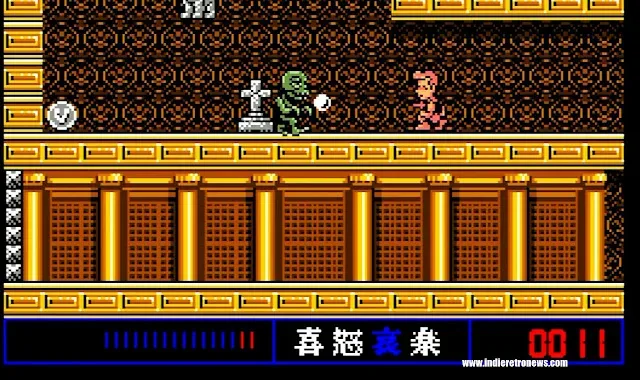
Treasure of Usas, a comparatively obscure platform adventure from Konami's MSX and MSX2 catalogue, is now playable on Commodore Amiga through a new port from developer Hoffman. The initial 1.0 release aims to retain the feel and structure of the original Japanese game while taking advantage of one particularly meaningful improvement: support for 50Hz and 60Hz operation, intended to make the action look and feel considerably smoother than it did on its original hardware.
The port is built with accessible classic Amiga hardware in mind. It is designed to run on a standard Amiga 500 with 512KB of chip RAM and a further 512KB of additional RAM, rather than requiring an expanded or heavily upgraded machine. For players who enjoy using original systems, or accurate Amiga 500 configurations through emulation, that target is an important part of the release's appeal.
Available as ADF floppy disk images, the current version offers retro-platform fans a chance to revisit--or discover for the first time--a Konami title that has never enjoyed the broad name recognition of the publisher's largest series. Hoffman is also considering a WHDLoad package for hard-drive users in the future. Meanwhile, a separate enhanced edition is already planned, promising newly redrawn visuals, a replacement soundtrack, and additional sound effects once those elements have received more development time.
A lesser-known Konami platformer finds a new home
Konami's MSX output is full of games that earned lasting admiration among dedicated players, even if their reach was limited by the platforms and regions in which they originally appeared. The company is widely associated with landmark names such as Metal Gear, Castlevania, Gradius, and Contra, but its work for the MSX family also includes titles that remain less familiar outside enthusiast circles. Treasure of Usas belongs to that latter group.
For useful background on this topic, read ANBERNIC's RG DS Plus Video Highlights Dual Screens, Stylus Play and Steam Streaming.
Its arrival on Amiga gives the game a chance to be experienced within a different branch of home-computer history. The MSX2 and Amiga both occupy cherished positions in the 1980s and early 1990s computing landscape, but their technical strengths, audiences, and software libraries developed along distinct paths. A conversion such as this does more than place an old game on another machine; it creates a meeting point for communities that may know Konami's work from very different perspectives.
For Amiga players, the release adds another compact action-platformer to a library already celebrated for its variety. For MSX fans, it represents an effort to preserve the identity of an older game rather than simply reimagine it beyond recognition. Hoffman's stated goal is a faithful, near one-to-one conversion, so the focus of version 1.0 is on making the original game work naturally on Commodore hardware while preserving its nostalgic character.
50Hz and 60Hz support is the headline improvement
The most notable technical change in the Amiga release is the modified support for both 50Hz and 60Hz refresh rates. That may sound like a specialized detail, but it can make a substantial difference to how a fast-moving platform game feels in play. Motion, scrolling, animation, and input response are all perceived through the cadence of the display and game updates. A smoother presentation can make an older design easier to read and more satisfying to control without altering its core rules or level design.
For another perspective on this story, read Treasure of Usas Reaches Amiga in a New 50/60Hz Port.
In this case, the modification is intended to deliver a slicker, more fluid experience than the original MSX hardware could provide. That makes the port more than a straightforward archival exercise. It retains the original adventure's foundations, but it also gives players a version shaped around one of the Amiga's advantages: a display environment that can present the game with a steadier sense of movement.
Such changes require restraint when the purpose is a faithful conversion. There is always a balance between polishing an older title and changing the qualities that made it distinctive. The version now available appears to prioritize that balance. Rather than positioning itself as a wholesale remake, it is a traditional port with a targeted improvement to responsiveness and visual flow.
Made for a standard Amiga 500 setup
One of the strongest details surrounding the release is its modest hardware target. The Amiga 500 was an enormously influential machine, but real systems are not all configured identically. Memory expansions, accelerators, hard drives, and later Amiga models can change what software is able to demand. Designing Treasure of Usas around 512KB chip RAM and 512KB of other RAM means the game is intended to remain within reach of a very recognizable baseline configuration.
That approach suits the project particularly well. The port is bringing an 8-bit-era game to a 16-bit home computer, not attempting to turn it into a modern production that only happens to resemble a classic. Keeping the requirements grounded lets the game feel appropriate to the period, while the improved refresh-rate handling gives it a worthwhile point of distinction.
The current release uses ADF images, the floppy-disk image format commonly used by Amiga owners and emulator users. This makes the game suited to the storage medium and loading habits associated with the machine. A WHDLoad version may arrive later, which would be welcome for players who use hard-drive-based Amiga setups and prefer the convenience of launching games without handling virtual or physical floppy images. However, that package has not been confirmed as part of the present 1.0 release.
Hoffman continues a run of Amiga conversions
The project follows Hoffman's recent work bringing other well-known MSX games to Amiga, including Metal Gear and Knightmare. That prior experience is meaningful context for Treasure of Usas. Ports of vintage games can face challenges that are not always visible at a glance: matching timing, translating display behavior, maintaining controls, fitting within memory constraints, and respecting details that long-time players recognize immediately.
Choosing Treasure of Usas also suggests an interest in exploring beyond the most obvious nostalgia picks. Metal Gear needs little introduction, while Knightmare has a dedicated following among shoot-'em-up fans. Treasure of Usas, by contrast, is the kind of game that can benefit greatly from renewed exposure. Its presence on Amiga could encourage players to explore further into Konami's MSX-era catalogue, especially titles that were historically difficult to access in some territories.
Community-developed ports are often at their best when they combine preservation with practical playability. A project can honor the original code, art direction, and design while ensuring that it has a viable future on active retro hardware. This release appears to fit that model, particularly because it does not treat version 1.0 as the final word.
An enhanced edition is planned
While the presently available build is centered on recreating the classic experience, a much more extensively upgraded version is in development. This enhanced edition is set to feature fully reworked graphics from Toni Galvez, a new soundtrack by BanjoGuyOllie, and an entirely fresh collection of sound effects.
Those additions could give the game a very different presentation while preserving its underlying platforming adventure. Updated art is especially significant on the Amiga, a system whose visual capabilities invite bold reinterpretations of 8-bit material. Likewise, a new soundtrack and sound suite could make the enhanced version feel more at home alongside native Amiga releases, many of which are remembered as much for their audio as for their graphics.
There is no announced release date for that enhanced version. The contributors need time to refine the new material, so players interested in the project can treat the 1.0 ADF release as the immediate way to play. It also provides a useful reference point for whatever changes the enhanced edition eventually introduces.
A welcome preservation project for Amiga and MSX fans
Treasure of Usas reaching Amiga is a reminder that retro gaming's most interesting releases do not always involve newly discovered prototypes or high-profile commercial revivals. Sometimes they come from enthusiasts taking a game that deserved a wider audience and carefully adapting it for another beloved machine.
The combination of a standard Amiga 500 target, ADF availability, and improved 50/60Hz performance makes this release appealing both as a historical curiosity and as a practical game to play. It respects the original MSX2 adventure, yet it does not ignore the opportunity to improve how naturally that adventure moves on Amiga hardware.
With the enhanced edition still ahead, the current port is also only the first stage of a larger effort. For now, retro players can enjoy an overlooked Konami platformer in a faithful Amiga form--and look forward to seeing how its planned visual and audio overhaul develops.
Community
Discussion
Start the conversation.
No comments have been posted yet.